Home
Class 12
PHYSICS
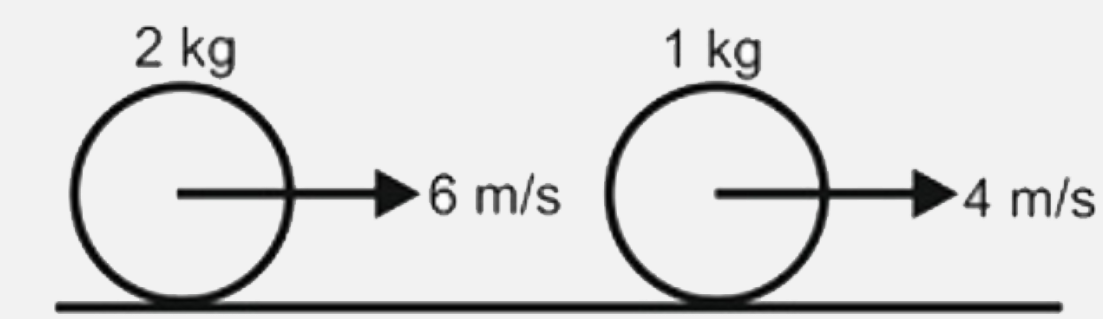
Two bodies collide as shown in the diagr...

Two bodies collide as shown in the diagram. During the collision , they exert impulse of magnitude J on each other

For what values of J(in N s) the 2 kg block will change its direction of velocity ?

A

`J lt 12`

B

`J gt 12`

C

`J lt 10`

D

`J gt 10`

Text Solution

Verified by Experts

The correct Answer is:

B
Promotional Banner

Similar Questions

Explore conceptually related problems

Comprehension # 2 When two bodies collide normally they exert equal and opposite impulses on each other. Impulse = change in linear momentum. Coefficient of restitution between two bodies is given by :- e = |"Relative velocity of separation"|/|"Relative velocity of approach"| = 1 , for elastic collision Two bodies collide as shown in figure. During collision they exert impulse of magnitude J on each other. For what value of J (in Ns ) the 2 kg block will change its direction of velocity?

Comprehension # 2 When two bodies collide normally they exert equal and opposite impulses on each other. Impulse = change in linear momentum. Coefficient of restitution between two bodies is given by :- e = |"Relative velocity of separation"|/|"Relative velocity of approach"| = 1 , for elastic collision. Two bodies collide as shown in figure. During collision they exert impulse of magnitude J on each other. If the collision is elastic, the value of J is ............. Ns .

Two balls of mass m and 2 m each have momentum 2p and p in the direction shown in figure. During collision they exert an impulse of magnitude p on each other. {:(,"Column I",,"Column II",),((A),"After collision momentum of m",(p),2p,),((B),"After collision momentum of 2m",(q),p,),((C ),"Coefficient of restitution between them",(r ),1,),(,,(s),"None",):}

Two balls of masses m and 2m and momenta 4p and 2p (in the directions shown) collide as shown in figure. During collsion, the value of linear impulse between them is J. In terms of J and p find coefficient of restitution 'e'. Under what condition collision is elastic. Also find the condition of perfectly inelastic collision.

Collision is a physical process in which two or more objects, either particle masses or rigid bodies, experience very high force of interaction for a very small duration. It is not essential for the objects to physically touch each other for collision to occur. Irrespective of the nature of interactive force and the nature of colliding bodies, Newton's second law holds good on the system. Hence, momentum of the system before and after the collision remains conserved if no appreciable external force acts on the system during collision. The amount of energy loss during collision, if at all, is indeed dependent on the nature of colliding objects. The energy loss is observed to be maximum when objects stick together after collision. The terminology is to define collision as 'elastic' if no energy loss takes place and to define collision as 'plastic' for maximum energy loss. The behaviour of system after collision depends on the position of colliding objects as well. A unidirectional motion of colliding objects before collision can turn into two dimensional after collision if the line joining the centre of mass of the two colliding objects is not parallel to the direction of velocity of each particle before collision. Such type of collision is referred to as oblique collision which may be either two or three dimensional. For which of the following collisions, the external force acting on the system during collision is not appreciable as mentioned in paragraph 1.

Assertion : In the s-t diagram as shown in figure, the body starts moving in positive direction but not form s = 0. Reason : At t = t_(0) , velocity of body changes its direction of motion.

Assertion: Two bodies moving in opposite directions with same magnitude of linear momentum collide each other. Then, after collision both the bodies will come to rest. Reason: Linear momentum of the system of bodies is zero.

Two point masses connected by an ideal string are placed on a smooth horizontal surface as shown in the diagram. A sharp impulse of "10 kg m s"^(-1) is given to the 5 kg mass at an angle of 60^(@) to the line joining the masses. The velocity of the 10 kg mass just after the impulse will be

A shell of mass 2 kg moving at a rate of 4 m//s suddenly explodes into two equal fragments. The fragments go in directions inclined with the original line of motion with equal velocities, If the explosion imparts 48 J of translational kinetic energy to the fragments, find the velocity and direction of each fragment.

A body of mass m_(1) moving with a velocity 3 m//s collides with another body at rest of m_(2) . After collision the velocities of the two bodies are 2 m//s and 5 m//s , respectively , along the direction of motion of m_(1) . The ratio m_(1)//m_(2) is
