Home
Class 12
PHYSICS
Block A is hanging from a vertical sprin...

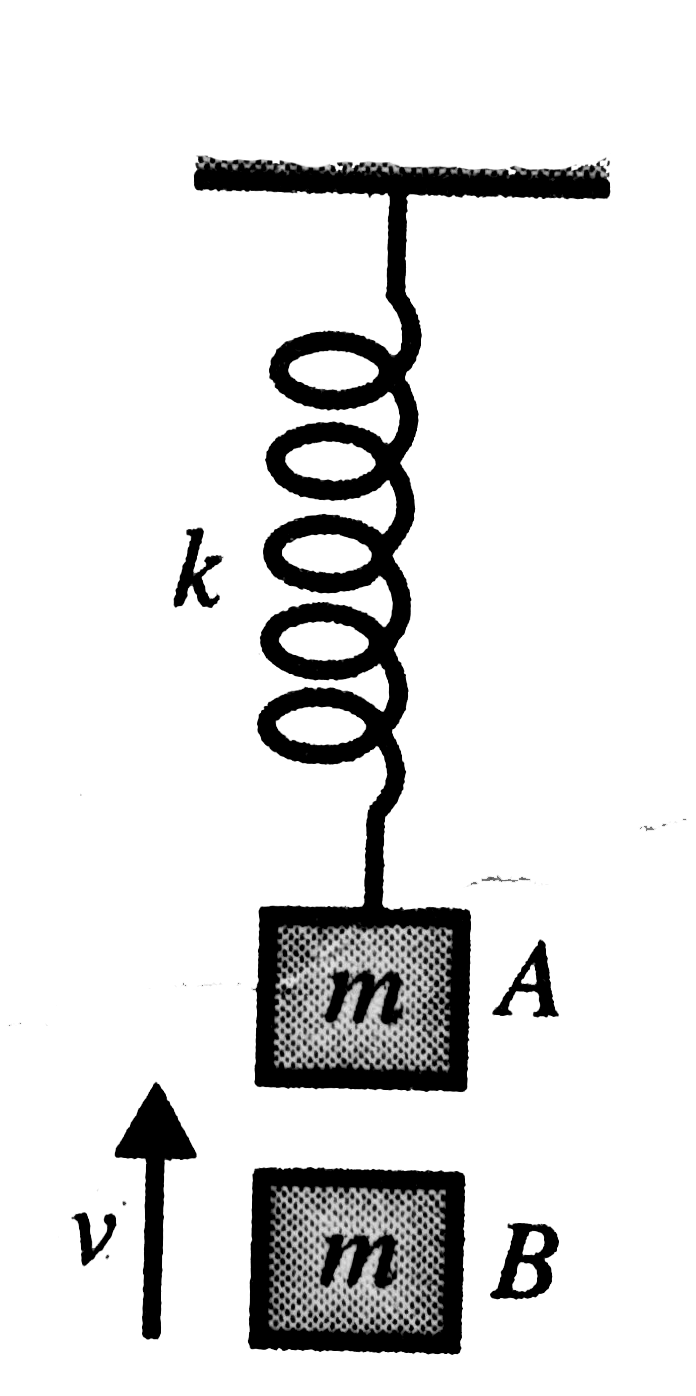
Block `A` is hanging from a vertical spring and is at rest. Block `B` strikes the block `A` with velocity `v` and sticks to it. Then the value of `v` for which the spring just attains natural length is

A

`sqrt((60 mg^2)/k)`

B

`sqrt((6 mg^2)/k)`

C

`sqrt((10 mg^2)/k)`

D

None of these

Text Solution

Verified by Experts

The correct Answer is:

B
Promotional Banner

Similar Questions

Explore conceptually related problems

Block A is hanging from vertical spring of spring constant K and is rest. Block B strikes block A with velocity v and sticks to it. Then the value of v for which the spring just attains natural length is

A block A of mass 2m is hanging from a vertical massless spring of spring constant k and is in equilibrium. Another block B of mass m strikes the block A with velocity u and sticks to it as shown in the figure. The magnitude of the acceleration of the combined system of the blocks just after the collision is

Two blocks A and B of masses in and 2m , respectively, are connected with the help of a spring having spring constant, k as shown in Fig. Initially, both the blocks arc moving with same velocity v on a smooth horizontal plane with the spring in its natural length. During their course of motion, block B makes an inelastic collision with block C of mass m which is initially at rest. The coefficient of restitution for the collision is 1//2 . The maximum compression in the spring is

A block of mass 2kg is attached with a spring of spring constant 4000Nm^-1 and the system is kept on smooth horizontal table. The other end of the spring is attached with a wall. Initially spring is stretched by 5cm from its natural position and the block is at rest. Now suddenly an impulse of 4kg-ms^-1 is given to the block towards the wall. Find the velocity of the block when spring acquires its natural length

A block Q of mass 2m is placed on a horizontal frictionless plane. A second block of mass m is placed on it and is connected to a spring of spring constant K, the two block are pulled by distance A. Block Q oscillates without slipping. The work done by the friction force on block Q when the spring regains its natural length is:

Assertion: Two blocks A and B are connected at the two ends of an ideal spring as shwon in figure. Initially, spring was released. Now block B is pressed. Linear momentum of the system will not remain constan till the spring reaches its initial natural length. Reason: An external force will act from the wall on block A.

Two blocks A and B . each of mass m , are connected by a massless spring of natural length I . and spring constant K . The blocks are initially resting in a smooth horizontal floor with the spring at its natural length, as shown in Fig. A third identical block C , also of mass m , moves on the floor with a speed v along the line joining A and B . and collides elastically with A . Then

A block of mass m, attacted to a string of spring constant k, oscillates on a smooth horizontal table. The other end of the spring is fixed to a wall. The block has a speed v when the spring is at its natural length. Before coming to an instantaneous rest. If the block moves a distance x from the mean position, then

A block of M is suspended from a vertical spring of mass m as shown in the figure. When block is pulled down and released the mass oscillates with maximum velocity v .

A block of mass m hangs from a vertical spring of spring constant k. If it is displaced from its equilibrium position, find the time period of oscillations.
