Home
Class 12
PHYSICS
If k(s) and k(p) respectively are effect...

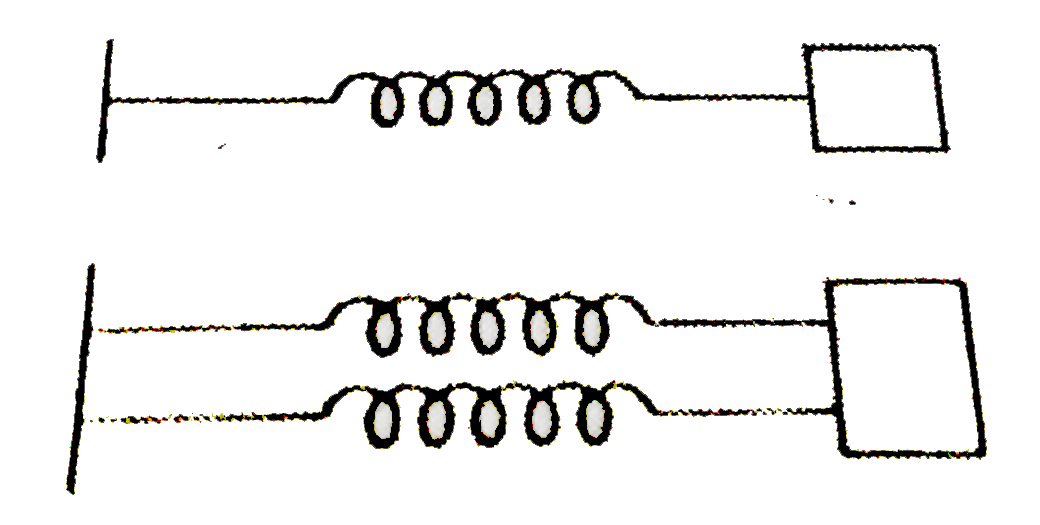
If `k_(s)` and `k_(p)` respectively are effective spring constant in series and parallel combination of springs as shown in figure, find `(k_(s))/(k_(p))`.

A

`9/2`

B

`3/7`

C

`2/9`

D

`7/3`

Text Solution

Verified by Experts

The correct Answer is:

C
Promotional Banner

Similar Questions

Explore conceptually related problems

What is the spring constant for the combination of shown in figure ?

The electrical analog of a spring constant k is

Write the expression for equivalent spring constant of (i) parallel combination of n- springs (ii) series combination of n- springs

The effective spring constant of two spring system as shown in figure will be

Two springs of spring constants K_(1) and K_(2) are joined in series. The effective spring constant of the combination is given by

Two springs of spring constants K_(1) and K_(2) are joined in series. The effective spring constant of the combination is given by

A mass is suspended separately by two springs of spring constants k_(1) and k_(2) in successive order. The time periods of oscillations in the two cases are T_(1) and T_(2) respectively. If the same mass be suspended by connecting the two springs in parallel, (as shown in figure) then the time period of oscillations is T. The correct relations is

This question has statement 1 and statement 2 . Of the four choice given after the Statement , choose the one that best describe the two Statement . If the spring S_(1) and S_(2) of force constant k_(1) and k_(2) respectively , are streached by the same force , it is found that more work is done on spring S_(1) then on spring S_(2) Statement -1: If statement by the same answer work done on S_(1) work on S_(1) is more then S_(2) Statement - 2 : k_(1) ltk_(2)

The frequency of oscillations of a mass m connected horizontally by a spring of spring constant k is 4 HZ. When the spring is replaced by two identical spring as shown in figure. Then the effective frequency is

Force constant of a spring (k) is anonymous to
