Home
Class 12
PHYSICS
A ring of radius R rolls without slippin...


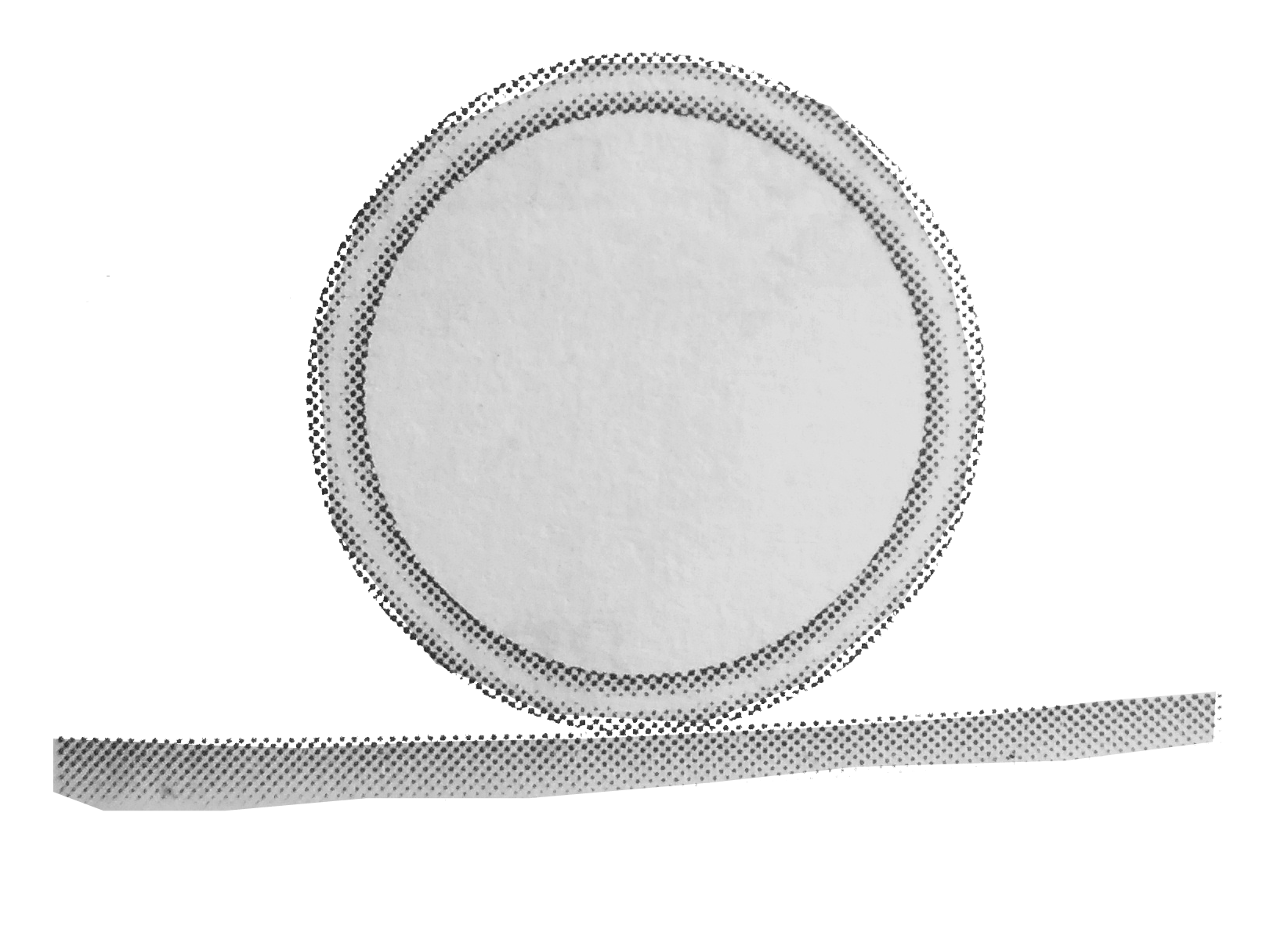
A ring of radius `R` rolls without slipping on a rough horizontal surface with a constant velocity. The radius of curvature of the path followed by any particle of the ring at the highest point of its path will be :

A

5 R

B

2 R

C

4 R

D

None of these

Text Solution

Verified by Experts

The correct Answer is:

C
Promotional Banner

Similar Questions

Explore conceptually related problems

When a body is rolling without slipping on a rough horizontal surface, the work done by friction is :

A ring rolls without slipping on a horizontal surface. At any instant its position is as shown in the figure.

A circular disc of radius R rolls without slipping along the horizontal surface with constant velocity v_0 . We consider a point A on the surface of the disc. Then, the acceleration of point A is

A uniform thin ring of mass 0.4kg rolls without slipping on a horizontal surface with a linear velocity of 10 cm/s. The kinetic energy of the ring is

A uniform circular ring rolls without slipping on a horizontal surface. At any instant, its position is as shown in the figure. Then

A solid cylinder of mass M and radius R rolls without slipping on a flat horizontal surface. Its moment of inertia about the line of contact is

A disc of radius R is rolling purely on a flat horizontal surface, with a constant angular velocity. The angle between the velocity and acceleration vectors of point P is .

A disc of radius R is rolling purely on a flat horizontal surface, with a constant angular velocity. The angle between the velocity ad acceleration vectors of point P is

A thin ring of mass m and radius R is in pure rolling over a horizontal surface. If v_0 is the velocity of the centre of mass of the ring, then the angular momentum of the ring about the point of contact is

A ring of radius R is rolling on a horizontal plane with constant velocity v. There is a constant and uniform magnetic field B which is perpendicular to the plane of the ring. Emf across the lowest point A and right-most point C as shown in the figure will
