Home
Class 12
PHYSICS
A uniformly charged thin spherical shell...

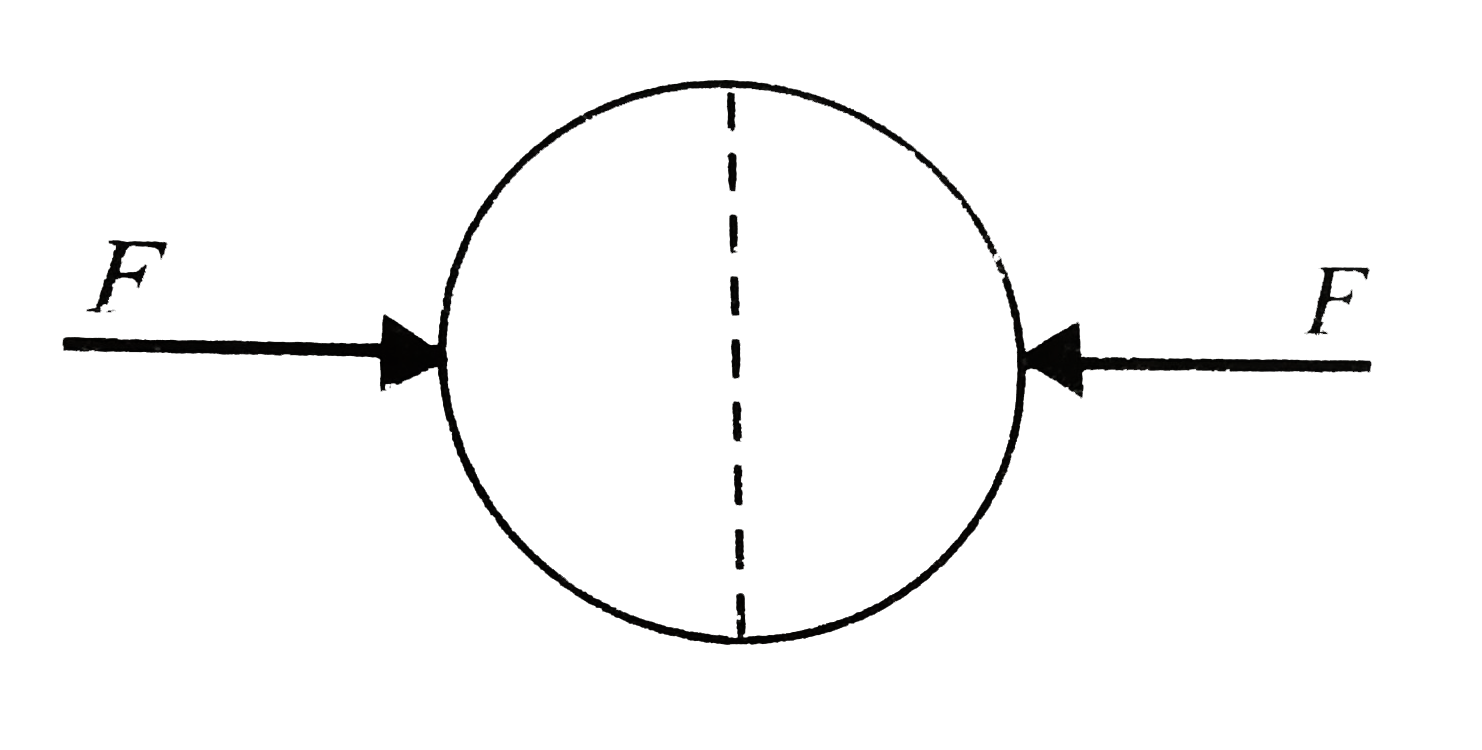
A uniformly charged thin spherical shell of radius R carries uniform surface charge density of `sigma` per unit area. It is made of two hemispherical shells, held together by pressing them with force F. F is proportional to

A

`1/epsilon_0sigma^2R^2`

B

`1/epsilon_0sigma^2R`

C

`1/epsilon_0sigma^2R`

D

`1/epsilon_0sigma^2/R^2`

Text Solution

Verified by Experts

The correct Answer is:

A
Promotional Banner

Similar Questions

Explore conceptually related problems

A uniformly charged thin spherical shell of radius R carries uniform surface charge denisty of isgma per unit area. It is made of two hemispherical shells, held together by presisng them with force F(see figure). F is proportional to

The electric field inside a spherical shell of uniform surface charge density is

A spherical shell of radius R has a uniformly distributed charge ,then electric field varies as

Consider a thin spherical shell of radius R consisting of uniform surface charge density sigma . The electric field at a point of distance x from its centre and outside the shell is

A hemispherical bowl of radius R carries a uniform surface charge density sigma . Find the potential at the topmost point A, taking potential at infinity to be zero.

The magnitude of the electric field on the surface of a sphere of radius r having a uniform surface charge density sigma is

Find the electric field caused by a disc of radius a with a uniform surfce charge density sigma (charge per unit area) at a point along the axis of the disc a distance x from its centre.

A thin circular disk of radius R is uniformly charged with density sigma gt 0 per unit area.The disk rotates about its axis with a uniform angular speed omega .The magnetic moment of the disk is :

(a) Using Gauss's law, derive an expression for the electric field intensity at any point outside a uniformly charged thin spherical shell of radius R and charge density sigma C//m^(2) . Draw the field lines when the charge density of the sphere is (i) positive, (ii) negative. (b) A uniformly charged conducting sphere of 2.5 m in diameter has a surface charge density of 100 mu C//m^(2) . Calculate the (i) charge on the sphere (ii) total electric flux passing through the sphere.
