Home
Class 12
PHYSICS
The figure shows the location of a sourc...

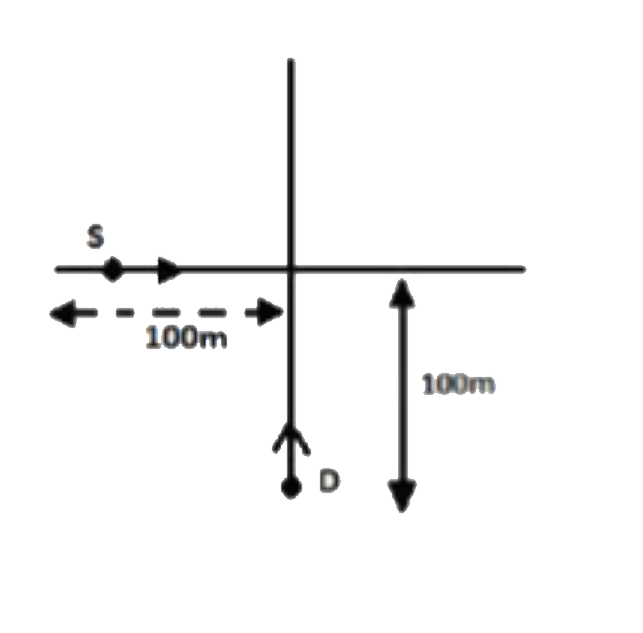
The figure shows the location of a source and detector at time t = 0. The source and detector are moving with velocities `v_s = 5hati m s^(-1) and v_D = 10 hatj ms^(-1)` respectively . The frequency of signals received by the detector at the moment when the source cros the origin is (the frequency of the source is 100 Hz . Velocity bof sound `330 m s^(-1)` .)

A

97 Hz

B

47 Hz

C

90 Hz

D

60 Hz

Text Solution

Verified by Experts

The correct Answer is:

A
Promotional Banner

Similar Questions

Explore conceptually related problems

A source and a detector move away from each other, each with a speed of 10 ms^-1 with respect to the ground with no wind. If the detector detects a frequency 1950 Hz of the sound coming from the source, what is the original frequency of the source? Speed of sound in air =340 ms^-1 .

A source and a detector move away from each other, each with a speed of 10 m/s with respect to ground with no wind. If the detector detects a frequency 1650 Hz of the sound coming from the source, what is the original frequency of the source? (speed of sound = 340 m/s

A sound source moving with speed 50 m/s along x-axis and observer at rest on y-axis.If the frequency observed by observer when source crosses the origin is 96 Hz, then the original frequency of source is :(speed of sound is given medium is 200 m/s)

Source and observer start moving simulatneously along x and y-axis respectively. The speed of source is twice the speed of observer V_0 . If the ratio of observer frequency to the frequency of the source is 0.75 , find the velocity of sound.

Source and observer start moving simulatneously along x and y-axis respectively. The speed of source is twice the speed of observer V_0 . If the ratio of observer frequency to the frequency of the source is 0.75 , find the velocity of sound.

A source of sound is moving along a circular orbit of radius 3 meter with an angular velocity of 10 rad//s . A sound detector located far away from the source is executing linear simple harmonic motion along the line BD with an amplitude BC = CD = 6 meters . The frequency of oscillation of the detector is (5)/(pi) per second. The source is at the point A when the detector is at the point B . If the source emits a continuous sound wave of frequency 340 Hz , Find the maximum and the minimum frequencies recorded by the detector.

A stationary source emits the sound of frequency f_0 = 492 Hz. The sound is reflected by a large car approaching the source with a speed of 2 ms^(-1) . The reflected signal is received by the source and superposed with the original. What will be the beat frequency of the resulting signal in Hz? (Given that the speed of sound in air is 330 ms^(-1) and the car reflects the sound at the frequency it has received).

An observer travelling with a constant velocity of 16.5 ms^(-1) , passes closes to a stationary source of sound and notices that there is a change of frequency of 50 Hz as he passes the source. Calculate the frequency of the source. ("Speed of sound in air = 330 ms"^(-1)).

A source of sound is moving along a circular orbit of radius 3 m with an angular velocity of 10 rad/s. A sound detector located far away from the source is executing linear S.H.M. along the line BD (see Fig. 14.4.13) with an amplitude BC = CD=6m. The frequency of oscillation of the detector is 5//pi per second. The source is at the point BA when the detector is at the point B. If the source epiits a continuous sound wave of frequency 340 Hz, find the maximum and the minimum frequencies recorded by the detector.

The figure shows the initial position of a point source of light s, a detector D and lens L. Now at t = 0 all three starts moving toward right with different velocity as shown in figure. The times at which detector receives the maximum light.
