Home
Class 12
PHYSICS
Two children Ramesh (on path ARB) and So...

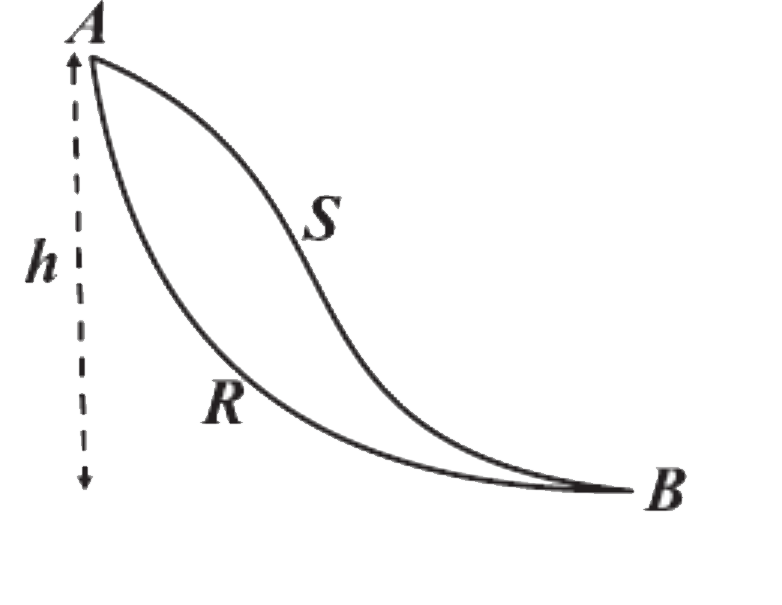
Two children Ramesh (on path ARB) and Sohan (on path ASB), travel down slides of identical height h but different shapes as shown in the figure. Assuming they start down the frictionless slides at the same time with zero initial velocity , which of the following statements is true?

A

Remesh reaches the bottom first with the same average velocity as Sohan.

B

Remesh reaches the bottom first with a larger average acceleration than Sohan.

C

Remesh reaches the bottom first with the same average acceleration as Sohan.

D

They reach the bottom at the same time with the same average acceleration.

Text Solution

Verified by Experts

The correct Answer is:

B
Promotional Banner

Similar Questions

Explore conceptually related problems

Two inclined frictionless tracks, one gradual and the other steep meet at a from where two stones are allowed to slide down from rest, one on each track as shown in Figure. Which of the following statement is correct ? .

A ball rolls down an inclined plane and acquires a velocity v_(r) when it reaches the bottom of the plane. If the same ball slides without friction and acquires rolling from the same height down an equally inclined smooth plane and acquires a velocity v_(s) (then which of the following statements are not correct?

From an inclined palne two particles P,Q are projected with same speed at same angle theta ,one up and other down the plane as shown in figure.Which of the following statement(s) is/are correct ?

In each of three figure shown, two blocks are connected by a light spring and the system is placed on smooth horizontal surface. A constant horizontal force of magnitude F is applied to left block as shown. Assuming spring constant in all three cases to be same, which of the following statements is/are true.

A particle can travel point A to B from two different path 1 and 2, as shown, in same interval of time. Then which of the following is incorrect?

A particle can travel point A to B from two different path 1 and 2, as shown, in same interval of time. Then which of the following is incorrect?

A block of mass M has a circular cut with a frictionless surface as shown. The block rests on the horizontal frictionless surface of a fixed table. Initially the right edge of the block is at x = 0, in a co-ordinate system fixed to the table. A point mass m is released from rest at the topmost point of the path as shown and it slides down. When the mass loses contact with the block, its position is x and the velocity is v. At that instant, which of the following options is/are correct?

An object of mass m is released from rest at a height h above the surface of a table. The object slides along the inside of the loop. The loop track consisting of a ramp and a circular loop of radius R shown in the figure. Assume that the track is frictionless. When the object is at the top of the circular track it pushes against the track with a force equal to three times its weight. What height was the object dropped from?

A bead under the inflence of gravity, sides down a frictionless wire whose y coordinate is changing with x co-ordinate as shown in the figure. Assume that at position O the wire is vertical and the bead passes this point with a given speed v_(0) downward. If the shape of the wire is such that the vertical component of velocity remains v_(0) at all time, find (a+b+c) , in the shape function of wire given by y +((agv_(0)x)^(b/c))/(2g) where g is gravitational acceleration.

A particle is dropped from point P at time t = 0. At the same time another particle is thrown from point O as shown in the figure and it collides with the particle P. Acceleration due to gravity is along the negative y-axis. If the two particles collide 2 s after they start, find the initial velocity v_0 of the particle which was projected from O. Point O is not necessarily on ground.
