Home
Class 12
PHYSICS
A particle is pulled along a curved surf...

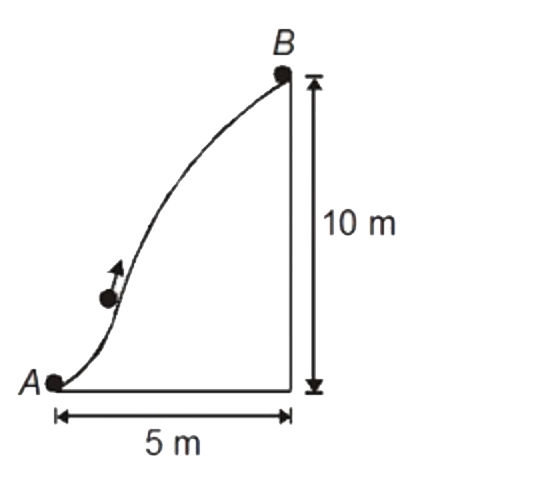
A particle is pulled along a curved surface very slowly. The coefficient of kinetic friction between the particle and surface is 0.4 . The heat generated during the pulling of the particle from the lowest point A to the topmost point B equals (The mass of the particle is 5 g )

A

100 J

B

0.1 J

C

50 J

D

23 J

Text Solution

Verified by Experts

The correct Answer is:

B
Promotional Banner

Similar Questions

Explore conceptually related problems

A block of mass m is slowly pulled along a curved surface from position 1 and 2. If the coefficient of kinetic friction between the block and surface is mu , find the work done by the applied force.

A particle of mass m is pulled along an arbitrary curved surface without acceleration as shown in figure. Coefficient of friction between surface and particle is mu . Then codes:

A point particle of mass m, moves long the uniformly rough track PQR as shown in figure. The coefficient of friction, between the particle and the rough track equals mu . The particle is released, from rest from the point P and it comes to rest at a point R. The energies, lost by the ball, over the parts, PQ and QR, of the track, are equal to each other, and no energy is lost when particle changes direction from PQ to QR. The value of the coefficient of friction mu and the distance x (=QR) , are, respectively close to:

A positively charged particle of mass m and charge q is projected on a rough horizontal x-y plane surface with z-axis in the vertically upward direction. Both electric and magnetic fields are acting in the region and given by vec E = - E_0 hat k and vec B= -B_0 hat k , respectively. The particle enters into the field at (a_0, 0, 0) with velocity vec v = v_0 hat j . The particle starts moving in some curved path on the plane. If the coefficient of friction between the particle and the plane is mu . Then calculate the (a) time when the particle will come to rest (b) distance travelled by the particle when it comes to rest.

A positively charged particle of mass m and charge q is projected on a rough horizontal x-y plane surface with z-axis in the vertically upward direction. Both electric and magnetic fields are acting in the region and given by vec E = - E_0 hat k and vec B= -B_0 hat k , respectively. The particle enters into the field at (a_0, 0, 0) with velocity vec v = v_0 hat j . The particle starts moving in some curved path on the plane. If the coefficient of friction between the particle and the plane is mu . Then calculate the (a) time when the particle will come to rest (b) distance travelled by the particle when it comes to rest.

A block of mass M rests on a rough horizontal surface as shown. Coefficient of friction between the block and the surface is mu . A force F=mg acting at angle theta with the vertical side of the block pulls it. In which of the following cases the block can be pulled along the surface?

A particle is moving with constant speed v along x - axis in positive direction. Find the angular velocity of the particle about the point (0, b), when position of the particle is (a, 0).

A rough horizontal plate rotates with angular velocity omega about a fixed vertical axis. A particle or mass m lies on the plate at a distance (5a)/(4) from this axis. The coefficient of friction between the plate and the particle is (1)/(3) . The largest value of omega^(2) for which the particle will continue to be at rest on the revolving plate is

A particle strikes a smooth horizontal surface at an angle of 45^(@) with a velocity of 100m//s and rebounds. If the coefficient of restitution between the floor and the particle is 0.57 then the angle which the velocity of the particle after it rebounds will make with the floor is

A particle is moving in a verticalcircle such that the tensionin the string at the topmost point B is zero.Theaccelerationof theparticle at point A is (g=10m//s^(2))
