Home
Class 12
PHYSICS
A block of mass 0.1 kg is attached to a ...

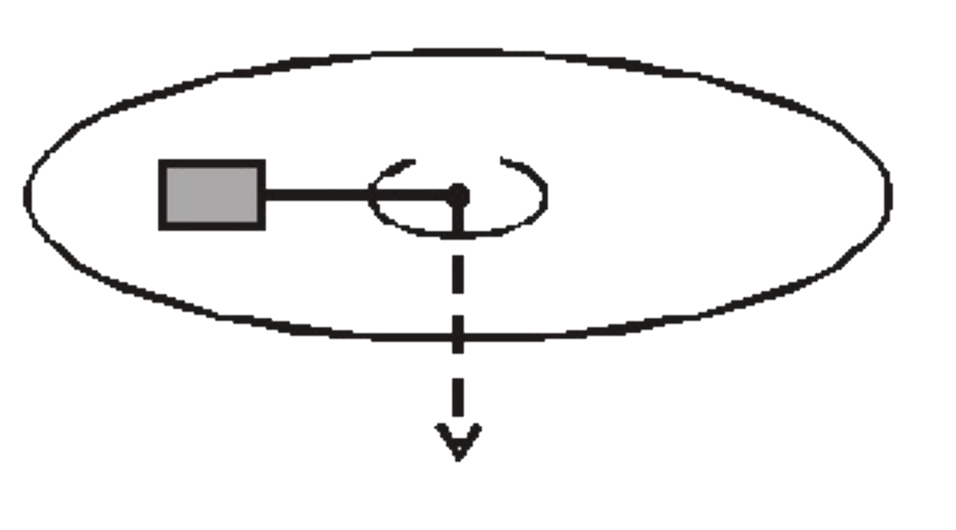
A block of mass 0.1 kg is attached to a cord passing through a hole in a horizontal frictionless horizontal surface as shown in the figure. The block is originally revolving at a distance of 0.4 m from the hole, with an angular velocity of `"2 rad s"^(-1)`. The cord is then pulled from below, shortening the radius of the circle in which the block revolves to 0.2 m. Considering the block to be point mass, calculate the new angular velocity `("in rad s"^(-1))`

Text Solution

Verified by Experts

The correct Answer is:

8
Promotional Banner

Similar Questions

Explore conceptually related problems

A small block of mass 4 kg is attached to a cord passing through a hole in a horizontal frictionless surface. The block is originally revolving in a circle of radius of 5 m about the hole, with a tangential velocity of 4 m//s . The cord is then pulled slowly from below, shortening the radius of the circle in which the block revolves. The breaking strength of the cord is 200 N . Velocity of the block at the time of breaking of the string

A small block of mass 4kg is attached to a cord passing through a hole in a horizontal frictionless surface. The block is originally revolving in a circle of radius 0.5 m about the hole with a tangential velocity of 4m//s . The cord is then pulled slowly from below, shorteing the radius of the circle in which the block revolves. The breaking strength of the cord is 600 N . What will be radius of the circle when the cord breaks?

A block of mass 10 kg, moving with acceleration 2m//s^(2) on horizontal rough surface is shown in figure

Two blocks are connected by a cord passing over a small frictionless pulley and resting on frictionless planes as shown in the figure. The acceleration of the blocks is :

A mass m is attached to a string passing through a small hole in a frictionless, horizontal surface. The mass is initially orbiting with a velocity v_(1) in a circle of radius r_(1) The string is then slowly pulled from below, decreasing the radius of the circles to r_2 (i) What is the speed of the mass when the radius is r_2 ? (ii) What is the tension in the string ? (iii) What is the work done in moving the mass m from r_(1) to r_(2) ?

A block of mass 1 kg in kept on a rough horizontal surface with mu_(s)=0.1 . A force of 0.5 N is applied as shown in the figure. What is the frictional force applied by ground on the block?

a block of mass 0.1 kg attached to a spring of spring constant 400 N/m pulled horizontally from x=0 to x_1 =10 mm. Find the work done by the spring force

Two blocks of masses M_1 and M_2 are placed in contact with each other on a frictionless horizontal surface. If a force F is applied on the block of mass M_1 , what is the contact force between the two blocks?

A wooden block of mass 0.8 kg is dragged along a level frictionless surface by a hanging block of mass 0.2 kg as shown in the figure. Calculate the tension in the string and the acceleration of blocks.

A wooden block of mass 0*8 kg is dragged along a level frictionless surface by a hanging block of mass 0*2 kg as shown in the figure . Calculate the tension in the string and the acceleration of blocks .
