Home
Class 12
PHYSICS
Consider a uniform disc in the x - y pla...

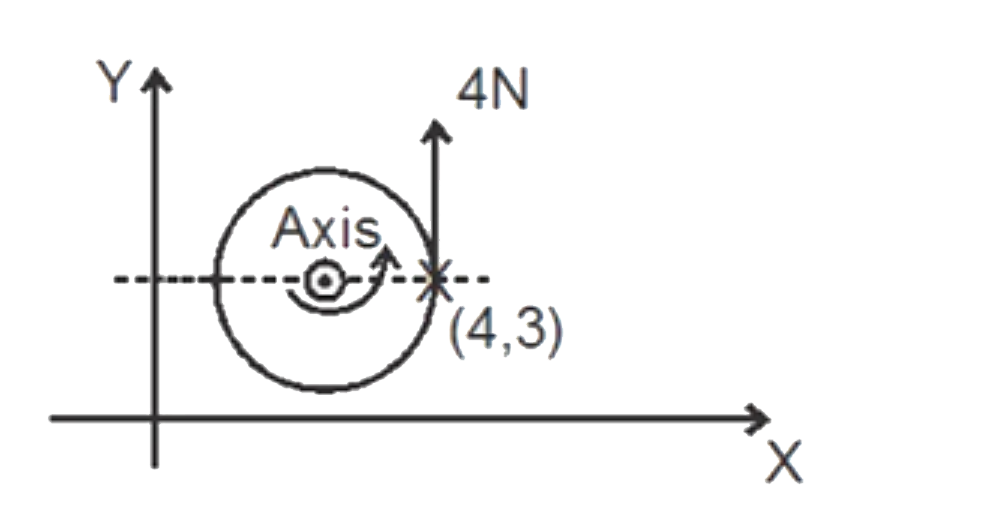
Consider a uniform disc in the x - y plane free to rotate about an axis parallel to the Z - axis as shown (passing through the centre). A force of 4N appliled at (4, 3) along y - axis, as shown produces an angular acceleration of `2s^(-1)`. Locate the centre of mass of the disc if the mass of the disc is 2 kg.

A

(1, 3)

B

(2, 3)

C

(0, 3)

D

(4, 3)

Text Solution

Verified by Experts

The correct Answer is:

B
Promotional Banner

Similar Questions

Explore conceptually related problems

A uniform disc of mass M and radius R is hinged at its centre C . A force F is applied on the disc as shown . At this instant , angular acceleration of the disc is

A uniform circular disc of radius 50 cm at rest is free to turn about an axis which is perpendicular to its plane and passes through its centre. It is subjected to a torque which produces a constant angular acceleration of 2 rad s^(-1) . Its net acceleration in ms^(-2) at the end of 2 s is approximately

A uniform solid disc of mass 1 kg and radius 1m is kept on a rough horizontal surface. Two forces of magnitude 2N and 4N have been applied on the disc as shown in the figure. Linear acceleration of the center of mass of the disc is if there is no slipping is

A disc is free to rotate about a smooth horizontal axis passing through its centre of mass. A particle is fixed at the top of the disc. A slight push is given to the disc and it starts rotating. During the process.

The moment of inertia of a copper disc, rotating about an axis passing through its centre and perpendicular to its plane

A disc of mass 4 kg and radius 6 metre is free to rotate in horizontal plane about a vertical fixed axis passing through its centre. There is a smooth groove along the diameter of the disc and two small blocks of masses 2 kg each are placed in it on either side of the centre of the disc as shown in figure. The disc is given initial angular velocity omega_(0) =12 rad/sec and released. Find the angular speed of disc (in radian/sec) when the blocks reach the ends of the disc.

Circular disc of mass 2 kg and radius 1 m is rotating about an axis perpendicular to its plane and passing through its centre of mass with a rotational kinetic energy of 8 J. The angular momentum is (Js) is

A disc of mass m and radius R is free to rotate in a horizontal plane about a vertical smooth fixed axis passing through its centre. There is a smooth groove along the diameter of the disc and two small balls of mass m//2 each are placed in it on either side of the centre of the disc as shown in Fig. The disc is given an initial angular velocity omega_(0) and released. The angular speed of the disc when the balls reach the end of the disc is

A uniform disc of mass m and radius R rotates about a fixed vertical axis passing through its centre with angular velocity omega . A particle of same mass m and having velocity of 2omegaR towards centre of the disc collides with the disc moving horizontally and sticks to its rim. Then

If a circular concentric hole is made on a disc then about an axis passing through the centre of the disc and perpendicular to its plane
