Home
Class 12
PHYSICS
Three (A,B,C) particle each of mass m ar...


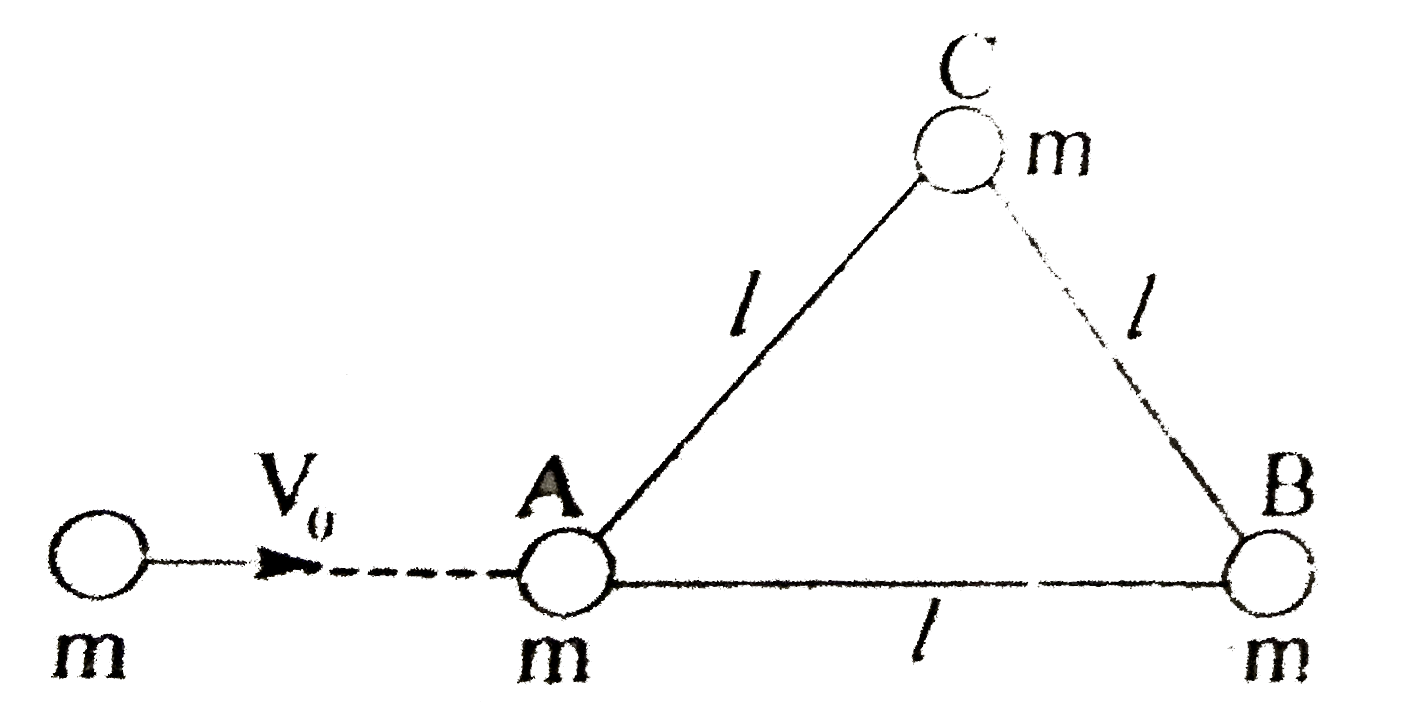
Three (A,B,C) particle each of mass m are connected by three mass-less rod of length l. All three particle lies on smooth horizontal plane. A particle of mass moving along one of the rod with velocity `v_(0)` strikes on a particle and stops as shown in diagram. Angular velocity of eachh particle after collision is.

A

`(mV_(0)^(2))/(36l)`

B

`(mV_(0)^(2))/(28l)`

C

`(mV_(0)^(2))/(24l)`

D

`(mV_(0)^(2))/(12l)`

Text Solution

Verified by Experts

The correct Answer is:

A
Promotional Banner

Similar Questions

Explore conceptually related problems

A Iong slender rod of mass 2 kg and length m is placed on a smooth horizontal table. Two particles of masses 2 kg and 1kg strike the rod simultaneously and stick to the rod after collision as shown in fig. Angular velocity of the rod after collision is

Two particles each of mass M are connected by a massless rod. The rod is lying on the smooth horizontal surface. If one of the particle is given an impulse MV as shown in the figure then angular velocity of the system would be:

A Iong slender rod of mass 2 kg and length m is placed on a smooth horizontal table. Two particles of masses 2 kg and 1kg strike the rod simultaneously and stick to the rod after collision as shown in fig. Velocity of the centre of mass of the rod after collision is

A particle of mass m moves along line PC with velocity v as shown. What is the angular momentum of the particle about O ?

A uniform rod of mass m and length L is at rest on a smooth horizontal surface. A ball of mass m, moving with velocity v_0 , hits the rod perpendicularly at its one end and sticks to it. The angular velocity of rod after collision is

A uniform rod of length l and mass 2 m rests on a smooth horizontal table. A point mass m moving horizontally at right angles to the rod with velocity v collides with one end of the rod and sticks it. Then

A uniform rod of length l and mass 2 m rests on a smooth horizontal table. A point mass m moving horizontally at right angles to the rod with velocity v collides with one end of the rod and sticks it. Then

A particle of mass m is whirled in horizontal circle with the help of two threads of length l each as shown in figure . Angular velocity equals omega , then

A rod AB of length 2L and mass m is lying on a horizontal frictionless surface. A particle of same mass m travelling along the surface hits the rod at distance (L)/(2) from COM with a velocity v_(0) in a direction perpendicular to rod and sticks to it. Angular velocity of rod just after collision is

A rod AB of length 2L and mass m is lying on a horizontal frictionless surface. A particle of same mass m travelling along the surface hits the rod at distance (L)/(2) from COM with a velocity v_(0) in a direction perpendicular to rod and sticks to it. Angular velocity of rod just after collision is
