Home
Class 12
PHYSICS
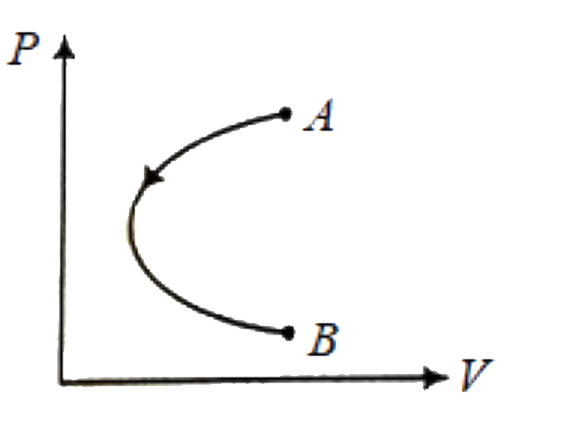
P - V diagram of an ideal gas is shown. ...

P - V diagram of an ideal gas is shown. The gas undergoes from initial state A to final state B such that initial and final volumes are same. Select the correct alternative for given process AB.

A

Work done by gas is positive

B

Work done by gas is negative

C

Temperature of gas increases continuously

D

Process is isochoric

Text Solution

Verified by Experts

The correct Answer is:

B
Promotional Banner

Similar Questions

Explore conceptually related problems

An ideal gas undergoes isothermal process from some initial state i to final state f . Choose the correct alternatives.

An idel gas undrgoes isothermal process from some initial state i to final state f . Choose the correct alternatives.

An ideal gas is taken from an initial state i to a final state f in such a way that the ratio of the pressure to the absolute temperature remains constant. What will be the work done by the gas ?

When a sample of ideal gas is changed from an initial state to a final state, various curves can be plotted for the process like P-V curve, V-T curve,P-T curve etc. For example, P-V curve for a fixed amount of an ideal gas at constant temperature is a rectangular hyperbola, V-T curve for a fixed amount of an ideal gas at constant volume is again a straight line. However, the shapes may vary if the constant parameters are also changed. Now, answer the following questions : Two moles of an ideal gas is changed from its initial state (16 atm, 6L) to final state (4 atm, 15L) in such a way that this change can be represented by a straight line in P-V curve.The maximum temperature attained by the gas during the above change is :(Take : R=1/12L atm K^(-1) "mol"^(-1) )

One mole of an ideal gas goes from an initial state A to final state B via two processs : It first undergoes isothermal expansion from volume V to 3 V and then its volume is reduced from 3 V to V at constant pressure. The correct P-V diagram representing the two process in (figure)

For an ideal gas of fixed amount, the initial pressure and volume are equal to the final pressure and volume

For an ideal gas, consider only P-V work in going from an initial state X to the final state Z . The final state Z can be reached by either of the two paths shown in the figure. Which of the following choice(s) is (are) correct? [Take DeltaS as change in entropy and w as work done]

For an ideal gas, consider only P-V work in going from an initial state X to the final state Z. The final state Z can be reached by either of the two paths shown in the figure. Which of the following choice(s) is(are) correct? [Take DeltaS as change in entropy and w as work done]

When a sample of ideal gas is changed from an initial state to a final state, various curves can be plotted for the process like P-V curve, V-T curve,P-T curve etc. For example, P-V curve for a fixed amount of an ideal gas at constant temperature is a rectangular hyperbola, V-T curve for a fixed amount of an ideal gas at constant volume is again a straight line. However, the shapes may vary if the constant parameters are also changed. Now, answer the following questions : Which of the following graphs is not possible for a fixed amount of ideal gas upon moving from initial state A to final state B :

Can we use Boyle's law to calculate the volume of a real gas from its initial state to final state during adiabatic expansion?
