Home
Class 12
PHYSICS
A rod made of glass, (mu = 1.5) and of s...

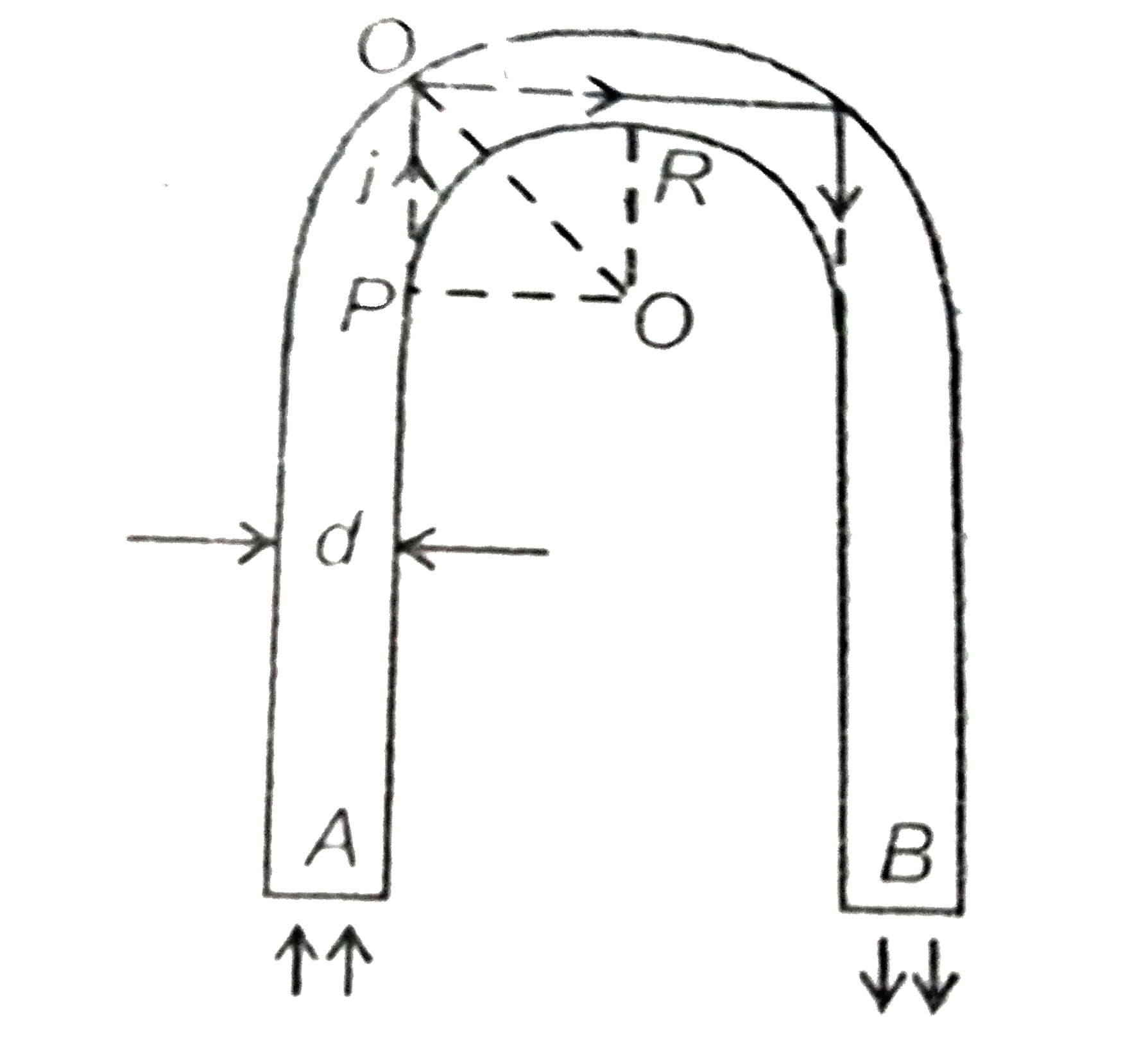
A rod made of glass, `(mu = 1.5)` and of square cross-section is bent into the shape shown in figure. A parallel beam of light falls perpendicularly on the plane flat surface A. Referring to the diagram, d is the width of a side and R the radius of inner semi-circle. Find the maximum value of ratio `((d)/(R))` so that all light entering the glass through surface A emerge from the glass through B.

Text Solution

Verified by Experts

The correct Answer is:

2
Promotional Banner

Similar Questions

Explore conceptually related problems

A rod made of glass (mu = 1.5) and of square cross-section is equal is bent into the shape shown in figure. A parallel beam of light falls perpendicurly on the plane flat surface . A . Referring to the diagram, d is the width of a side & R is radius of inner semicircle. find the maximum value of ratio (d)/(R) so that all light entering the glass through surface A emerge from the glass through surface B.

A rod of glass ( mu = 1.5) and of square cross section is bent into the shape shown in the figure. A parallel beam of light falls on the plane flat surface A as shown in the figure. If d is the width of a side and R is the radius of circular arc then for what maximum value of (d)/(R) light entering the glass slab through surface A emerges from the glass through B

A parallel beam of light is incident normally on the flat surface of a hemisphere of radius 6 cm and refractive index 1.5 , placed in air as shown in figure (i). Assume paraxial ray approxiamtion. .

A glass rod having square cross-section is bent into the shape as shown in the figure. The radius of the inner semi-circle is R and width of the rod is d. Find the minimum value of d//R so that the light that enters at A will emerge at B. Refractive index of glass is mu=1.5

Find the maximum angle of refraction when a light ray is refracted from glass (mu= 1.50) to air.

A parallel beam of light emerges from the opposite surface of the sphere when a point source of light lies at the surface of the sphere. The refractive index of the sphere is

What should be the value of refractive index n of a glass rod placed in air, so that the light entering through the flat surface of the rod does not cross the curved surface of the rod?

A transparent sphere of radius R ahs a cavity of radius R//2 as shown in figure,. Find the refractive index of the sphere if a parallel beam of light falling on left sureface focuses at point P.

A portion of a straight glass rod of diameter 2 cm and refractive index 1.5 is bent into an arc of a circle of radius R cm and a parallel beam of light is incident on it as shown in figure. Find the smallest R which permits all the light to pass around the arc.

Light is incident at an angle i on one planer end of a transparent cylinderical rod of refractive index mu. Find the least value of mu so that the light entering the rod does not emerge from the curved surface of the rod irrespective of the value of i.
