
Home
Class 12
PHYSICS
Three rods of the same length and the sa...

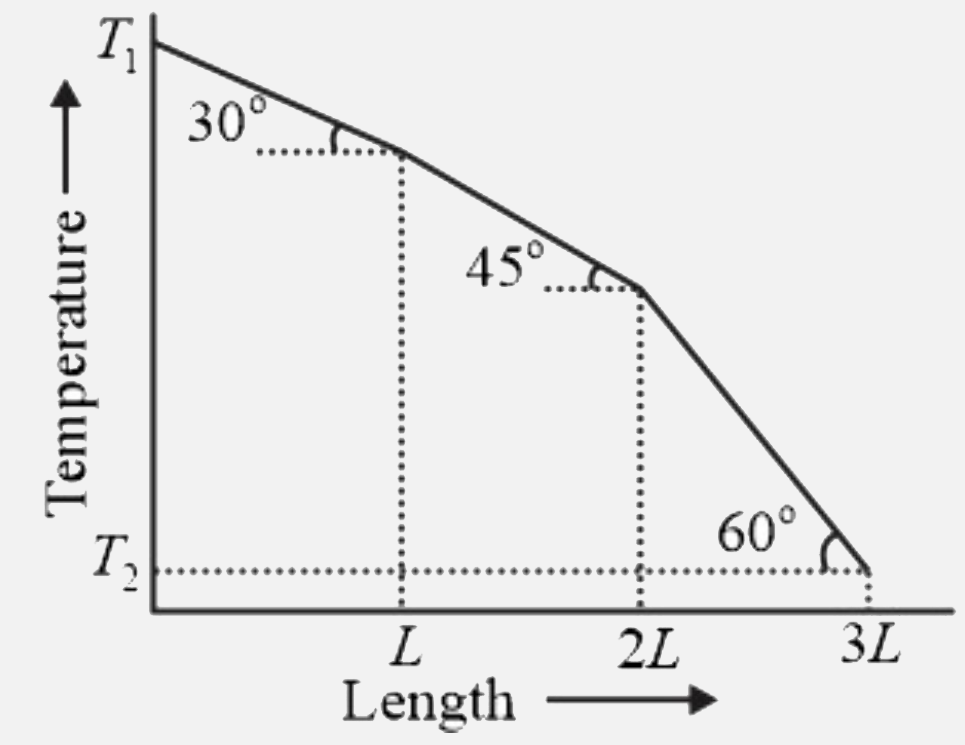
Three rods of the same length and the same area of the cross-section are joined. The temperature of two ends one `T_(1)` and `T_(2)` as shown in the figure.
As we move along the rod the variation of temperature are as shown in the following [Rods are insulated from the surrounding except at the faces]
A

`(K_(1))/(sqrt(3))=(K_(2))/(3)=(K_(3))/(1)`

B

`(K_(1))/(3)=(K_(2))/(1)=(K_(3))/(sqrt(3))`

C

`(K_(1))/(3)=(K_(2))/(sqrt(3))=(K_(3))/(1)`

D

`(K_(1))/(sqrt(3))=(K_(2))/(1)=(K_(3))/(3)`

Text Solution

Verified by Experts

The correct Answer is:

C
Promotional Banner

Similar Questions

Explore conceptually related problems

Three rods of same cross-section but different length and conductivity are joined in series . If the temperature of the two extreme ends are T_(1) and T_(2) (T_(1)gtT_(2)) find the rate of heat transfer H.

Four identical heat conductors are connected as shown in the figure. The temperature theta of the junction is [rods are insulated from the sides ]

Four rods of same material and having the same cross section and length have been joined, as shown. The temperature of the junction of four rods will be :

Two ends of a rod of non uniform area of cross section are maintained at temperature T_(1) and T_(2) (T_(1)>T_(2)) as shown in the figure If l is heat current through the cross-section of conductor at distance x from its left face, then the variation of l with x is best represented by

Three rods are made from the same material and having the same cross-sectional area and length have been joined as shown in the figure. The left end and right end are kept 0^@C and 100^@C , respectively . The temperature of the junction of three rods will be

Two bars of same length and same cross-sectional area but of different thermal conductivites K_(1) and K_(2) are joined end to end as shown in the figure. One end of the compound bar it is at temperature T_(1) and the opposite end at temperature T_(2) (where T_(1) gt T_(2) ). The temperature of the junction is

Two rods of same length and same material having area of cross section A and 4A respectively are joined as shown in the figure. If T_(A) and T_(B) are temperatures of free ends in steady state. The temperature of junction point C is (Assume no heat loss wil take place through lateral surface)

Two rods A and B of same cross-sectional area A and length l are connected in series between a source (T_(1)=100^(@)C) and a sink (T_(2)-0^(@)C) as shown in figure. The rod is laterally insulated. The ratio of the thermal resistance of the rods is

All the rods have same conductance 'K' and same area of cross section ' A' . If ends A and C are maintained at temperature 2T_(0) and T_(0) respectively then which of the following is // are correct?

Three rods A, B and C of the same length and same cross-sectional area are joined as shown. Their thermal conductivities are in the ratio 1:2:3/2. If the open ends of A and C are at 200^@ C and 18^@ C, respectively, then the temperature at the junction of A at steady state is
