Home
Class 12
PHYSICS
A thin non conducting disc of mass M = 2...

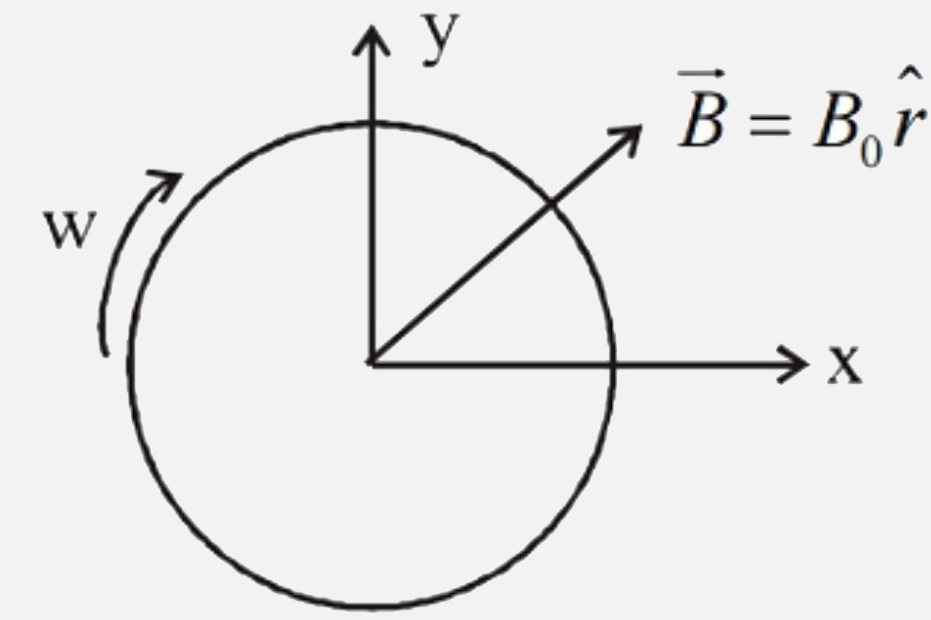
A thin non conducting disc of mass M = 2 kg, charge `Q = 2 xx 10^(2-) C` and radius `R = (1)/(6)m` is placed on a frictionless horizontal plane with its centre at the origin of the coordinate system. A non- uniform, radial magnetic field `vecB = B_(0) hat(r)` is exists in space, where `B_(0)= 10 T` and `hat(r)` is a unit vector in the radially outward direction. The disc is set in motion with an angular velocity `omega = x xx 10^(2)" rad s"^(-1)`, about an axis passing through its centre and perpendicular to its plane, as shown in the figure. At what value of x, the disc will lift off from the surface.

Text Solution

Verified by Experts

The correct Answer is:

9
Promotional Banner

Similar Questions

Explore conceptually related problems

A rectangular loop of dimensions (axxb) carries a current i. A uniform magnetic field vec(B)=B_(0) hat(i) exists in space. Then :

A charge q is uniformly distributed on a non-conducting disc of radius R . It is rotated with an angular speed co about an axis passing through the centre of mass of the disc and perpendicular to its plane. Find the magnetic moment of the disc.

An electric field vec(E)=B x hat(i) exists in space, where B = 20 V//m^(2) . Taking the potential at (2m, 4m) to be zero, find the potential at the origin.

A uniform disc of mass M, radius R is attached to a frictionless horizontal axis. Its rim is wound with a light string and a tension T is applied to it, the angular acceleration will be?

A thin uniform circular disc of mass M and radius R is rotating in a horizontal plane about an axis passing through its centre and perpendicular to its plane with an angular velocity omega . Another disc of same dimensions but of mass (1)/(4) M is placed gently on the first disc co-axially. The angular velocity of the system is

A magnetic field vec(B)=-B_(0)hat(i) exists within a sphere of radius R=v_(0)Tsqrt(3) where T is the time period of one revolution of a charged particle starting its motion form origin and moving with a velocity vce(v)_(0) = (v_0)/(2) sqrt(3) hat(i) - v_(0)/(2) hat(j) . Find the number of turns that the particle will take to come out of the magnetic field.

A non - conducting ring of mass m = 4 kg and radius R = 10 cm has charge Q = 2 C uniformly distributed over its circumference. The ring is placed on a rough horizontal surface such that the plane of the ring is parallel to the surface. A vertical magnetic field B=4t^(3)T is switched on at t = 0. At t = 5 s ring starts to rotate about the vertical axis through the centre. The coefficient of friction between the ring and the surface is found to be (k)/(24) . Then the value of k is

In the space shown a non-uniform magnetic field vec(B) = B_(0)(1+x)(-hat(k)) tesla is present. A closed loop of small resistance, placed in the x y plane is given velocity V_(0) . The force due to magnetic field on the loop is

In the space shown a non-uniform magnetic field vec(B) = B_(0)(1+x)(-hat(k)) tesla is present. A closed loop of small resistance, placed in the x y plane is given velocity V_(0) . The force due to magnetic field on the loop is

A uniform conducting ring of mass pi kg and radius 1 m is kept on smooth horizontal table. A uniform but time varying magnetic field B = (hat (i) + t^(2) hat (j))T is present in the region, where t is time in seconds. Resistance of ring is 2 (Omega) . Then Time (in second) at which ring start toppling is
