Home
Class 12
PHYSICS
A block is held stationary at the positi...

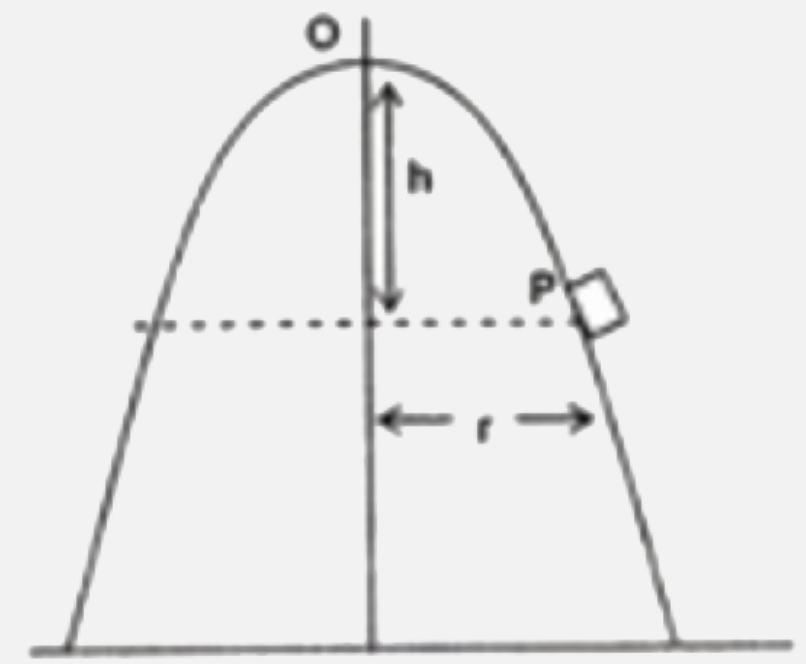
A block is held stationary at the position shown in the figure over the surface of a solid paraboloid. What should be the magnitude of the velocity, needed to be given to the block at this point such that it moves along the surface of the paraboloid without having any normal reaction anywhere ?
`(g = 10 ms^(2)) r = sqrt(2)h, h = ((10)/(3)) m`.
Consider motion only along the plane of the paper.

A

`20 ms^(-1)`

B

`10sqrt((2)/(3)) ms^(-1)`

C

`10 ms^(-1)`

D

cannot be calculated

Text Solution

Verified by Experts

The correct Answer is:

C
Promotional Banner

Similar Questions

Explore conceptually related problems

Consider the situation shown in figure. All the surfaces are frictions and the string and the pulley are light. Find the magnitude of the acceleration of the two blocks.

A smooth block of mass m is held stationary on a smooth wedge of mass M and inclination theta as shown in figure .If the system is released from rest , then the normal reaction between the block and the wedge is

A block of mass sqrt(3)//10kg is placed on a rough horizontal surface as shown in the figure. A force of 1N is applied at one end of the block and the block remains stationary. The normal force exerted by the sruface on the block acts(g=10 m//s^(2) )

A block of mass m slides down along the surface of the bowl from the rim to the bottom as shown in fig. The velocity of the block at the bottom will be-

A block of mass 3kg is at rest on a rough inclined plan as shown in the Figure. The magnitude of net force exerted by the surface on the block will be

A block of mass M is placed on the top of a bigger block of mass 10 M as shown in figure. All the surfaces are frictionless. The system is released from rest, then the distance moved by the bigger block at the instant the smaller block reaches the ground :

A small block slides with velocity 0.5sqrt(gr) on the horizontal frictionless surface as shown in the figure. The block leaves the surface at point C . Calculate angle theta in the figure.

Consider the situation shown in figure. The block B moves on a frictionless surface ,while the coefficient of friction between A and the surface on which it moves is 0.2 . Find the acceleration with which the masses move and also the tension in the strings. (Take g = 10 m//s^(2)) .

Assertion A small block of mass m is rotating in a circle inside a smooth cone as shown in figure. In this case the normal reaction, N ne "mg cos"theta Reason In this case, acceleraion of the block is not along the surface of cone. It is horizontal.

A block of 10 kg mass is placed on a rough inclined surface as shown in figure. The acceleration of the block will be
