Home
Class 12
PHYSICS
Three identical balls are connected by l...

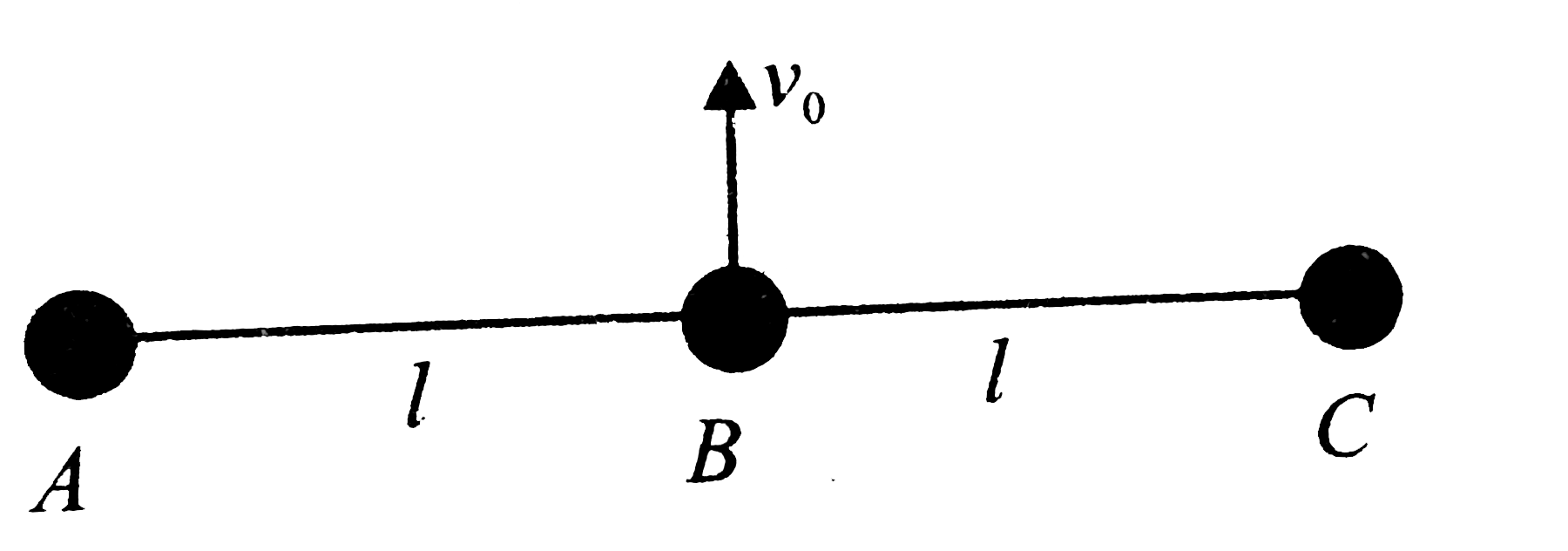
Three identical balls are connected by light inextensible strings with each other as shown and rest over a smooth horizontal table. Length of each string is `l`.
At moment `t = 0`, ball `B` is imparted a velocity `v_(0)` perpendicular to the strings and then the system is left on its own.

If collision between the balls is completely inelastic, then

A

`(v_(0))/(3)`

B

`(2v_(0))/(3)`

C

`(2v_(0))/(3)`

D

`(2v_(0))/(9)`

Text Solution

Verified by Experts

The correct Answer is:

B
Promotional Banner

Similar Questions

Explore conceptually related problems

Three identical balls are connected by light inextensible strings with each other as shown and rest over a smooth horizontal table. Length of each string is l . At moment t = 0 , ball B is imparted a velocity v_(0) perpendicular to the strings and then the system is left on its own. Calculate the velocity of A at the above given instant.

Three identical balls are connected by light inextensible strings with each other as shown and rest over a smooth horizontal table. Length of each string is l . At moment t = 0 , ball B is imparted a velocity v_(0) perpendicular to the strings and then the system is left on its own. Calculate the velocity of B just before A collides with ball C .

Two identical small balls, each of mass m , are connected by a massless and inextensible string of length l and placed on a smooth horizontal xy plane. An external agent pulling the string from its mid-point along y -axis with velocity v_(0) as shown in Fig. When the separation between the two balls reduces to l//2 then the speed of each ball will be

Two particles each of mass m are connected by a light inextensible string and a particle of mass M is attached to the midpoint of the string. The system is at rest on a smooth horizontal table with string just taut and in a straight line. The particle M is given a velocity v along the table perpendicular to the string. Prove that when the two particles are about to collide : (i) The velocity of M is (Mv)/((M + 2m)) (ii) The speed of each of the other particles is ((sqrt2M (M + m))/((M + 2m)))v .

Two identical balls each of mass m interconnected by a small light inextensible string are kept on a smooth horizontal surface. One of the balls is pushed towards the other with a speed v_(0) find the loss of K.E. of the ball. What will be the final velocities of the balls ? (e=1).

A bead is connected with a fixed disc of radius R by an inextensible massless string in a smooth horizontal plane. If the bead is pushed with a velocity v_(0) prependicular to the string, the bead moves in a curve and consequently collapses on the disc. Then

Three balls A, B and C are placed on a smooth horizontal surface. Given that m_A=m_C=4m_B . Ball B collides with ball C with an initial velocity v as shown in figure. Find the total number of collisions between the balls. All collisions are elastic.

Three blocks of masses 5 kg, 10 kg and 15 kg are connected to - light inextensible string placed on smooth horizontal tble as shown below. (T_(1)) /( T_(2)) will be

Two balls marked 1 and 2 of the same mass m and a third ball marked 3 of mass M are arranged over a smooth horizontal surface as shown in the figure. Ball 1 moves with a velocity v_(1) towards ball 2. All collisions are assumed to be elastic. If Mltm , the number of collisions between the balls will be.

Two balls marked 1 and 2 of the same mass m and a third ball marked 3 of mass M are arranged over a smooth horizontal surface as shown in the figure. Ball 1 moves with a velocity v_(1) towards ball 2. All collisions are assumed to be elastic. If Mltm , the number of collisions between the balls will be.
