Home
Class 12
CHEMISTRY
In the hober's process of ammonia manufa...

In the hober's process of ammonia manufacture,
`N_(2)(g)+3H_(2)(g) rarr2NH_(3)(g)`
the rate of appearance of `NH_(3)` is :
`(d[NH_(3)])/(dt)=2xx10^(-4)"mol" L^(-1)"sec"^(-1)`
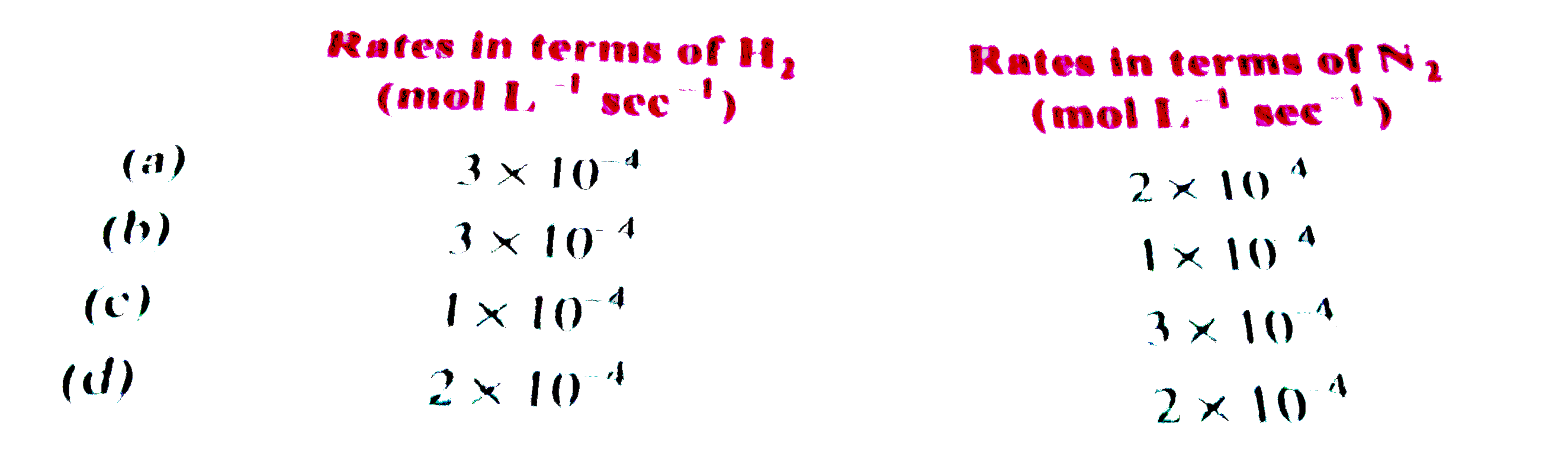
The rates of the reaction expressed in terms of `N_(2) and H_(2)` will be :

A

`{:(3xx10^(-4),2xx10^(-4)):}`

B

`{:(3xx10^(-4),1xx10^(-4)):}`

C

`{:(1xx10^(-4),3xx10^(-4)):}`

D

`{:(2xx10^(-4),2xx10^(-4)):}`

Text Solution

Verified by Experts

The correct Answer is:

B
Promotional Banner

Similar Questions

Explore conceptually related problems

For the reaction H_(2) (g)+I_(2)(g) rarr 2HI(g) , the rate of disappearance of H_(2) is 1.0 xx 10^(-4) mol L^(-1) s^(-1) . The rate of appearance of HI will be

In a reaction N_(2(g))+3H_(2(g))to2NH_(3(g)) rate of appearance of NH_(3) is 2.5xx10^(-4)molL^(-1)sec^(-1) then rate of reaction and rate of disappearance of H_(2) respectively is :-

In a catalyst experiment involving the Haber process N_(2) + 3H_(2) rarr 2NH_(3) , the rate of reaction was measured as Rate = (Delta[NH_(3)])/(Delta t) = 2.0 xx 10^(-4) mol L^(-1) s^(-1) What is the rate of reaction expressed in terms of (a) N_(2) (b) H_(2) ?

In a catalyst experiment involving the Haber process N_(2) + 3H_(2) rarr 2NH_(3) , the rate of reaction was measured as Rate = (Delta[NH_(3)])/(Delta t) = 2.0 xx 10^(-4) mol L^(-1) s^(-1) What is the rate of reaction expressed in terms of (a) N_(2) (b) H_(2) ?

For the reaction, N_(2)(g)+3H_(2)(g) hArr 2NH_(3)(g) , the units of K_(p) are …………

For the reaction N_(2)(g) + 3H_(2)(g) hArr 2NH_(3)(g), DeltaH=?

For the reaction N_(2)+3H_(2) rarr 2NH_(3) , if (d[NH_(3)])/(dt).=4xx10^(-4) mol L^(-1)s^(-1) , the value of (-d[H_(2)])/(dt) would be

For the reaction N_(2)+3H_(2) rarr 2NH_(3) , if (d[NH_(3)])/(dt).=4xx10^(-4) mol L^(-1)s^(-1) , the value of (-d[H_(2)])/(dt) would be

For the reaction , N_2+3H_2rarr2NH_3 if (d[NH_3])/(dt)=2xx10^(-4)"mol L"^(-1) s^(-1) , the value of (-d[H_2])/(dt) would be

For the reaction 4NH_(3) + 5O_(2) to 4NO + 6H_(2) O , if the rate of disappearance of NH_(3) is 3.6 xx 10^(-3) mol L^(-1) s^(-1) , what is the rate of formation of H_(2) O
