Home
Class 12
CHEMISTRY
Benene diazonium chloride in aqueous sol...

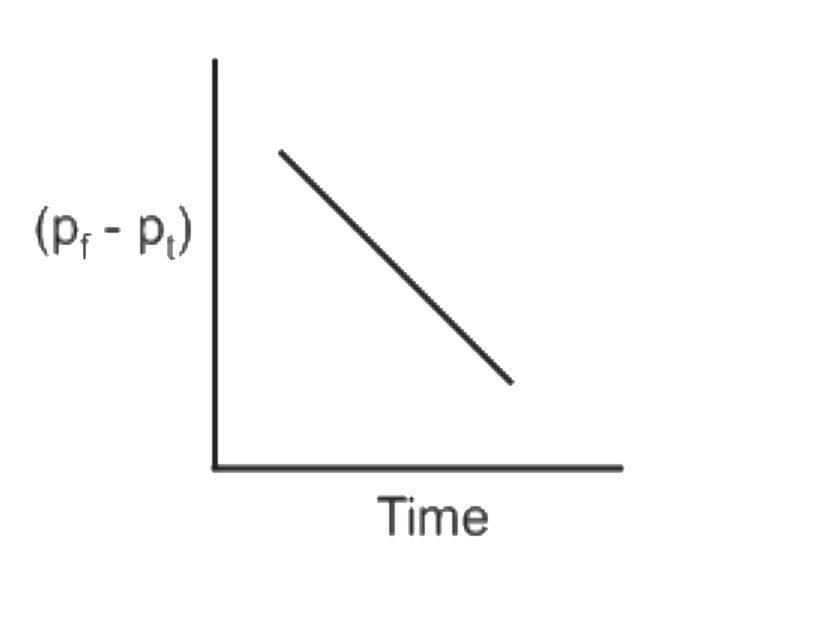
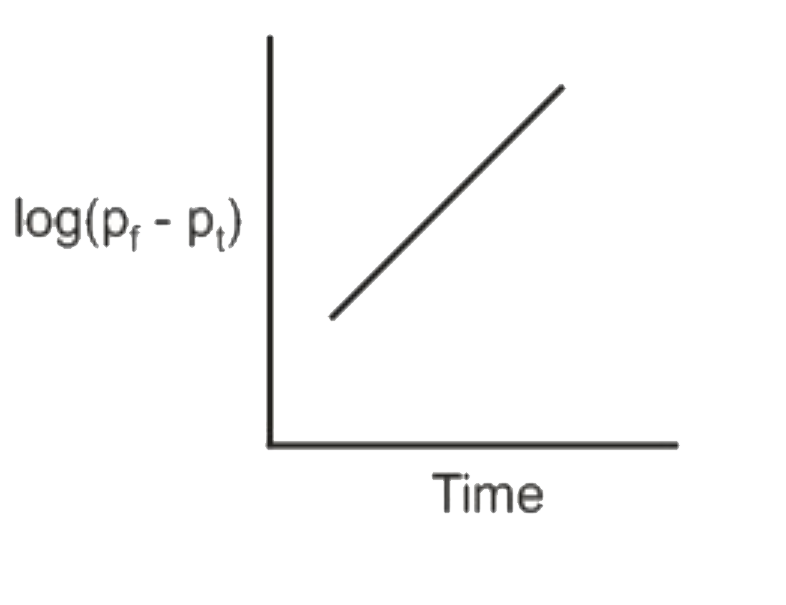
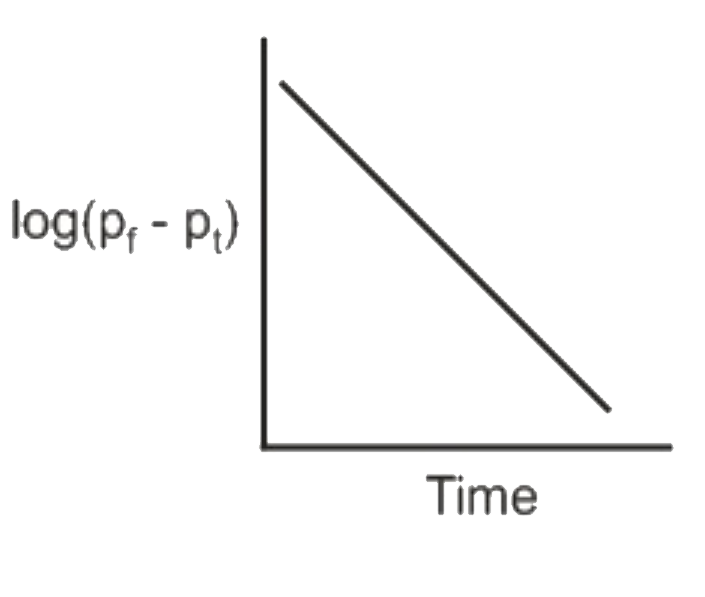
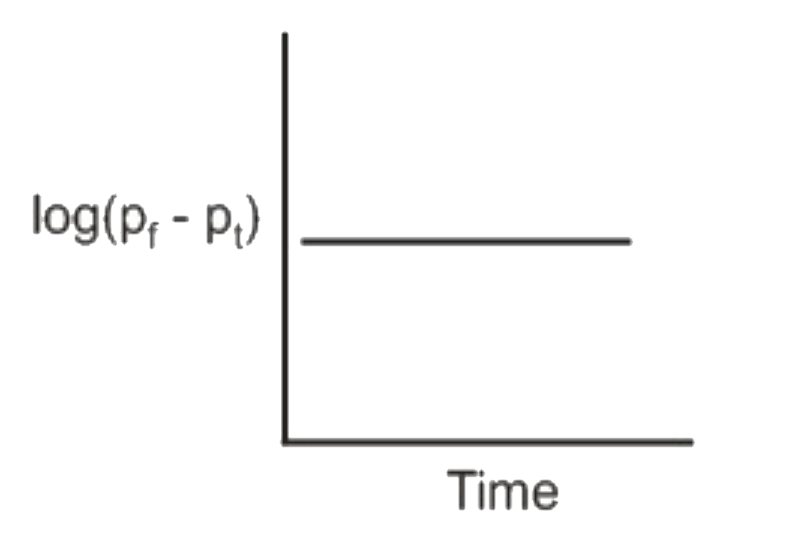
Benene diazonium chloride in aqueous solution decomposes as : `C_6H_5-N=N^(+)Cl_(aq)^(-) +H_2O_(aq)rarrC_6H_5OH_(aq)+N_2(g)+HCl_(aq)` The reaction follows first order kinetics. If `P_t` is the pressure of `N_2` at time t and `P_f` that after completion of the reaction, at constant volume and temperature, then which of the following graphs conforms to the kinetics of the reaction ?

A

B

C

D

Text Solution

AI Generated Solution

The correct Answer is:

To solve the problem regarding the decomposition of benzene diazonium chloride and its kinetics, we will follow these steps: ### Step 1: Understand the Reaction The given reaction is: \[ C_6H_5-N=N^+(Cl^-) + H_2O \rightarrow C_6H_5OH + N_2 + HCl \] This reaction indicates that benzene diazonium chloride decomposes in the presence of water to produce phenol, nitrogen gas, and hydrochloric acid. ### Step 2: Identify the Kinetics The problem states that this reaction follows first-order kinetics. For a first-order reaction, the rate of reaction is directly proportional to the concentration of the reactant. ### Step 3: Write the Integrated Rate Law The integrated rate law for a first-order reaction can be expressed as: \[ k = \frac{2.303}{t} \log \left( \frac{a}{a - x} \right) \] Where: - \( k \) is the rate constant, - \( t \) is the time, - \( a \) is the initial concentration, - \( x \) is the amount reacted. ### Step 4: Relate Pressure to Concentration In this case, we can relate the pressure of nitrogen gas produced to the concentration of the reactant. Let: - \( P_t \) be the pressure of nitrogen at time \( t \), - \( P_f \) be the pressure of nitrogen at the completion of the reaction. The initial pressure \( P_f \) corresponds to the initial concentration of benzene diazonium chloride. As the reaction progresses, the pressure \( P_t \) increases as nitrogen gas is produced. ### Step 5: Substitute into the Rate Law We can express the concentrations in terms of pressures: - \( a \) is proportional to \( P_f \), - \( a - x \) is proportional to \( P_f - P_t \). Thus, we can rewrite the integrated rate law: \[ k = \frac{2.303}{t} \log \left( \frac{P_f}{P_f - P_t} \right) \] ### Step 6: Rearranging the Equation Rearranging gives: \[ \log (P_f - P_t) = -\frac{k}{2.303} t + \log P_f \] This equation is in the form of \( y = mx + b \), where: - \( y = \log (P_f - P_t) \), - \( m = -\frac{k}{2.303} \) (the slope), - \( x = t \), - \( b = \log P_f \) (the y-intercept). ### Step 7: Graph Interpretation The graph of \( \log (P_f - P_t) \) versus time \( t \) will be a straight line with a negative slope, indicating that as time increases, the logarithm of the pressure difference decreases. ### Conclusion The correct graph that represents the kinetics of the reaction will show a straight line with a negative slope when plotting \( \log (P_f - P_t) \) against time \( t \).
Promotional Banner

Similar Questions

Explore conceptually related problems

Complete the following reaction equations : (i) C_(6)H_(5)N_(2)Cl + H_(3)PO_(2) + H_(2)O to (ii) C_(6)H_(5)NH_(2) + Br_(2) (aq.) to

Diazonium salt decomposes as C_(6)H_(5)N_(2)^(o+)Cl^(ɵ) rarrC_(6)H_(5)Cl+N_(2) at 10^(@)C , the evolution of N_(2) becomes two first faster when the initial concentration of the salt is doubled. Thus, it is

The reaction 2N_(2)O_(5)(g) rarr 4NO_(2)(g) is first order w.r.t. N_(2)O_(5) . Which of the following graphs would yield a straight line?

CH_(3)COOC_(2)H_(5)(aq)+H_(2)O(l)overset(H^(+)(aq))toCH_(3)COOH(aq)+C_(2)H_(5)OH(aq) . What type of reaction is this?

Decomposition of NH_(4)NO_(2)(aq into N_(2)(g) and 2H_(2)O(l) is first order reaction.

In the resction 2NH_(4)^(+)+6NO_(3)^(-)(aq)+4H^(+)(aq)rarr 6NO_(2)(g)+N_(2)(g)+6H_(2)O the reducing agent is

Complete the reaction : C_2H_5Cl + KOH(aq) to

The heat liberated in the following reaction H^(+)(aq)+OH^(-)(aq) to H_(2)O(l) is

C_(6) H_(5)N2^+Cl^-overset(Cu_(2)Cl_(2)//HCl)(rarr) , this reaction is named as

Write the equilibrium constant expression for the following reactions : HCl( aq) +H_2O(l) hArr H_3O^(+) +Cl^(-) (aq)
