Home
Class 12
CHEMISTRY
Ten moles of an ideal gas are filled in ...

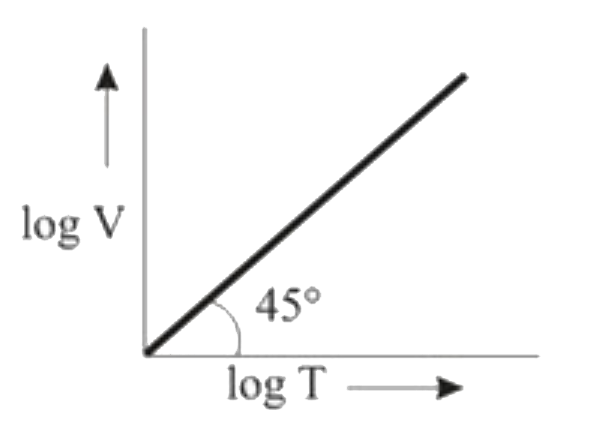
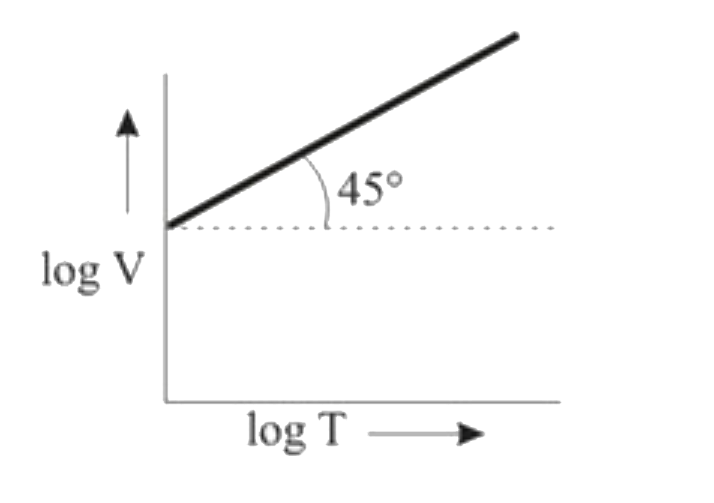
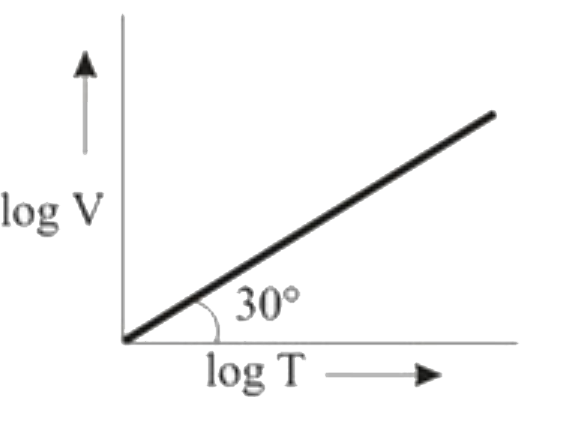
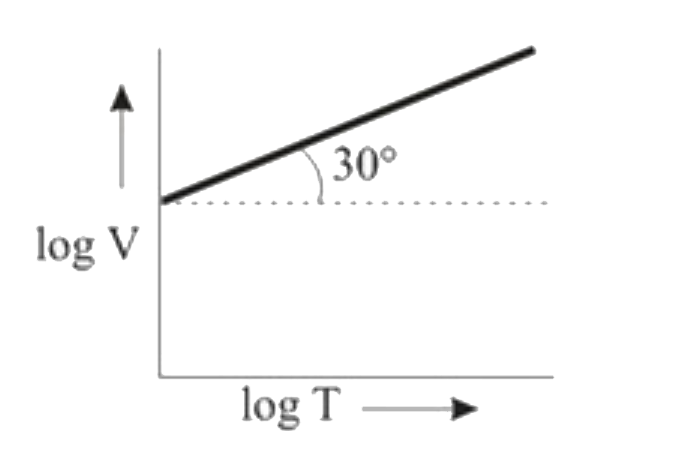
Ten moles of an ideal gas are filled in a closed vessel. The vessel has cylinder and piston type arrangement and pressure of the gas remains constant at 0.821 atm. Which of the following graph represents correct variation of log V vs log T?
(V = Volume in litre and T = temperature in Kelvin)

A

B

C

D

Text Solution

AI Generated Solution

The correct Answer is:

To solve the problem, we need to analyze the relationship between the volume (V) and temperature (T) of an ideal gas under constant pressure using the ideal gas law. Let's break it down step by step: ### Step 1: Understand the Ideal Gas Law The ideal gas law is given by the equation: \[ PV = nRT \] Where: - \( P \) = Pressure - \( V \) = Volume - \( n \) = Number of moles - \( R \) = Ideal gas constant - \( T \) = Temperature in Kelvin ### Step 2: Rearranging the Ideal Gas Law Since the pressure (P) is constant, we can rearrange the ideal gas law to express volume (V) in terms of temperature (T): \[ V = \frac{nRT}{P} \] ### Step 3: Taking the Logarithm To find the relationship between log V and log T, we take the logarithm of both sides: \[ \log V = \log\left(\frac{nRT}{P}\right) \] Using the properties of logarithms, this can be expanded to: \[ \log V = \log(nR) - \log(P) + \log(T) \] ### Step 4: Identifying the Linear Relationship This can be rewritten as: \[ \log V = \left(\log(nR) - \log(P)\right) + \log(T) \] This shows that the graph of \( \log V \) vs. \( \log T \) is a straight line with: - Slope (m) = 1 - Y-intercept (c) = \( \log(nR/P) \) ### Step 5: Calculating the Y-intercept Given: - \( n = 10 \) moles - \( R = 0.0821 \, \text{L atm/(K mol)} \) - \( P = 0.821 \, \text{atm} \) We can calculate the intercept: \[ \log\left(\frac{nR}{P}\right) = \log\left(\frac{10 \times 0.0821}{0.821}\right) \] Calculating the value inside the logarithm: \[ \frac{10 \times 0.0821}{0.821} = 1 \] Thus: \[ \log(1) = 0 \] ### Step 6: Conclusion of the Graph The equation of the line is: \[ \log V = 0 + 1 \cdot \log T \] This indicates that: - The slope is 1 (which corresponds to a 45-degree angle). - The intercept is 0. ### Step 7: Analyzing the Graph Options From the analysis, we can conclude: - The correct graph must have a slope of 1 (45 degrees) and an intercept of 0. - Therefore, options with intercepts not equal to 0 or slopes not equal to 1 are incorrect. ### Final Answer The correct option representing the variation of \( \log V \) vs. \( \log T \) is **Option 1**. ---
Promotional Banner

Similar Questions

Explore conceptually related problems

For a closed container containing 100 mol of an ideal gas fitted with movable, frictionless, weightless piston operating such that pressure of gas remain constant at 8.21 atm, which graph repsents correct variation of log V v//s log T where V is in litre and T is in Kelvin ? (R = 0.0821 (atmL)/(molK))

For a closed container containing 10 moles of an ideal gas, at constant pressure of 0.82 atm, which graph correctly represent, variation of log V us log T where volume is in litre and temp. in kelvin :

Which of the following graphs correctly represents the variation of beta=-(dV//dP)/V with P for an ideal gas at constant temperature?

Which of the following graphs correctly represents the variation of beta= -((dV)/(dP))//V with P for an ideal gas at constant temperature

Which of the following graphs correctly represents the variation of beta=-(dV//dP)/V with P for an ideal gas at constant temperature?

V vs T curves at constant pressure P_1 and P_2 for an ideal gas are shown in the figure. Which of the following is correct?

At time t=0 , some radioactive gas is injected into a sealed vessel. At time T , some more of the same gas is injected into the same vessel. Which one of the following graphs best represents the variation of the logarithm of the activity A of the gas with time t ?

3 moles of an ideal gas are contained within a cylinder by a frictionless piston and are initially at temperature T . The pressure of the gas remains constant while it is heated and its volume doubles . If R is molar gas constant , the work done by the gas in increasing its volume is

The given curve represents the variation of temperature as a function of volume for one mole of an ideal gas. Which of the following curves best represents the variation of pressure as a function of volume?

The given curve represents the variation of temperature as a function of volume for one mole of an ideal gas. Which of the following curves best represents the variation of pressure as a function of volume?
