Home
Class 12
CHEMISTRY
Which graph correctly correlates E("cell...

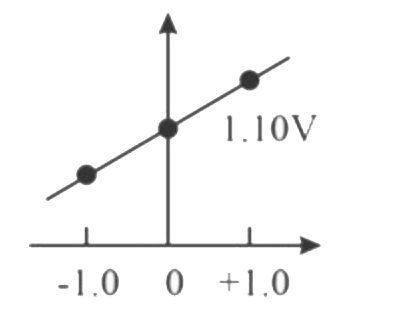
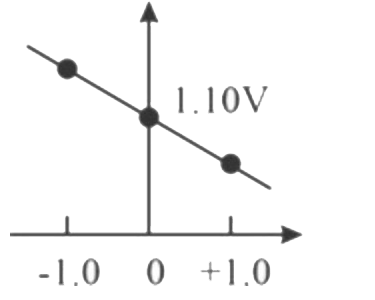
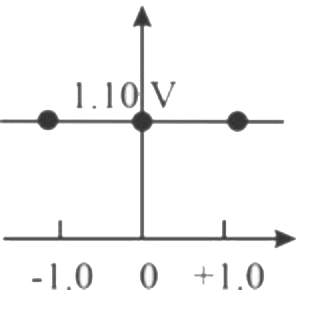
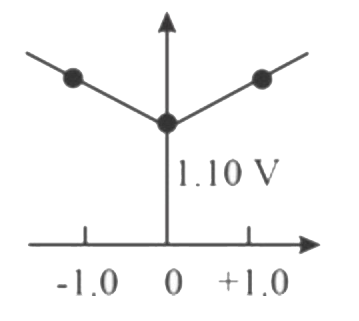
Which graph correctly correlates `E_("cell")` as a function of concentration for the cell (for different values of M nad M' `Zn(s)+Cu^(2+)(M)rarrZn^(2+(M')+Cu(s), E_("cell")^(@)=1.10V`
X - axis : `log_(10).([Zn^(2+)])/([Cu^(2+)]),` Y - axis : `E_("cell")`

A

B

C

D

Text Solution

AI Generated Solution

The correct Answer is:

To solve the problem, we need to determine the relationship between the cell potential \( E_{\text{cell}} \) and the concentrations of the reactants and products in the electrochemical cell reaction given by: \[ \text{Zn}(s) + \text{Cu}^{2+}(M) \rightleftharpoons \text{Zn}^{2+}(M') + \text{Cu}(s) \] with a standard cell potential \( E^\circ_{\text{cell}} = 1.10 \, \text{V} \). ### Step 1: Write the Nernst Equation The Nernst equation relates the cell potential to the concentrations of the reactants and products: \[ E_{\text{cell}} = E^\circ_{\text{cell}} - \frac{0.059}{n} \log \left( \frac{[\text{Zn}^{2+}]}{[\text{Cu}^{2+}]} \right) \] where: - \( E_{\text{cell}} \) is the cell potential under non-standard conditions. - \( E^\circ_{\text{cell}} \) is the standard cell potential. - \( n \) is the number of electrons transferred in the reaction (which is 2 for this reaction). - \( [\text{Zn}^{2+}] \) and \( [\text{Cu}^{2+}] \) are the concentrations of zinc and copper ions, respectively. ### Step 2: Substitute Values into the Nernst Equation Substituting \( n = 2 \) into the Nernst equation gives: \[ E_{\text{cell}} = 1.10 \, \text{V} - \frac{0.059}{2} \log \left( \frac{[\text{Zn}^{2+}]}{[\text{Cu}^{2+}]} \right) \] This simplifies to: \[ E_{\text{cell}} = 1.10 \, \text{V} - 0.0295 \log \left( \frac{[\text{Zn}^{2+}]}{[\text{Cu}^{2+}]} \right) \] ### Step 3: Define the Variables for the Graph In the problem, we are asked to plot \( E_{\text{cell}} \) as a function of \( \log \left( \frac{[\text{Zn}^{2+}]}{[\text{Cu}^{2+}]} \right) \). We can rewrite the equation as: \[ E_{\text{cell}} = 1.10 \, \text{V} - 0.0295 \cdot \log \left( \frac{[\text{Zn}^{2+}]}{[\text{Cu}^{2+}]} \right) \] ### Step 4: Analyze the Graph The equation can be rearranged to the form of a straight line \( y = mx + c \): - \( y \) corresponds to \( E_{\text{cell}} \) - \( m \) (the slope) is negative (\(-0.0295\)) - \( x \) corresponds to \( \log \left( \frac{[\text{Zn}^{2+}]}{[\text{Cu}^{2+}]} \right) \) - \( c \) is the y-intercept (\(1.10 \, \text{V}\)) Since the slope is negative, this indicates that as the logarithm of the concentration ratio increases, the cell potential \( E_{\text{cell}} \) decreases. ### Conclusion The graph that correctly represents this relationship will be a straight line with a negative slope. Therefore, the correct option is **B**, which shows a downward sloping line.
Promotional Banner

Similar Questions

Explore conceptually related problems

Which graph correctly correlates E_(cell) as a function of concentration for the cell Zn(s)+2Ag^+(aq)toZn^(2+)(aq)+2Ag(s), E_(cell)^(@)=1.56V y-axis: E_(cell) , X-axis: log_(10)"([Zn^(2+)])/([Ag^+]^2)

The cell reaction Zn(s) + Cu^(+2)rarr Zn^(+2) + Cu(s) is best represented as :

Calculate the equilibrium constant for the reaction at 298K. Zn(s) +Cu^(2+)(aq) hArr Zn^(2+)(aq) +Cu(s) Given, E_(Zn^(2+)//Zn)^(@) =- 0.76V and E_(Cu^(2+)//Cu)^(@) = +0.34 V

Calculate the equilibrium constant for the reaction at 298K. Zn(s) +Cu^(2+)(aq) hArr Zn^(2+)(aq) +Cu(s) Given, E_(Zn^(2+)//Zn)^(@) =- 0.76V and E_(Cu^(2+)//Cu)^(@) = +0.34 V

Write Nernst equation for the following cell reaction : Zn"|"Zn^(2+)(aq)"||"Cu^(2+)(aq)"|"Cu(s)

Calculate the emf of the following cell at 25^(@)C : Ag(s)| Ag^(+)(10^(-3)M)||Cu^(2+)(10^(-1)M)|Cu(s)" Give "E_("cell")^(@)=-0.46 V and log 10^(n)=n

Calculate the e.m.f. and DeltaG for the cell reaction at 298 K: Mg_((s))"/"Mg_((0.1M))^(2+)"//"Cu_((0.01M))^(2+)"/"Cu_((s)) Given E_("cell")^(@) = -2.71V 1F=96,500C

Calculate the equilibrium constant for the reaction at 298 K Zn(s)+Cu^(2+)(aq)harr Zn^(2+)(aq)+Cu(s) Given " " E_(Zn^(2+)//Zn)^(@)=-0.76 V and E_(Cu^(2+)//Cu)^(@)=+0.34 V

For the redox reaction Zn(s) + Cu^(2+) (0.1M) rarr Zn^(2+) (1M) + Cu(s) that takes place in a cell, E^(o)""_(cell) is 1.10 volt. E_(cell) for the cell will be:

The standard cell potential of: Zn(s) abs( Zn^(2+) (aq) )abs( Cu^(2+) (aq)) Cu (s) cell is 1.10 V The maximum work obtained by this cell will be
