Home
Class 12
CHEMISTRY
Mg(s)|Mg^(2+)(aq)||Zn^(2+)(aq)|Zn(s),E^(...

`Mg(s)|Mg^(2+)(aq)||Zn^(2+)(aq)|Zn(s),E^(@)=+3.13V`
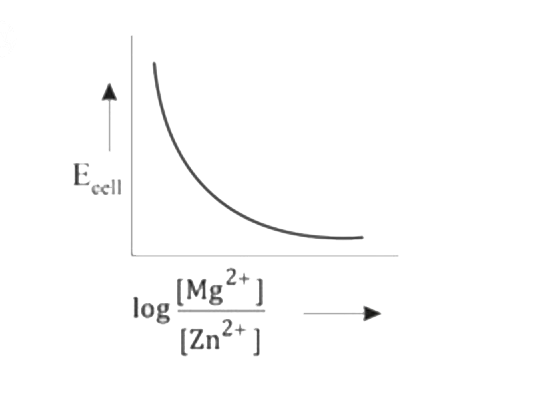
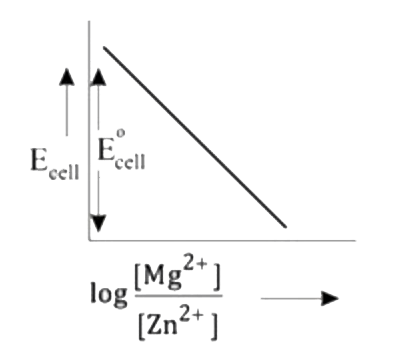
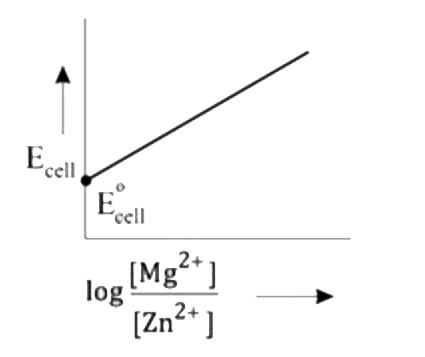
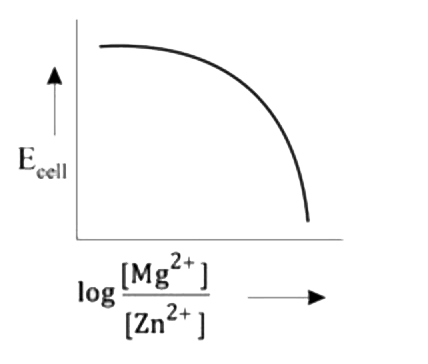
The correct plot of `E_("cell")` versus `log.([Mg^(2+)])/([Zn^(2+)])` will be represented as

A

B

C

D

Text Solution

AI Generated Solution

The correct Answer is:

To solve the problem, we need to analyze the given electrochemical cell and apply the Nernst equation to determine how the cell potential (E_cell) varies with the logarithm of the concentration ratio of magnesium ions to zinc ions. ### Step-by-Step Solution: 1. **Identify the Cell Reaction**: The cell is represented as: \[ \text{Mg(s)} | \text{Mg}^{2+}(aq) || \text{Zn}^{2+}(aq) | \text{Zn(s)} \] The half-reactions are: - Oxidation: \(\text{Mg} \rightarrow \text{Mg}^{2+} + 2e^-\) - Reduction: \(\text{Zn}^{2+} + 2e^- \rightarrow \text{Zn}\) 2. **Write the Overall Cell Reaction**: The overall cell reaction can be written as: \[ \text{Mg} + \text{Zn}^{2+} \rightarrow \text{Mg}^{2+} + \text{Zn} \] 3. **Apply the Nernst Equation**: The Nernst equation for the cell potential is given by: \[ E_{cell} = E^\circ_{cell} - \frac{0.0591}{n} \log \left( \frac{[\text{Mg}^{2+}]}{[\text{Zn}^{2+}]}\right) \] Where: - \(E^\circ_{cell} = +3.13 \, \text{V}\) (given) - \(n = 2\) (number of electrons transferred) 4. **Substitute Values into the Nernst Equation**: Substituting the values into the Nernst equation: \[ E_{cell} = 3.13 - \frac{0.0591}{2} \log \left( \frac{[\text{Mg}^{2+}]}{[\text{Zn}^{2+}]}\right) \] Simplifying gives: \[ E_{cell} = 3.13 - 0.02955 \log \left( \frac{[\text{Mg}^{2+}]}{[\text{Zn}^{2+}]}\right) \] 5. **Identify the Plot Characteristics**: - On the y-axis, we have \(E_{cell}\). - On the x-axis, we have \(\log \left( \frac{[\text{Mg}^{2+}]}{[\text{Zn}^{2+}]}\right)\). - The slope of the line is negative (\(-0.02955\)), indicating that as the log ratio increases, the cell potential decreases. 6. **Determine the Correct Plot**: Since the slope is negative, the correct plot of \(E_{cell}\) versus \(\log \left( \frac{[\text{Mg}^{2+}]}{[\text{Zn}^{2+}]}\right)\) will be a straight line with a negative slope. ### Conclusion: The correct option for the plot of \(E_{cell}\) versus \(\log \left( \frac{[\text{Mg}^{2+}]}{[\text{Zn}^{2+}]}\right)\) is the one that shows a negative slope, which corresponds to option 2.
Promotional Banner

Similar Questions

Explore conceptually related problems

The cell reaction Zn(s) + Cu^(+2)rarr Zn^(+2) + Cu(s) is best represented as :

For the galvanic cell Mg(s)|Mg^(2+)(aq)||Zn^(2+)(aq)|Zn(s) ,the standard free energy change is ( Given:E_((mg^(2+))/(mg))^@= -2.36 V,E_((Zn^(2+))/(Zn))^@= -0.76 V)

For the galvanic cell Zn(s)abs(Zn^(2+) ) abs(Cd^(2+)) Cd(s),E_(cell ) = 0.30 V and E_(cell)^(o) = 0.36 V, then value of [Cd^(2+)]//[Zn^(2+)] will be:

Zn(s) + Cu^(2+)(aq) rarr Zn^(2+)(aq) + Cu(s) The cell representation for the above redox reaction is

Calculate the emf of the cell. Mg(s)|Mg^(2+) (0.2 M)||Ag^(+) (1xx10^(-3))|Ag E_(Ag^(+)//Ag)^(@)=+0.8 volt, E_(Mg^(2+)//Mg)^(@)=-2.37 volt What will be the effect on emf If concentration of Mg^(2+) ion is decreased to 0.1 M ?

The standard electrode potential of the half cells are given below : Zn^(2+)+ 2e^(-) rarr Zn(s), E^(o) = - 7.62 V Fe^(2+) + 2e^(-) rarr Fe(s) , E^(o) = -7 .81 V The emf of the cell Fe^(2+) + Zn rarr Zn^(2+) + Fe will be :

If E_((Mg)/(Mg^2+))^0 = +2.37 and E_((Cu)/(Cu^2+))^0 = -0.34 V then standard EMF of the cell, (Mg)/(Mg^(2+))/(Cu^(2+))/(Cu) is

Zn+Cu^(2+)(aq)toCu+Zn^(2+)(aq) . Reaction quotient is Q=([Zn^(2+)])/([Cu^(2+)])*E_(cell)^(@)=1.10V ltb rgt E_(cell) will be 1.1591 V when :

The equilibrium constant for the reaction Sr(s)+Mg^(+2)(aq)rarr Sr^(+2)(aq)+Mg(s) "is" 2.69xx10^(12)at25^(@)C "The" E^(@) for a cel made up of Sr//Sr^(+2) and Mg^(+2)//Mg half cells is

For the electrochemical cell, Mg(s)|Mg^(2+) (aq. 1M)||Cu^(2+) (aq. 1M)|Cu(s) the standard emf of the cell is 2.70 V at 300 K. When the concentration of Mg^(2+) is chaged to x M, the cell potential changes to 2.67 V at 300 K. The value of x is ________ . (Given F/R=11500 kV^(-1) . where F is the Faraday constant and R is the gas constant, ln (10) = 2.30)
