Animal cells are suspended in a culture medium that contains excess glucose. The graph below shows glucose utilisation under different growth conditions (A),(B), and (C) in the graph indicate
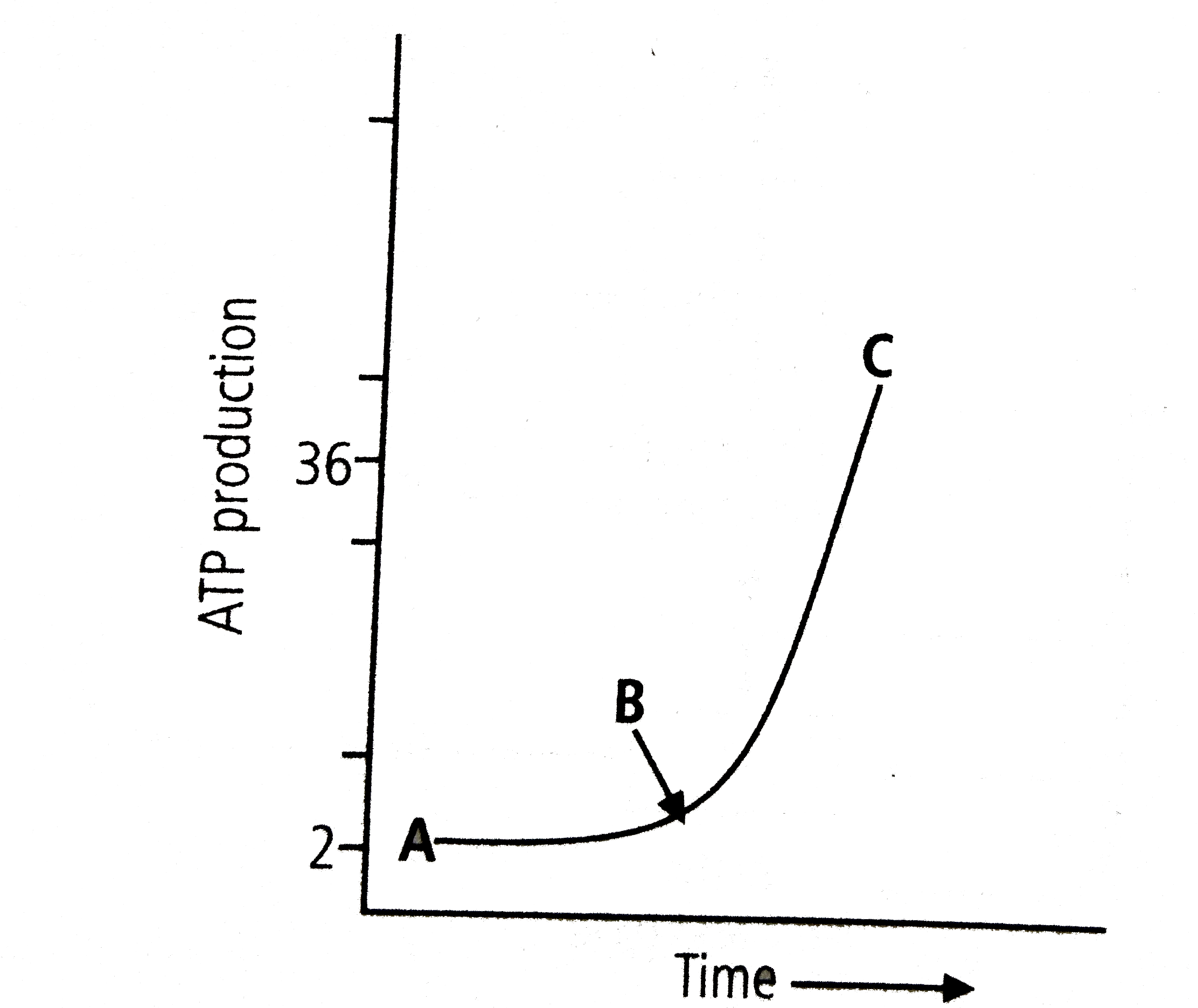
Animal cells are suspended in a culture medium that contains excess glucose. The graph below shows glucose utilisation under different growth conditions (A),(B), and (C) in the graph indicate
A
X – Anaerobic respiration
Y - Introduction of `O_2` to the culture medium
Z - Aerobic respiration
Y - Introduction of `O_2` to the culture medium
Z - Aerobic respiration
B
X – Anaerobic respiration
Y - Introduction of `CO_2` to the culture medium
Z - Aerobic respiration
Y - Introduction of `CO_2` to the culture medium
Z - Aerobic respiration
C
X – Anaerobic respiration
Y - Supply of organic triphosphate
Z - Aerobic respiration
Y - Supply of organic triphosphate
Z - Aerobic respiration
D
X – Anaerobic respiration
Y - Introduction of CO to the culture medium
Z - Aerobic respiration
Y - Introduction of CO to the culture medium
Z - Aerobic respiration
Text Solution
Verified by Experts
The correct Answer is:
A



Similar Questions
Explore conceptually related problems
A mass of living cells are kept in a culture medium under anaerobic conditions. The cells were supplied with labelled c^14 glucose. Pick up the true statement
An animal cell was grown in a culture medium containing P^(32) nucleotides, the parts from which DNA is built. Later examination of the cell showed the radioactivity to be concentrated in the
The diagram below-shows features of an animal cell as seen under electron microscope : What is the relationship of E and C?
The diagram below-shows features of an animal cell as seen under electron microscope : Name the structure B.
Figure shows the relationship between tensile stress and strain for a typical material. Below proportional point A, stress is directly proportional to strain which means Young's moudulus (Y) is a constant. In this region the material obeys Hooke's law. Provided the strain is below the yield point 'B' the material returns to its original shape and size when the force is removed. Beyond the yield point, the material retains a permancnt deformation after the stress is removed. For stresses beyond the yeld point, the material exhibit plastic flow, which means that it continues to elongate for little increases in the stress. Beyond C a local constriction occurs. The material fractures at D (i.e. breaking point). The graph below shows the stress-strain curve for 4 different materials. If you bough a new shoe which bites in the beginning and later on fits perfectly, then the material used to making the shoe is
Figure shows the relationship between tensile stress and strain for a typical material. Below proportional point A, stress is directly proportional to strain which means Young's moudulus (Y) is a constant. In this region the material obeys Hooke's law. Provided the strain is below the yield point 'B' the material returns to its original shape and size when the force is removed. Beyond the yield point, the material retains a permancnt deformation after the stress is removed. For stresses beyond the yeld point, the material exhibit plastic flow, which means that it continues to elongate for little increases in the stress. Beyond C a local constriction occurs. The material fractures at D (i.e. breaking point). The graph below shows the stress-strain curve for 4 different materials. Material which is good for making wires by stretching is
Figure shows the relationship between tensile stress and strain for a typical material. Below proportional point A, stress is directly proportional to strain which means Young's moudulus (Y) is a constant. In this region the material obeys Hooke's law. Provided the strain is below the yield point 'B' the material returns to its original shape and size when the force is removed. Beyond the yield point, the material retains a permancnt deformation after the stress is removed. For stresses beyond the yeld point, the material exhibit plastic flow, which means that it continues to elongate for little increases in the stress. Beyond C a local constriction occurs. The material fractures at D (i.e. breaking point). The graph below shows the stress-strain curve for 4 different materials. If you bough a new shoe which bites in the beginning and later on fits perfectly, then the material used to making the shoe is
Figure shows the relationship between tensile stress and strain for a typical material. Below proportional point A, stress is directly proportional to strain which means Young's moudulus (Y) is a constant. In this region the material obeys Hooke's law. Provided the strain is below the yield point 'B' the material returns to its original shape and size when the force is removed. Beyond the yield point, the material retains a permancnt deformation after the stress is removed. For stresses beyond the yeld point, the material exhibit plastic flow, which means that it continues to elongate for little increases in the stress. Beyond C a local constriction occurs. The material fractures at D (i.e. breaking point). The graph below shows the stress-strain curve for 4 different materials. If you bough a new shoe which bites in the beginning and later on fits perfectly, then the material used to making the shoe is
Three colonies of insects were each treated with a different pesticide over an 8-week period to test the effectiveness of the three pesticides. Colonies A, B, and C were treated with Pesticides A, B, and C, respectively. Each pesticide was applied every 2 weeks to one of the three colonies over the 8-week period. The bar graph above shows the insect counts for each of the three colonies 0, 2, 4, 6, and 8 weeks after the initial treatment. Which of the following colonies showed a decrease in size every two weeks after the initial treatment with pesticide? I.Colony A II.Colony B III. Colony C
Three colonies of insects were each treated with a different pesticide over an 8-week period to test the effectiveness of the three pesticides. Colonies A, B, and C were treated with Pesticides A, B, and C, respectively. Each pesticide was applied every 2 weeks to one of the three colonies over the 8-week period. The bar graph above shows the insect counts for each of the three colonies 0, 2, 4, 6, and 8 weeks after the initial treatment. Of the following, which is closest to the ratio of the total number of insects in all three colonies in week 8 to the total number of insects at the time of initial treatment?
Recommended Questions
- Animal cells are suspended in a culture medium that contains excess gl...
Text Solution
|
- Animal cells are suspended in a culture medium that contains excess gl...
Text Solution
|
- The urine under normal conditions does not contain glucose because
Text Solution
|
- A mass of living cells are kept in a culture medium under anaerobic co...
Text Solution
|
- Condition of excessive glucose excreted in urine.
Text Solution
|
- किसी कोशिका की वृद्धि दर का समय के साथ सम्बन्ध प्रदर्शित करने वाले ग्र...
Text Solution
|
- Illustrate the velocity-time graph under different conditions.
Text Solution
|
- Illustrate the acceleration-time graph under different conditions.
Text Solution
|
- किसी कोशिका में ग्लूकोज के अंतर्ग्रहण की दर को ग्राफ में दर्शाया गया ह...
Text Solution
|