Home
Class 12
CHEMISTRY
Perovaskite, a mineral containing calciu...

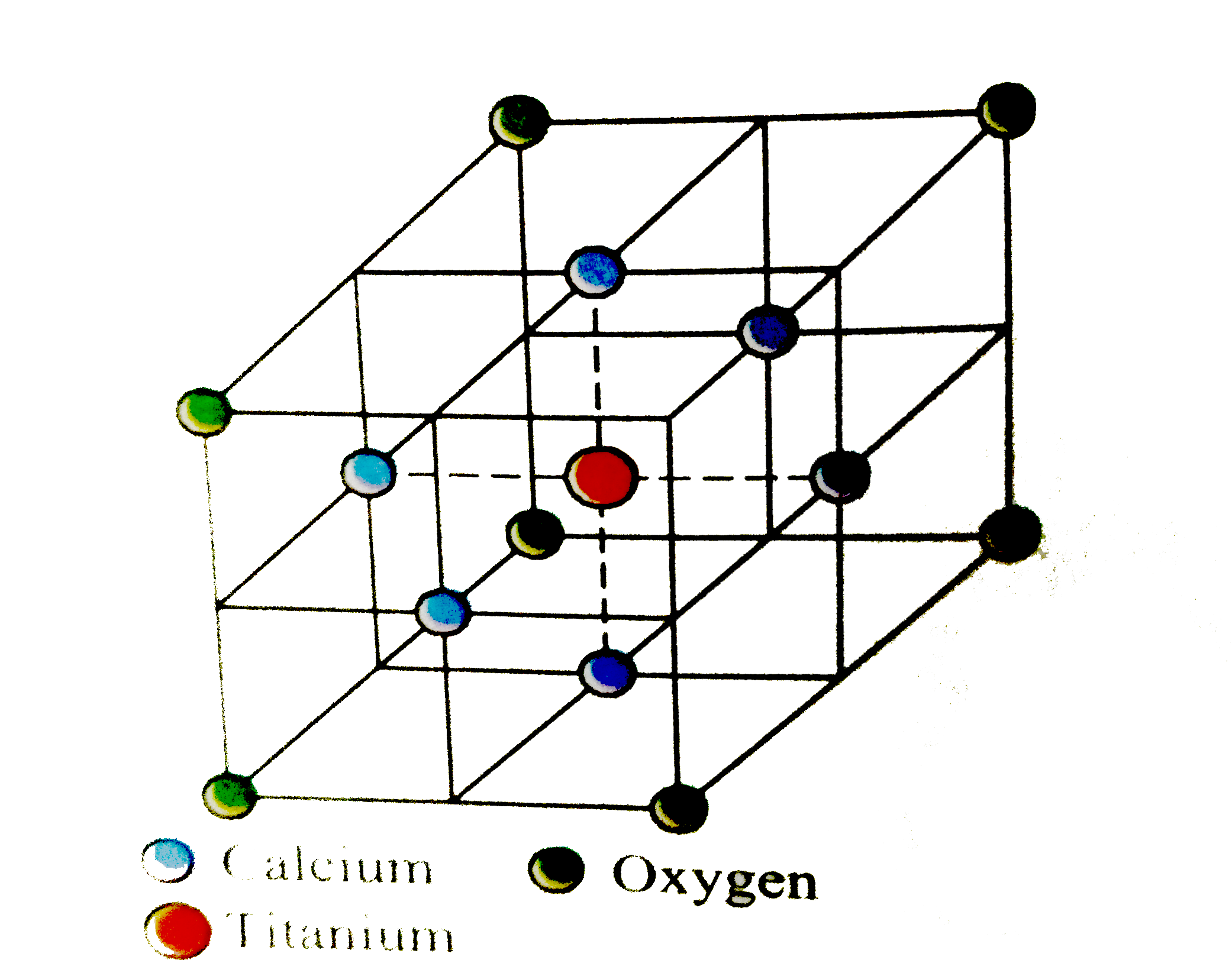
Perovaskite, a mineral containing calcium, oxygen `&` titanium crystallizes in the given unit cell

The oxidation number of titanium in the perovskite is

A

`+2`

B

`+3`

C

`+4`

D

`+1`

Text Solution

Verified by Experts

The correct Answer is:

C
Promotional Banner

Similar Questions

Explore conceptually related problems

A mineral containing calcium, oxygen and titanius crystallises in a given cubic unit cell. What is the formula of the mineral?

Perovskite is a mineral composed of Ca, Ti and oxygen, cations of titanium lie at the centre, oxides ions at the face centres and calcium ions lie at corners. In this compound the oxidation number of Titanium is +x . Find the value of x?

In sc, bcc and fcc the ratio of number of atoms per unit cell is given by

The mineral rutile is an oxide of titanium containing 39.35% oxygen and is isomorphous with cassiterite (SnO_(2)) . The atomic weight of titanium is

Calculate the packing fraction for the Ca unit cell, given that Ca crystallizes in a face-centered cubic unit cell.

The number of atoms contained in a fcc unit cell of a monoatomic substance is

For a crystal of sodium chloride, state: (i) The type of lattice in which it crystallizes. (ii) The coordination number of each sodium ion and chloride ion in the crystal lattice. (iii) The number of sodium ions and chloride ions present in a unit cell of sodium chloride. (iv) The structural arrangement of the sodium chloride crystal.

Paramagnetism is a property due to the presence of unpaired electrons. In case of transition metals, as they contain unpaired electrons in the (n-1) d orbitals , most of the transition metal ions and their compounds are paramagnetic. Para magnetism increases with increases in number of unpaired electrons. Magnetic moment is calculated from 'spin only formula' Vz mu=sqrt(n(n+2)) B.M n="number of unpaired electrons" Similarly the colour of the compounds of transition metals may be attributed to the presence of incomplete (n-1) d sub-shell. When an electron from a lower energy of d-orbitals is excited to a higher energy d-orbital, the energy of excitation corresponds to the frequency of light absorbed. This frequency generally lies in the visible region. The colour observed corresponds to complementary colour of the light observed. The frequency of the light absorbed is determined by the nature of the ligand. Titanium shows magnetic moments of 1.73 BM in its compound. What is the oxidation state of titanium in the compound?

The number of NaCl molecules in unit cell of its crystal is

Na and Mg crystallize in bcc- and fcc-type crystals, the ratio of number of atoms present in the unit cell of their respective crystal is
