Home
Class 12
CHEMISTRY
Which of these carbocation will undergo ...

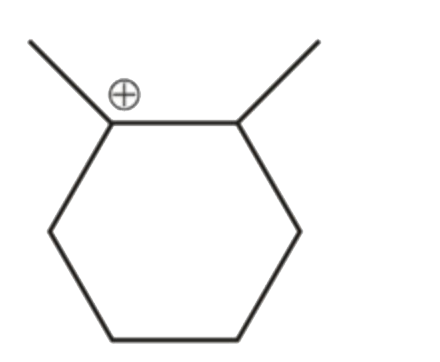
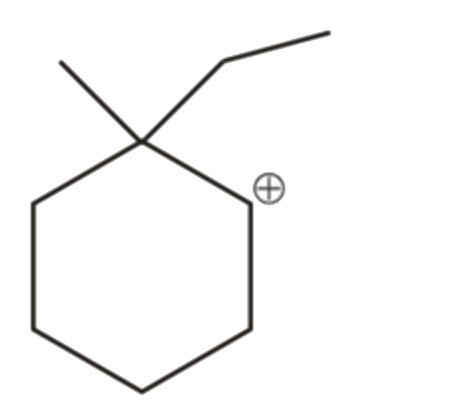
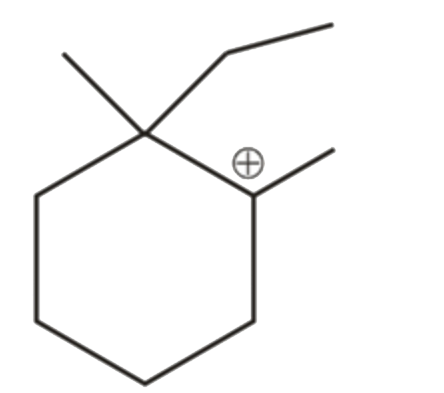
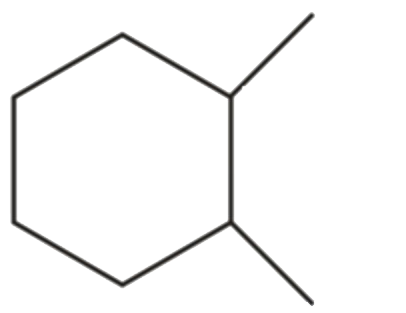
Which of these carbocation will undergo favourable rearrangement?

A

B

C

D

Text Solution

AI Generated Solution

The correct Answer is:

To determine which carbocation will undergo favorable rearrangement, we need to analyze the stability of the carbocations involved and see if rearrangement leads to a more stable structure. Here’s a step-by-step solution: ### Step 1: Understand Carbocation Stability Carbocations are classified based on the number of alkyl groups attached to the positively charged carbon: - **Tertiary (3°) carbocation**: More stable due to hyperconjugation and inductive effects from three alkyl groups. - **Secondary (2°) carbocation**: Less stable than tertiary but more stable than primary. - **Primary (1°) carbocation**: Least stable. ### Step 2: Identify the Carbocations Assume we have several carbocations to analyze: 1. **Tertiary Carbocation (3°)** 2. **Secondary Carbocation (2°) with one methyl and one ethyl group** 3. **Tertiary Carbocation (3°)** 4. **Secondary Carbocation (2°)** ### Step 3: Analyze Each Carbocation for Rearrangement 1. **First Carbocation (Tertiary)**: - Already a tertiary carbocation. - Rearrangement will not lead to increased stability (remains tertiary). - **Conclusion**: No favorable rearrangement. 2. **Second Carbocation (Secondary with Methyl and Ethyl)**: - This is a secondary carbocation. - If a methyl or ethyl group migrates, it can become a tertiary carbocation. - **Conclusion**: This carbocation will undergo favorable rearrangement due to increased stability. 3. **Third Carbocation (Tertiary)**: - Similar to the first, it is already a tertiary carbocation. - Rearrangement will not lead to increased stability. - **Conclusion**: No favorable rearrangement. 4. **Fourth Carbocation (Secondary)**: - This is also a secondary carbocation. - Rearrangement does not lead to a more stable structure (remains secondary). - **Conclusion**: No favorable rearrangement. ### Step 4: Final Conclusion The only carbocation that will undergo favorable rearrangement is the **second carbocation**, as it can rearrange to form a more stable tertiary carbocation. ### Summary The carbocation that will undergo favorable rearrangement is the **second one**, which is a secondary carbocation that can rearrange to a tertiary carbocation. ---
Promotional Banner

Similar Questions

Explore conceptually related problems

Which of the following carbocation can not undergo rearrangement ?

Which of the following carbocations would not likely rearrange to more stable carbocation ?

Which of the following carbocation is most stable?

Which of the following carbocation is most stable

Which of the following carbocations is most stable ?

Which of the following carbocations is most stable ?

Which of the following carbocations is least stable ?
