Home
Class 12
CHEMISTRY
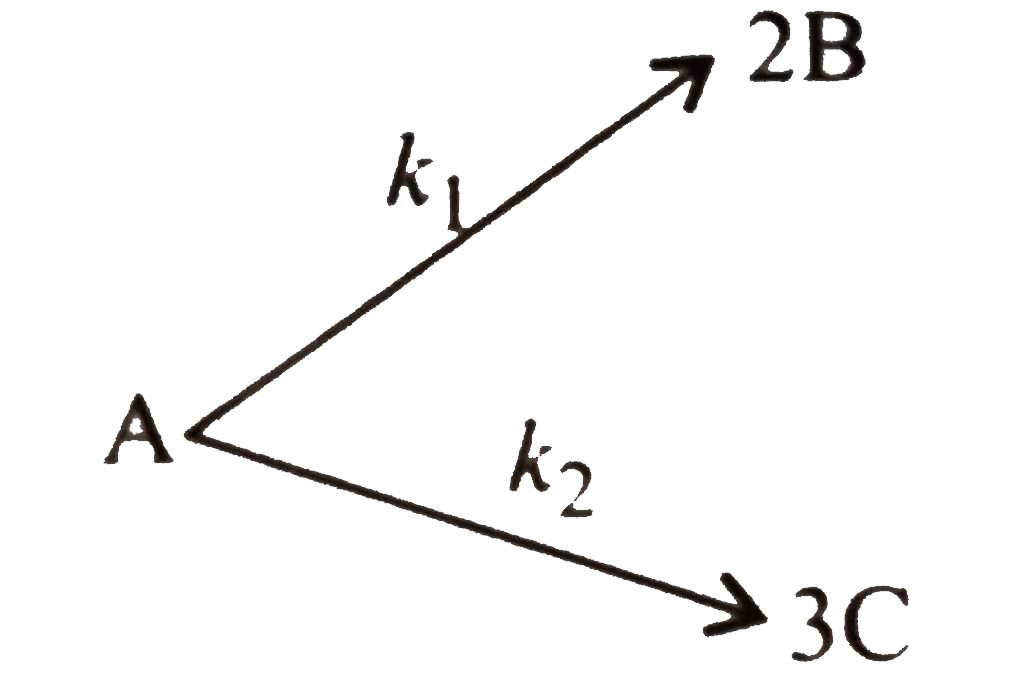
Consider the following parallel reaction...

Consider the following parallel reactions being given by `A(t_(1//2) = 1.386 xx 10^(2) hours)`, each path being first order.

If the distribution of `B` in the Product mixture is `50%`, the partical half life of `A` for converison into `B` is

A

346.5 h

B

231 h

C

154 h

D

92.4 h

Text Solution

Verified by Experts

The correct Answer is:

B
Promotional Banner

Similar Questions

Explore conceptually related problems

In a first order reaction A to B, if k is rate constant and initial concentration of the reactant A is 2 M then the half life of the reaction is:

A first order gas reaction has k = 1.5 xx 10^(-6) s^(-1) at 200^(@)C . If the reaction is allowed to run for 10 h , what have changed in the Product? What is the half-life of this reaction?

For a reaction, A+Brarr Product, the rate law is given by r=k[A]^((1)/(2))[B]^(2) . What is the order of the reaction ?

A graph between log t_((1)/(2)) and log a (abscissa), a being the initial concentration of A in the reaction For reaction Ato Product, the rate law is :

A graph between log t_((1)/(2)) and log a (abscissa), a being the initial concentration of A in the reaction For reaction Ato Product, the rate law is :

Half life ( t_1 ) of the first order reaction and half life ( t_2 ) of the 2 ""^(nd) order reaction are equal. If initial concentration of reactants in both reaction are same then ratio of the initial rate of the reaction

For the following elementary first order reaction: If k_(2)=2k_(1) , then % of B in overall product is:

The rate law of reaction A+2Bto product given by r=K(A)^(2)(B)^(1) . If A is taken in excess the order of the reaction will be :-

(a) For a reaction ABrarrP , the rate law is given by, r=k[A]^(1//2)[B]^(2). What is the order of this reaction? (b) A first order reaction is found to have a rate constant k=5.5xx10^(-14)s^(-1) , Find the half life of the reaction.

The rate of first order reaction is 1.5 xx 10^(-2) mol L^(-1) min ^(-1) at 0.5 M concentration of the reactant. The half-life of the reaction is
