Home
Class 12
PHYSICS
A particle is placed at the origin and a...

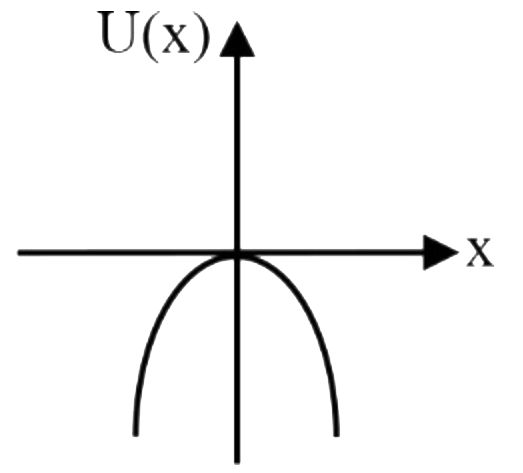
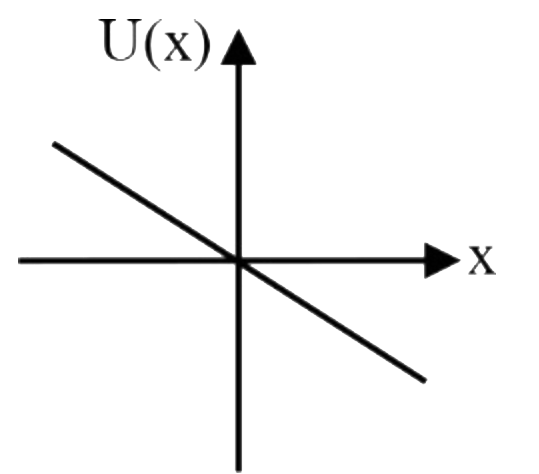
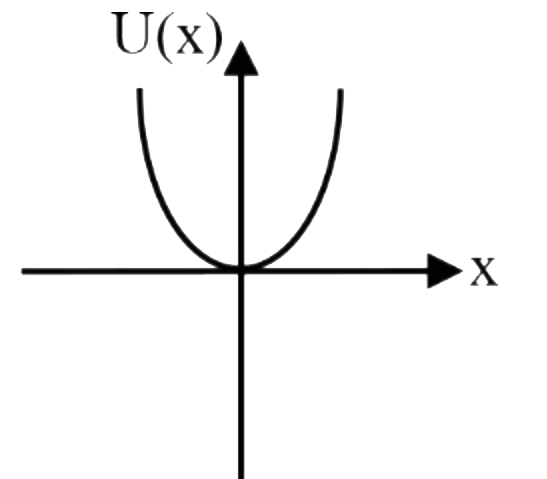
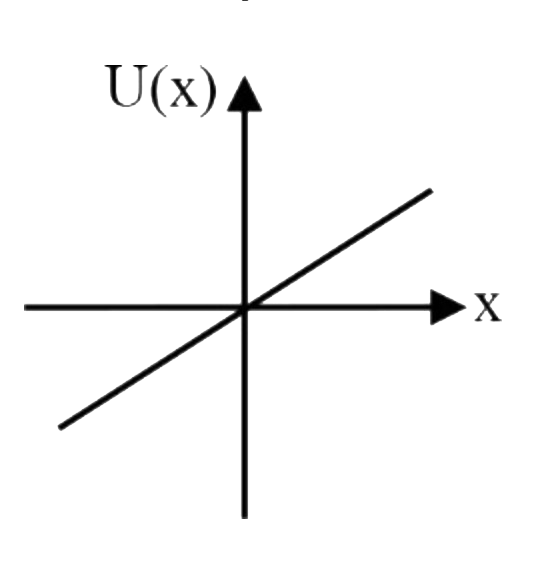
A particle is placed at the origin and a force F=Kx is acting on it (where k is a positive constant). If `U_((0))=0`, the graph of `U (x)` verses x will be (where U is the potential energy function.)

A

B

C

D

Text Solution

AI Generated Solution

The correct Answer is:

To solve the problem, we need to find the potential energy function \( U(x) \) given the force \( F = kx \), where \( k \) is a positive constant. We know that the force is related to the potential energy by the equation: \[ F = -\frac{dU}{dx} \] ### Step 1: Relate Force to Potential Energy Given the force \( F = kx \), we can substitute this into the equation: \[ kx = -\frac{dU}{dx} \] ### Step 2: Rearranging the Equation Rearranging the equation gives us: \[ \frac{dU}{dx} = -kx \] ### Step 3: Integrate to Find Potential Energy Now, we need to integrate both sides with respect to \( x \): \[ dU = -kx \, dx \] Integrating both sides: \[ U = -\frac{1}{2} kx^2 + C \] ### Step 4: Determine the Constant of Integration We are given that \( U(0) = 0 \). Plugging in \( x = 0 \): \[ U(0) = -\frac{1}{2} k(0)^2 + C = 0 \implies C = 0 \] Thus, the potential energy function simplifies to: \[ U(x) = -\frac{1}{2} kx^2 \] ### Step 5: Analyze the Graph of \( U(x) \) The equation \( U(x) = -\frac{1}{2} kx^2 \) represents a downward-opening parabola. The vertex of this parabola is at the origin (0,0), and as \( x \) moves away from the origin in either direction, \( U(x) \) becomes more negative. ### Conclusion The graph of \( U(x) \) versus \( x \) is a downward-opening parabola symmetrical about the \( U \)-axis with the vertex at the origin.
Promotional Banner

Similar Questions

Explore conceptually related problems

On a particle placed at origin a variable force F=-ax (where a is a positive constant) is applied. If U(0)=0, the graph between potential energy of particle U(x) and x is best represented by:-

A particle of mass m is executing osciallations about the origin on the x-axis with amplitude A. its potential energy is given as U(x)=alphax^(4) , where alpha is a positive constant. The x-coordinate of mass where potential energy is one-third the kinetic energy of particle is

A particle, which is constrained to move along x-axis, is subjected to a force in the some direction which varies with the distance x of the particle from the origin an F (x) =-kx + ax^(3) . Here, k and a are positive constants. For x(ge0, the functional form of the potential energy (u) U of the U (x) the particle is. (a) , (b) , (c) , (d) .

The potential energy U for a force field vec (F) is such that U=- kxy where K is a constant . Then

The potential energy of configuration changes in x and y directions as U=kxy , where k is a positive constant. Find the force acting on the particle of the system as the function of x and y.

A particle is acted by x force F = Kx where K is a( + ve) constant its potential energy at x = 0 is zero . Which curve correctly represent the variation of potential energy of the block with respect to x

A particle free to move along x-axis is acted upon by a force F=-ax+bx^(2) whrte a and b are positive constants. , the correct variation of potential energy function U(x) is best represented by.

A particle moving along the X-axis executes simple harmonic motion, then the force acting on it is given by where, A and K are positive constants.

A particle of mass m moves in a one dimensional potential energy U(x)=-ax^2+bx^4 , where a and b are positive constant. The angular frequency of small oscillation about the minima of the potential energy is equal to

The potential energy function for a particle executing linear SHM is given by V(x)= 1/2kx^2 where k is the force constant of the oscillator. For k = 0.5 Nm^(-1) , the graph of V(x) versus x is shown in the figure A particle of total energy E turns back when it reaches x=pmx_m .if V and K indicate the potential energy and kinetic energy respectively of the particle at x= +x_m ,then which of the following is correct?
