Home
Class 12
PHYSICS
Two identical capacitors A and B of capa...

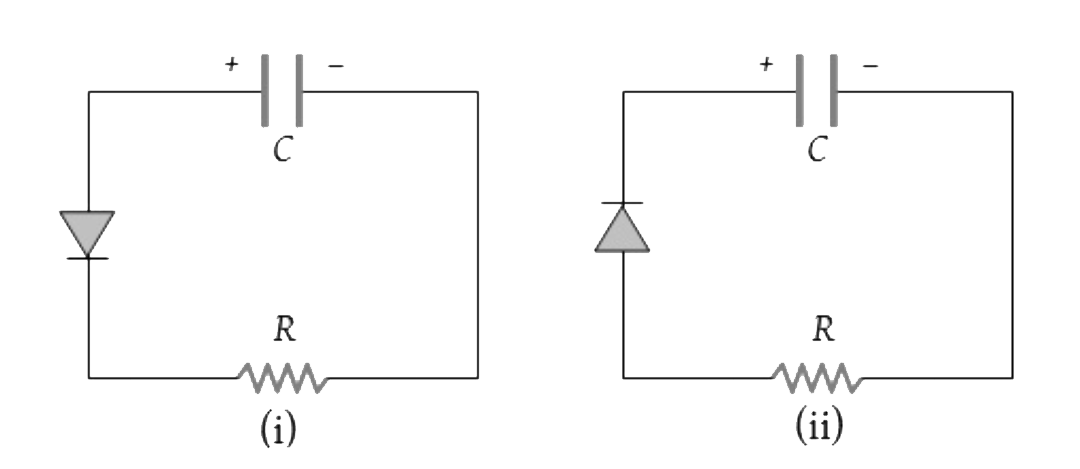
Two identical capacitors A and B of capacitance C each, are charged to the same potential V and are connected in two circuits at t = 0, as shown in the figure (i) and (ii) respectively. The charge on the capacitors at time t = CR are respectively

A

VC, VC

B

`(VC)/e, VC`

C

`VC, (VC)/e`

D

`(VC)/e, (VC)/e`

Text Solution

Verified by Experts

The correct Answer is:

B
Promotional Banner

Similar Questions

Explore conceptually related problems

Two identical capacitors A and B are charged to the same potential V and are connected in two circuits at t = 0 as shown in figure. The charge of the capacitors at a time t = CR are respectively -

Two identical capacitors A and B are charged to the same potential V and are connected in two circuits at t=0 as shown in figure.The charges on the capacitor at a time t=CR are, respectively, A. VC,VC B. VC/e,VC C. VC,VC/e D. VC/e,VC/e

Two identical capacitor A and B, charged to the same potential 5V are connected in two different circuits as shown below at time t=0. t=CR is Q_(A) and Q_(B) respectively, then (Here e is the base of natureal logarithm)

In the circuit shown , the charges on the capacitors A and B are respectively

Three capacitors A,B and C are connected in a circuit as shown in figure. What is the charge in muC on the capacitor B?

Two capacitor each of capacitance C = 1 muF each charged to potential 100 V and 50 V respectively and connected across a uncharged capacitor 'C' = 1muF as shown in the figure if switch 'S' is closed then charge in the uncharged capacitor at equilibrium will be

There is no resistance in the capacitive circuit shown. Then charge on the capacitor at an time t

Two capacitors of 10muF and 20 muF are connected in series with a 30 V battery. The charge on the capacitors will be, respectively

Two identical capacitors A and B are charged to the same potential and then made to discharge through resistances R_(A) and R_(B) respectively, with R_(A) gt R_(B) .

Two capacitors C_(1) and C_(2) are charged to same potential V , but with opposite polarity as shown in the figure. The switches S_(1) and S_(2) are then closed
