Home
Class 12
PHYSICS
The mass density of a spherical body is ...

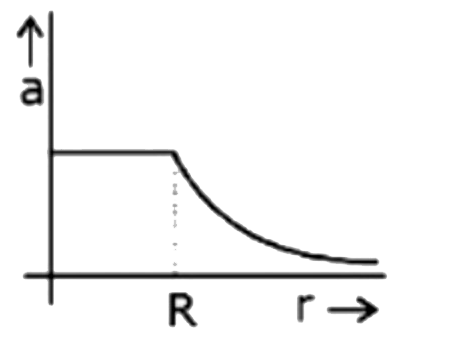
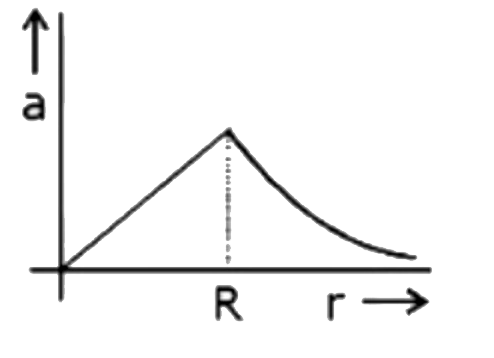
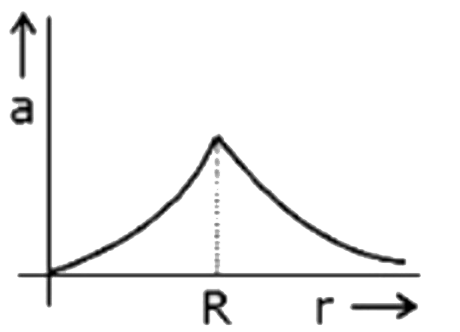
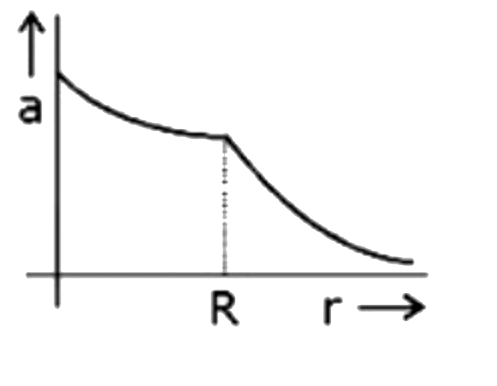
The mass density of a spherical body is given by `rho(r)=k/r` for `r le R` and `rho (r)=0`for r > R , where r is the distance from the centre. The correct graph that describes qualitatively the acceleration, a, of a test particle as a function of r is :

A

B

C

D

Text Solution

Verified by Experts

The correct Answer is:

A
Promotional Banner

Similar Questions

Explore conceptually related problems

Find the gravitational potential due to a spherical shell of mass M and radius R at r lt R and r gt R , where r is the distance from the centre of the shell.

Let there be a spherical symmetric charge density varying as p(r )=p_(0)(r )/(R ) upto r = R and rho(r )=0 for r gt R , where r is the distance from the origin. The electric field at on a distance r(r lt R) from the origin is given by -

The density inside a solid sphere of radius a is given by rho=rho_0/r , where rho_0 is the density at the surface and r denotes the distance from the centre. Find the gravitational field due to this sphere at a distance 2a from its centre.

The potential energy function of a particle is given by U(r)=A/(2r^(2))-B/(3r) , where A and B are constant and r is the radial distance from the centre of the force. Choose the correct option (s)

Let there be a spherically symmetric charge distribution with charge density varying as rho(r)=rho(5/4-r/R) upto r=R , and rho(r)=0 for rgtR , where r is the distance from the origin. The electric field at a distance r(rltR) from the origin is given by

The density inside a solid sphere of radius a is given by rho=rho_0/r , where rho_0 is the density ast the surface and r denotes the distance from the centre. Find the graittional field due to this sphere at a distance 2a from its centre.

The mass density of a spherical galaxy varies as (K)/(r) over a large distance 'r' from its centre . In that region , a small star is in a circular orbit of radius R . Then the period of revolution , T depends on R as :

Charge density of a sphere of radius R is rho = rho_0/r where r is distance from centre of sphere.Total charge of sphere will be

Let a total charge 2Q be distributed in a sphere of radius R, with the charge density given by , rho(r)=kr , where r is the distance from the centre. Two charge A and B, of –Q each, are placed on diametrically opposite points, at equal distance, a from the centre. If A and B do not experience any force, then:

The potential energy of a particle in a force field is: U = (A)/(r^(2)) - (B)/(r ) ,. Where A and B are positive constants and r is the distance of particle from the centre of the field. For stable equilibrium the distance of the particle is
