Home
Class 12
PHYSICS
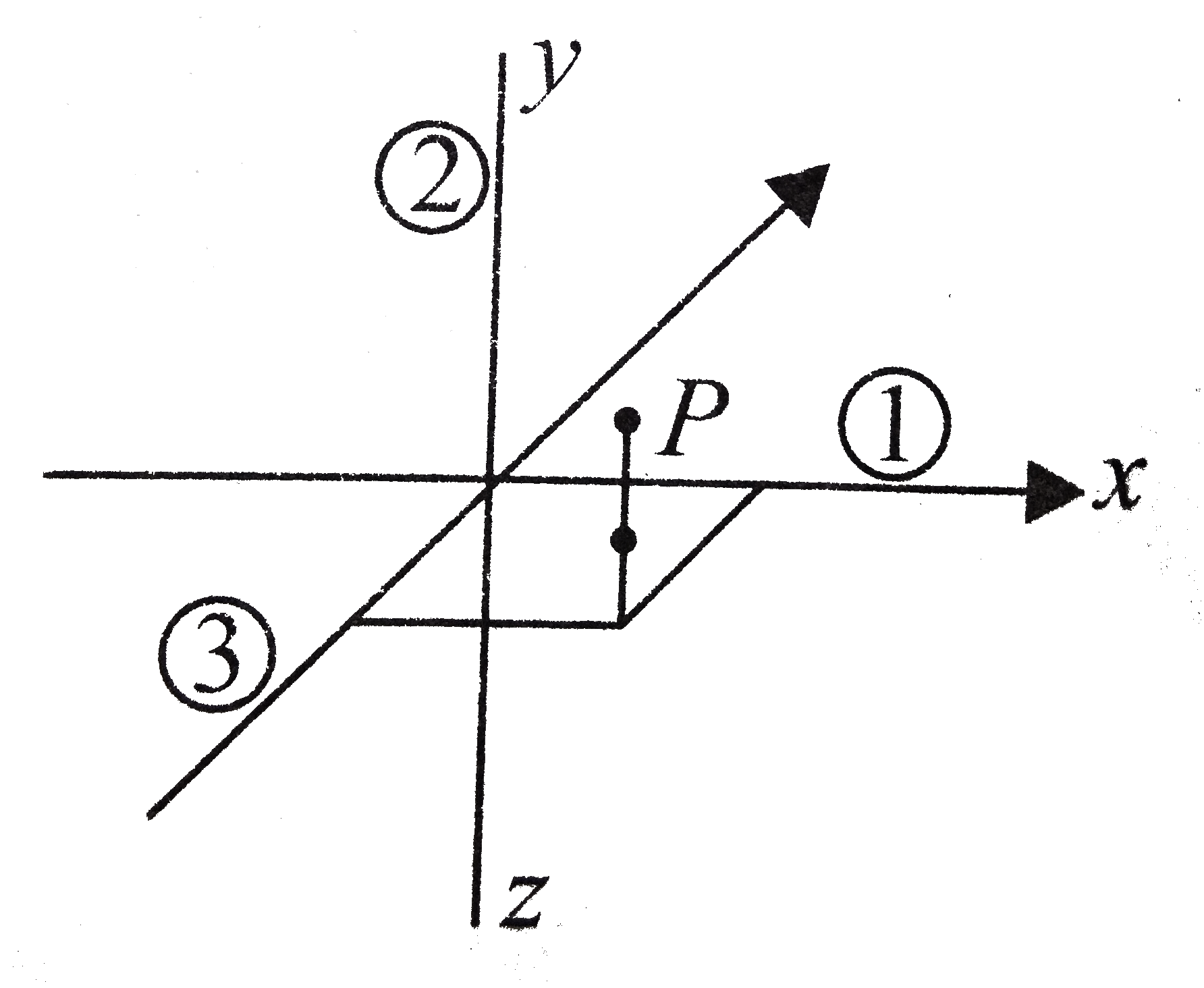
Find the electric field vector at P (a,a...

Find the electric field vector at P (a,a,a) due to three infinitely long lines of charges along the x-, y- and z-axis, respectively. The charge density i.e. charge per unit length of each wire is `(lambda)`,

A

`(lambda)/(3pi epsilon_(0)a)(hati+hatj+hatk)`

B

`(lambda)/(2piepsilon_(0)a)(hati+hatj+hatk)`

C

`(lambda)/(2sqrt2 pi epsilon_(0)a)(hati+hatj+hatk)`

D

`(sqrt2 lambda)/(pi epsilon_(0)a)(hati+hatj+hatk)`

Text Solution

Verified by Experts

The correct Answer is:

B
Promotional Banner

Similar Questions

Explore conceptually related problems

The electric field at distance .r. from infinte line of charge ("having linear charge density" lambda) is

Equal currents are flowing in three infinitely long wires along positive x,y and z -directions. The magnetic field at a point (0,0-a) would be ( i= current in each wire)

Find the electric field due to an infinitely long cylindrical charge distribution of radius R and having linear charge density lambda at a distance half of the radius from its axis.

Calculate the potential due to a thin charged rod of length L at the points along and perpendicular to the length. Charge per unit length on the rod is lambda .

The diagram shows three infinitely long uniform line charges placed on the X, Y and Z axis . The work done in moving a unit positive charge from (1,1,1) to (0 , 1,1,) is equal to .

Electric field intensity at a point due to an infinite sheet of charge having surface charge density sigma is E .If sheet were conducting electric intensity would be

Three infinitely long charge sheets are placed as shown in figure. The electric field at point P is

Fig. shows some of the electric field lines due to three point charges arranged along the vertical axis. All three charges have the same magnitude. (a) What are the signs of each of the three charges? Explain your reasoning. (b) At what points(s) is the magnitude of the electric field the smallest? Explain your reasoning. Explain how the fields produced by each individual point charge combine to give a small net field at this point or points. (c ) Two point charges q and -q are placed at a distance d apart. What are the points at which the resultant electric field is parallel to the line joining the two charge? .

Find electric field at point A, B, C, D due to infinitely long uniformly charged wire with linear charge density lambda and kept along z-axis (as shown in figure). Assume that all the parameters are in S.l. units.

(i) Two infinitely long line charges each of linear charge density lambda are placed at an angle theta as shown in figure. Find out electric field intensity at a point P, which is at a distance x from point O along angle bisector of line charges. (ii) Repeat the above question if the line charge densities are lambda and -lambda . as shown in figure.
