Home
Class 12
PHYSICS
A massless string and a spring connect t...

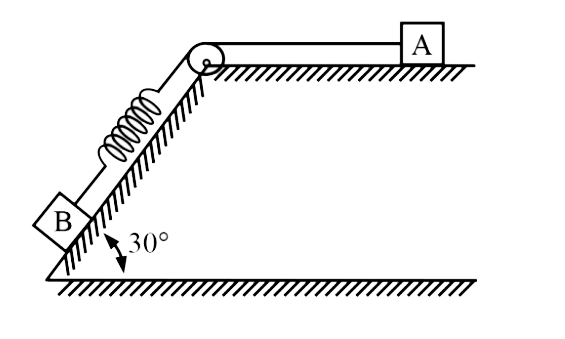
A massless string and a spring connect two blocks A and B to each other. Block B slides over a frictionless inclined plane while block A slides over horizontal surface. Coefficient of friction between block a A horizontal surface is `mu=0.2`. At the instant shown blocks are moving with constant speed. Mass of block A and energy stored in spring the respectively. `[g=10m//s^(2),k=1000N/m, m_(B)=2kg]`

A

5 kg, 1J

B

10 kg, 0.05 J

C

5 kg, 0.05 J

D

10 kg, 1J

Text Solution

Verified by Experts

The correct Answer is:

C
Promotional Banner

Similar Questions

Explore conceptually related problems

A block of mass 50 kg slides over a horizontal distance of 1m. If the coefficient of friction between their surface is 0.2, then work done against friction is (take g = 9.8 m//s^(2) ) :

A block of mass m is moving on a rough horizontal surface. mu is the coefficient of kinetic friction between the block and the surface. What is the net force exerted by the surface on the block?

A block of mass m slides down an inclined plane which makes an angle theta with the horizontal. The coefficient of friction between the block and the plane is mu . The force exerted by the block on the plane is

A block of mass m is placed at rest on an inclination theta to the horizontal. If the coefficient of friction between the block and the plane is mu , then the total force the inclined plane exerts on the block is

Two block of masses M and m are connected to each other by a massless string and spring of force constant k as shown in the figure. The spring passes over a frictionless pulley connected rigidly to the egde of a stationary block A. The coefficient of friction between block M and plane horizontal surface of A is mu . The block M slides over the horizontal top surface of A and block m slides vertically downward with the same speed. The mass M is equal to

A block A slides over an another block B which is placed over a smooth inclined plane as shown in figure . The coefficient of friction between the two blocks A and B is mu . Mass of block B is two times the mass of block A . The acceleration of the centre of mass of two blocks is

Two blocks A and B of respective masses 6 kg and 4 kg are connected with a string passing over a light friction less pulley as shown in the figure . The coefficient of friction between the block A and horizontal surface is 0.4 . Then the minimum mass of block C which should be placed over A to prevent it from moving is :

A block of mass 8 kg is sliding on a surface inclined at an angle of 45^(@) with the horizontal. Calculate the acceleration of the block. The coefficient of friction between the block and surface is 0.6. (Take g=10m//s^(2) )

A block of mass 8 kg is sliding on a surface inclined at an angle of 45^(@) with the horizontal . Calculate the acceleration of the block . The coefficient of friction between the block and surface is 0*6 ( Take g = 10 m//s^(2) )

Two blocks A and B of masses 10 kg and 15 kg are placed in contact with each other rest on a rough horizontal surface as shown in the figure. The coefficient of friction between the blocks and surface is 0.2. A horizontal force of 200 N is applied to block A. The acceleration of the system is ("Take g"=10ms^(-2))
