Home
Class 12
BIOLOGY
Given below is a pedigree chart of a fam...

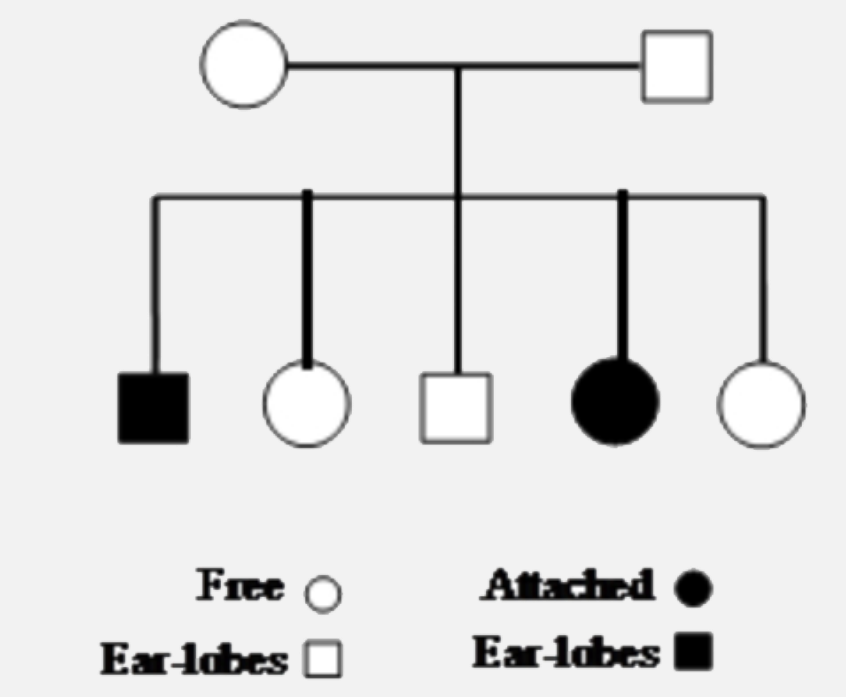
Given below is a pedigree chart of a family with five children. It shows the inheritance of attached earlobes as opposed to the free ones. The squares represent the male individulas and circules the female individuals. Which one of the following conclusions drawn is correct?

A

The trait is Y-linked.

B

The parents are homozygous dominant

C

The parents are homozygous recessive

D

The parents are heterozygous

Text Solution

Verified by Experts

The correct Answer is:

D
Promotional Banner

Similar Questions

Explore conceptually related problems

Given below is a pedigree chart of a family with five children. It shows the inheritance of attached ear lobes as opposed to the free ones. The squares represent the male indiones. The squares represent the male individuals and circles the female individuals Which of one of the following conclusions drawn is correct?

Given ahead is a pedigree chart of a family with five children . It shows the Inheritance of attached ear-lobes as opposed to the free ones. Which one is a following conclusions drawn is correct ?

Study the pedigree chart of a certain family given below and select the correct conclusion which can be drawn for the character

The diagram given below shows how things get to and from the liver. They are labelled as A, B, C, D, E and F. Which one of the following labellings is correct Choose the correct option

The diagram given below [Fig] shows how things get to and from the liver. They are labelled as A, B, C, D, E and F. Which one of the following labellings is correct Choose the correct option

A pedigree chart given here, presents a particular generation which shows a trait irrespective of sexes (ie.. present in both male and female). Neither of the parents of the particular generation shows that trait. Draw your conclusion on the basis of the pedigree.

Study the pedigree chart given, showing the Inheritance pattern of blood groups in a family and answer the following questions (a) Give the possible genotypes of the individuals 1 and 2. (b) Which antigen or antigens will be present on the plasma membranes of the RBC's of individuals 5 and 9. (c) Give the genotypes of the individuals 3 and 4.
