Home
Class 12
PHYSICS
A stream of non-viscous liquid emerges f...

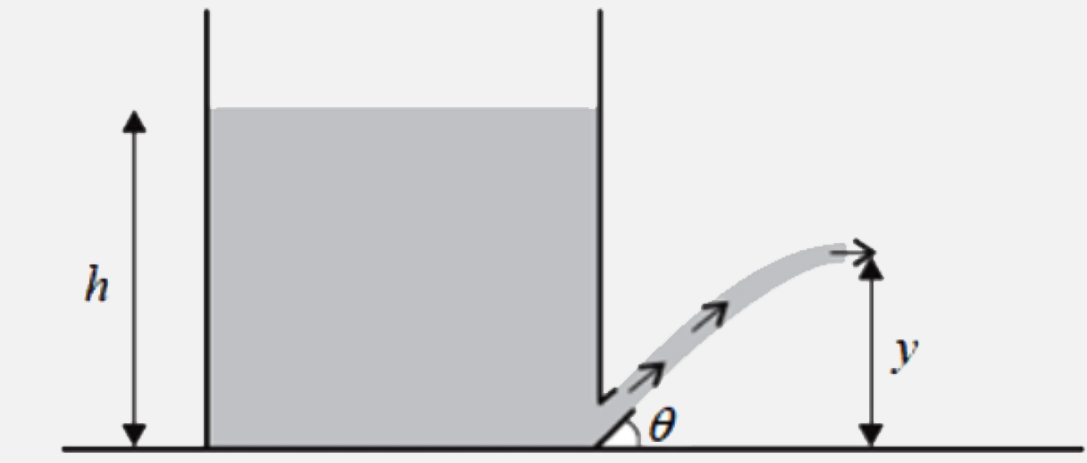
A stream of non-viscous liquid emerges from a very short outlet tube at the base of a large . Open tank , in which the depth of liquid is h. The tube is at a fixed angle `theta` to the ground as shown in the figure. The maximum height of the stream y is

A

`h sin^2 theta`

B

`h sin 2 theta`

C

`1/2 h sin theta`

D

`h tan^2 theta`

Text Solution

Verified by Experts

The correct Answer is:

A
Promotional Banner

Similar Questions

Explore conceptually related problems

Two liquids which do not react chemically are placed in a bent tube as shown in figure. The height of the liquids above their surface of separation are

Two chemically non-reactive liquids are placed in a U-shaped tube as shown in the figure. The height of any liquid above a common reference line is

A liquid of density rho is filled in a U-tube is accelerated with an acceleration a so that the height of liquid in its two vertical arms are h_1 and h_2 as shown in the figure. If l is the length of horizontal arm of the tube, the acceleration a is

Figure shows a stream of fluid emerging from a tube in the base of an open tank. Obtain an expression for 'y' in terms of theta and 'h' . Can exceed 'h' ?

A non viscous liquid of density rho is filled in a tube with A as the area of cross section, as shown in the figure. If the liquid is slightly depressed in one of the arms, the liquid column oscillates with a frequency

Two vertical plates submerged partially in a wetting liquid form a wedge with a very small angle delta varphi . The edge of this wedge is vertical. The density of the liquid is rho , its surface tension is alpha , the contact angle is theta . Find the height h , to which the liquid rises, as a function of the distance x from the edge.

A non-viscous liquid of constant density 1000kg//m^3 flows in a streamline motion along a tube of variable cross section. The tube is kept inclined in the vertical plane as shown in Figure. The area of cross section of the tube two point P and Q at heights of 2 metres and 5 metres are respectively 4xx10^-3m^2 and 8xx10^-3m^2 . The velocity of the liquid at point P is 1m//s . Find the work done per unit volume by the pressure and the gravity forces as the fluid flows from point P to Q.

Consider a regular tank of size (lxxb) filled with a liquid of density rho to a height H as shown in figure. Find the force at the base and on the wall of the tank.

A small ball of density rho is placed from the bottom of a tank in which a non viscous liquid of density 2 rho is filled . Find the time taken by the ball to reach the surface of liquid and maximum height reached above the bottom of container . (Size of the ball and any type of drag force acting on the ball are negligible )

A vertical U -tube is spinned about the vertical axis passing through the left hand limb, with an angular speed omega such that the liquid columns in the limbs have heights h and 3h , as shown in the figure. Find the value of to omega .
