

Home
Class 10
MATHS
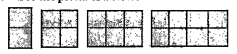
See the pictures below: How many large s...

See the pictures below: How many large squares? Continuing this pattern, is each such sequence of numbers, an arithmetic sequence?

Promotional Banner

Similar Questions

Explore conceptually related problems

See the pictures below: How many squares in all? Continuing this pattern, is each such sequence of numbers, an arithmetic sequence?

See the pictures below: How many small squares are there in each rectangle? Continuing this pattern, is each such sequence of numbers, an arithmetic sequence?

Look at these pictures: If the pattern is continued, do the numbers of coloured squares form an arithmetic sequence? Give reasons.

Consider an arithmetic sequence with first term 18 and common difference 3. i) Write the terms of this sequence. ii) Write the perfect square terms of this sequence. Check whether it is an arithmetic sequence.

Prove that for a set of numbers in arithmetic sequence, the mean and median are equal.

Write the whole numbers in 'the arithmetic sequence 11/8, 14/8, 17/8,….. Do they form an arithmetic sequence?

Prove that in any square pyramid, the squares of the height, slant height and lateral edge are in arithmetic sequence.

In an A.P., the first term is 3 and the last term is 17. The sum of all the terms in the sequence is 70. Then the number of terms in the arithmetic sequence is

Consider the numbers between 100 and 300 which leave remainder 2 on division by 3 a) Which is the first number in this sequençe? b) Which is the last number in this sequence? c). How many such numbers are there in this sequence? d) Find the, sum of all numbers in the sequence.

Consider an arithmetic sequence frac(17)(7) , frac(20)(7) , frac(23)(7) ,........ Write the sequence of counting numbers in the above given sequence. Is the newly obtained sequence an arithmetic, sequence