

Home
Class 10
CHEMISTRY
f. How and when a reversible reaction at...


f. How and when a reversible reaction attain chemical equilibrium

Promotional Banner

Topper's Solved these Questions

  • COMPOUNDS OF NON-METALS

    BODY BOOKS PUBLICATION|Exercise EXERCIES|7 Videos
  • CHEMICAL REACTIONS OF ORGANIC COMPOUNDS

    BODY BOOKS PUBLICATION|Exercise EXERCISE|20 Videos
  • GAS LAWS AND MOLE CONCEPT

    BODY BOOKS PUBLICATION|Exercise EXERCISE|6 Videos

Similar Questions

Explore conceptually related problems

Which of the following will favours the reverse reaction in a chemical equilibrium? (1)Increasing the concentration of one of the reactants. (2)Removal of atleast one of the products at regular intervals. (3)Increasing the concentration of one or more of the products. (4)None of the these

A graph given below deals with the revers-ible reaction. What change occurs to the equilibrium, when a catalyst is used?

A catalyst added to a reversible reaction.

For the following equilibrium K_p = 6.3xx10^14 at 1000 K, NO(g) + O_3(g) harr NO_2(g) + O_2(g) Both the forward and reverse reactions in the equilibrium are elementary biomolecular reactions. What is K_c , reaction?

A graph given below deals with the revers-ible reaction. In which minute does the system attain equilibrium?

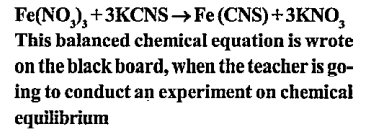
Fe(NO_3)_3+3KCNSrarrFe(CNS)3+3KNO_3 , This balanced chemical equation is wrote on the black board,when the teacher is going to conduct an experiment on chemical equilibrium: In the above reaction, which chemical has red colour.

Assertion : At constant temperature and pressure chemical reactions are spontaneous in the direction of decreasing Gibb's energy Reason : For every chemical reaction at equilibrium standard Gibb's energy of the reaction is zero

a) What is the role of catalyst in a reversible reaction? b) is it beneficial to add a catalyst in a system which has already attained equlibrium? Explain the answer. c) Which is the catalyst used in 'Haber process'?