

Home
Class 12
CHEMISTRY
Polymers are classified into elastomers,...

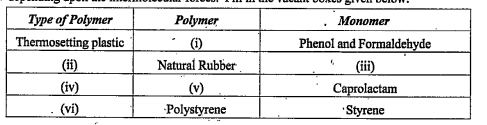
Polymers are classified into elastomers, fibres, thermoplastics and thermosetting plastics, depending upon the intermolecular forces. Fill in the vacant boxes given below:

Promotional Banner

Topper's Solved these Questions

  • HALOAKANES AND HALOARENES

    BODY BOOKS PUBLICATION|Exercise Example|113 Videos
  • SOLUTIONS

    BODY BOOKS PUBLICATION|Exercise EXAMPLE|111 Videos

Similar Questions

Explore conceptually related problems

PVC, bakelite and polythene are plastics. Classify the above plastics into thermoplastics and thermosetting plastics.

To a question, a student answered that bakelite is the thermosetting polymer What is the type of intermolecular forces present in nylon 6,6

Three polymers are given below silk, rubber, PVC. Categorise each under separate heading based on intermolecular forces.

Polymers can be classified based on molecular forces. Classify the following polymers Into elastomers and fibres: Terylene

Polymers can be classified based on molecular forces. Classify the following polymers Into elastomers and fibres: Rubber

Polymers can be classified based on molecular forces. Classify the following polymers Into elastomers and fibres: Nylon 6 6

Polymers can be classified based on molecular forces. Classify the following polymers Into elastomers and fibres: Buna-S

Polymers can be classified based on molecular forces Classify the following polymers into elastomers and fibres : Rubber, Nylon 6, 6, Buna-S, Terylene

The following are the names of certain polymers Neoprene, Nylon, Polystyrene, silk, PVC, Bakelite. classify the above polymers based on the intermolecular forces

BODY BOOKS PUBLICATION-POLYMERS-EXAMPLE
  1. Name two thermoplastics

    Text Solution

    |

  2. Nylon 6, 6 and Dacron are two synthetic fibres. Suggest the monomers o...

    Text Solution

    |

  3. Polymers are classified into elastomers, fibres, thermoplastics and th...

    Text Solution

    |

  4. Is (NH-CHR-CO)n A homopolymer or copolymer?

    Text Solution

    |

  5. Distinguish between the terms homopolymer and copolymer and give an ex...

    Text Solution

    |

  6. How does the presence of double bonds in rubber molecules influence th...

    Text Solution

    |

  7. How is dacron obtained from ethylene glycol and terephthalic acid?

    Text Solution

    |

  8. Explain the term copolymerisation and give two examples.

    Text Solution

    |

  9. Explain the terms polymer and monomer.

    Text Solution

    |

  10. The monomer of natural rubber is

    Text Solution

    |

  11. Vulcanisation is carried out to improve the physical properties of rub...

    Text Solution

    |

  12. Classify the following into addition and condensation polymers: PVC

    Text Solution

    |

  13. Classify the following into addition and condensation polymers: Nylon ...

    Text Solution

    |

  14. Classify the following into addition and condensation polymers: Teflon

    Text Solution

    |

  15. Classify the following into addition and condensation polymers: Teryle...

    Text Solution

    |

  16. The monomeric unit of natural rubber is.

    Text Solution

    |

  17. What is meant by step growth polymerisation? Give an example.

    Text Solution

    |

  18. What Is the cross linked polymer obtained by the polymerisation of phe...

    Text Solution

    |

  19. Match the following

    Text Solution

    |

  20. Which of the following is not applicable to Nylon 6, 6 ?

    Text Solution

    |