Home
Class 10
MATHS
Satellite TV manufacturing businesses te...

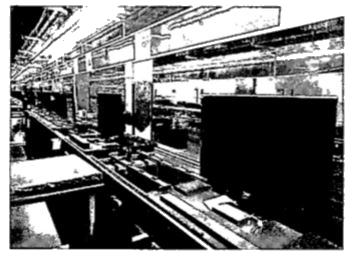
Satellite TV manufacturing businesses tend to have what economists call "economies of scale." When economies of scale exist, bigness can be its own reward.
The more TV's you manufacture in a single run, lower the costs per unit, which in turn increases your bottom-line margins.

Keeping that in mind, a T.V. manufacturing company increases its production uniformly by fixed number every year. The company produces 8000 sets in the 6th year and 11,300 sets in the 9th year.
In which year the company's production is 9100 sets ?

A

`5^(th)`

B

`6^(th)`

C

`7^(th)`

D

`9^(th)`

Text Solution

Verified by Experts

Promotional Banner

Topper's Solved these Questions

  • SAMPLE PAPER 4

    AGRAWAL PUBLICATION|Exercise EXERCISE|99 Videos
  • SAMPLE PAPER 6

    AGRAWAL PUBLICATION|Exercise EXERCISE|102 Videos

Similar Questions

Explore conceptually related problems

Satellite TV manufacturing businesses tend to have what economists call "economies of scale." When economies of scale exist, bigness can be its own reward. The more TV's you manufacture in a single run, lower the costs per unit, which in turn increases your bottom-line margins. Keeping that in mind, a T.V. manufacturing company increases its production uniformly by fixed number every year. The company produces 8000, sets in the 6^(th) year and 11,300 sets in the 9^(th) year. The company's production increases every year by:

Satellite TV manufacturing businesses tend to have what economists call "economies of scale." When economies of scale exist, bigness can be its own reward. The more TV's you manufacture in a single run, lower the costs per unit, which in turn increases your bottom-line margins. Keeping that in mind, a T.V. manufacturing company increases its production uniformly by fixed number every year. The company produces 8000 sets in the 6th year and 11,300 sets in the 9th year. The company's production increases every year by:

Satellite TV manufacturing businesses tend to have what economists call "economies of scale." When economies of scale exist, bigness can be its own reward. The more TV's you manufacture in a single run, lower the costs per unit, which in turn increases your bottom-line margins. Keeping that in mind, a T.V. manufacturing company increases its production uniformly by fixed number every year. The company produces 8000, sets in the 6^(th) year and 11,300 sets in the 9^(th) year. The company's production of the first year is:

Satellite TV manufacturing businesses tend to have what economists call "economies of scale." When economies of scale exist, bigness can be its own reward. The more TV's you manufacture in a single run, lower the costs per unit, which in turn increases your bottom-line margins. Keeping that in mind, a T.V. manufacturing company increases its production uniformly by fixed number every year. The company produces 8000, sets in the 6^(th) year and 11,300 sets in the 9^(th) year. The company's production of the 8th year is:

Satellite TV manufacturing businesses tend to have what economists call "economies of scale." When economies of scale exist, bigness can be its own reward. The more TV's you manufacture in a single run, lower the costs per unit, which in turn increases your bottom-line margins. Keeping that in mind, a T.V. manufacturing company increases its production uniformly by fixed number every year. The company produces 8000 sets in the 6th year and 11,300 sets in the 9th year. The company's production of the 8th year is:

Satellite TV manufacturing businesses tend to have what economists call "economies of scale." When economies of scale exist, bigness can be its own reward. The more TV's you manufacture in a single run, lower the costs per unit, which in turn increases your bottom-line margins. Keeping that in mind, a T.V. manufacturing company increases its production uniformly by fixed number every year. The company produces 8000 sets in the 6th year and 11,300 sets in the 9th year. The company's total production of the first 6 years is:

Satellite TV manufacturing businesses tend to have what economists call "economies of scale." When economies of scale exist, bigness can be its own reward. The more TV's you manufacture in a single run, lower the costs per unit, which in turn increases your bottom-line margins. Keeping that in mind, a T.V. manufacturing company increases its production uniformly by fixed number every year. The company produces 8000, sets in the 6^(th) year and 11,300 sets in the 9^(th) year. The company's total production of the first 6 years is:

Satellite TV manufacturing businesses tend to have what economists call "economies of scale." When economies of scale exist, bigness can be its own reward. The more TV's you manufacture in a single run, lower the costs per unit, which in turn increases your bottom-line margins. Keeping that in mind, a T.V. manufacturing company increases its production uniformly by fixed number every year. The company produces 8000 sets in the 6th year and 11,300 sets in the 9th year. On the basis of the above information, answer any four of the following questions: The company's production of the first year is:

The production of TV in a factory increases uniformly by a fixed number every year .It produced 8000 TV's in 6^(th) year & 11300 in 9^(th) year , find the production in 8^(th) year .

AGRAWAL PUBLICATION-SAMPLE PAPER 5-EXERCISE
  1. Satellite TV manufacturing businesses tend to have what economists cal...

    Text Solution

    |

  2. Satellite TV manufacturing businesses tend to have what economists cal...

    Text Solution

    |

  3. Satellite TV manufacturing businesses tend to have what economists cal...

    Text Solution

    |

  4. Eshan purchased a new building for her business. Being in the prime lo...

    Text Solution

    |

  5. Eshan purchased a new building for her business. Being in the prime lo...

    Text Solution

    |

  6. Eshan purchased a new building for her business. Being in the prime lo...

    Text Solution

    |

  7. Eshan purchased a new building for her business. Being in the prime lo...

    Text Solution

    |

  8. Eshan purchased a new building for her business. Being in the prime lo...

    Text Solution

    |

  9. As part of the 'Swachh Bharat Abhyan', some houses of a locality in Ag...

    Text Solution

    |

  10. As part of the 'Swachh Bharat Abhyan', some houses of a locality in Ag...

    Text Solution

    |

  11. As part of the 'Swachh Bharat Abhyan', some houses of a locality in Ag...

    Text Solution

    |

  12. As part of the 'Swachh Bharat Abhyan', some houses of a locality in Ag...

    Text Solution

    |

  13. Write the prime factorisation of 8190

    Text Solution

    |

  14. Form the quadratic polynomials whose zeroes are 3+sqrt2, 3-sqrt2

    Text Solution

    |

  15. If the point P(6,2) divides the line segment joining A(6,5) and B(4, y...

    Text Solution

    |

  16. In a right triangle ABC, right-angled at B, if sin (A - C) = (1)/(2) f...

    Text Solution

    |

  17. If sin theta = (2m n)/(m^(2) + n^(2)), find the value of (sin theta co...

    Text Solution

    |

  18. A die is thrown once. Find the probability of getting (A) a prime numb...

    Text Solution

    |

  19. Prove that 2 sqrt3 - 4 is an irrational number , using the fact that s...

    Text Solution

    |

  20. The figure shows a rectangle with its length and breadth as indicated....

    Text Solution

    |

