Home
Class 10
MATHS
Radio towers are typically tall structur...

Radio towers are typically tall structures designed to support antennas for tele communications and broadcasting, including television. There are 2 main types: guyed and self-supporting structures.
They are among the tallest human-made structures. Masts are often named after the broadcasting organizations that originally built them or currently use them.

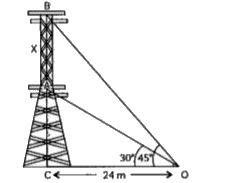
On a similar concept, a radio - station tower was built in two sections A and B. From a point 24 m from the base of the tower, the angle of elevation of the top of section A is `30^(@)` and the angle of elevation of the top of section B is `45^@).`


The height of the tower is

A

17.9 m

B

24m

C

31.6 m

D

20 m

Text Solution

Verified by Experts

Promotional Banner

Topper's Solved these Questions

  • SAMPLE PAPER 7

    AGRAWAL PUBLICATION|Exercise EXERCISE|81 Videos
  • SAMPLE PAPER 9

    AGRAWAL PUBLICATION|Exercise EXERCISE|85 Videos

Similar Questions

Explore conceptually related problems

Radio towers are typically tall structures designed to support antennas for tele communications and broadcasting, including television. There are 2 main types: guyed and self-supporting structures. They are among the tallest human-made structures. Masts are often named after the broadcasting organizations that originally built them or currently use them. On a similar concept, a radio - station tower was built in two sections A and B. From a point 24 m from the base of the tower, the angle of elevation of the top of section A is 30^(@) and the angle of elevation of the top of section B is 45^@). The height of the section A is

Radio towers are typically tall structures designed to support antennas for tele communications and broadcasting, including television. There are 2 main types: guyed and self-supporting structures. They are among the tallest human-made structures. Masts are often named after the broadcasting organizations that originally built them or currently use them. On a similar concept, a radio - station tower was built in two sections A and B. From a point 24 m from the base of the tower, the angle of elevation of the top of section A is 30^(@) and the angle of elevation of the top of section B is 45^@). The height of the section B is

Radio towers are typically tall structures designed to support antennas for tele communications and broadcasting, including television. There are 2 main types: guyed and self-supporting structures. They are among the tallest human-made structures. Masts are often named after the broadcasting organizations that originally built them or currently use them. On a similar concept, a radio - station tower was built in two sections A and B. From a point 24 m from the base of the tower, the angle of elevation of the top of section A is 30^(@) and the angle of elevation of the top of section B is 45^@). On the basis of the above information, answer any four of the following question: The length of the wire structure from the point o to the top of section B is

Radio towers are typically tall structures designed to support antennas for tele communications and broadcasting, including television. There are 2 main types: guyed and self-supporting structures. They are among the tallest human-made structures. Mosts are often named after the broadcasting organizations that originally built them or currently use them. On a similar concept, a radio - station tower was built in two sections A and B. From a point 24 m from the base of the tower, the angle of elevation of the top of section A is 30^(@) and the angle of elevation of the top of section B is 45^@). On the basis of the above information, answer any four of the following question: The length of the wire structure from the point to the top of section A is

For television broadcasting, the frequency employed is normally.

For television broadcasting, the frequency employed is normally

The supportive structure of our pinna is also found in

AGRAWAL PUBLICATION-SAMPLE PAPER 8-EXERCISE
  1. Radio towers are typically tall structures designed to support antenna...

    Text Solution

    |

  2. Radio towers are typically tall structures designed to support antenna...

    Text Solution

    |

  3. Radio towers are typically tall structures designed to support antenna...

    Text Solution

    |

  4. Radio towers are typically tall structures designed to support antenna...

    Text Solution

    |

  5. Radio towers are typically tall structures designed to support antenna...

    Text Solution

    |

  6. Express   0.3528   in the form (p)/( 2 ^(m) 5 ^(n)) and write the va...

    Text Solution

    |

  7. If HCF (150, 210) = 30, then find LCM (150, 210).

    Text Solution

    |

  8. Find the value of x for which 2x, (x + 10) and (3x + 2) are three cons...

    Text Solution

    |

  9. If the first term of an A.P. is p and its common difference is q. then...

    Text Solution

    |

  10. Find a relation between x and y such that the point (x, y) is equidis...

    Text Solution

    |

  11. The shadow of a 5-m-long stick is 2m long. At the same time, the lengt...

    Text Solution

    |

  12. The area of a circle is 154 sq. cm. Find its circumference.

    Text Solution

    |

  13. A bag contains 3 red and 5 blue balls. A ball is drawn at random from ...

    Text Solution

    |

  14. A bag contains 3 red and 5 blue balls. A ball is drawn at random from ...

    Text Solution

    |

  15. Find the greatest 4-digit number which is divisible by 15, 24 and 36.

    Text Solution

    |

  16. Determine the AP whose 3rd term is 5 and the 7^(th) term is 9 .

    Text Solution

    |

  17. In the given figure , DEFG is a square and angleBAC= 90^(@) prove t...

    Text Solution

    |

  18. Draw a line segment of length 5.6 cm and divide it in the ratio 4:3. M...

    Text Solution

    |

  19. In Figure, a quadrilateral ABCD is drawn to circumscribe a circle . ...

    Text Solution

    |

  20. A cubical block of side 7 cm is surmounted by a hemisphere. What is...

    Text Solution

    |

