

Home
Class 10
MATHS
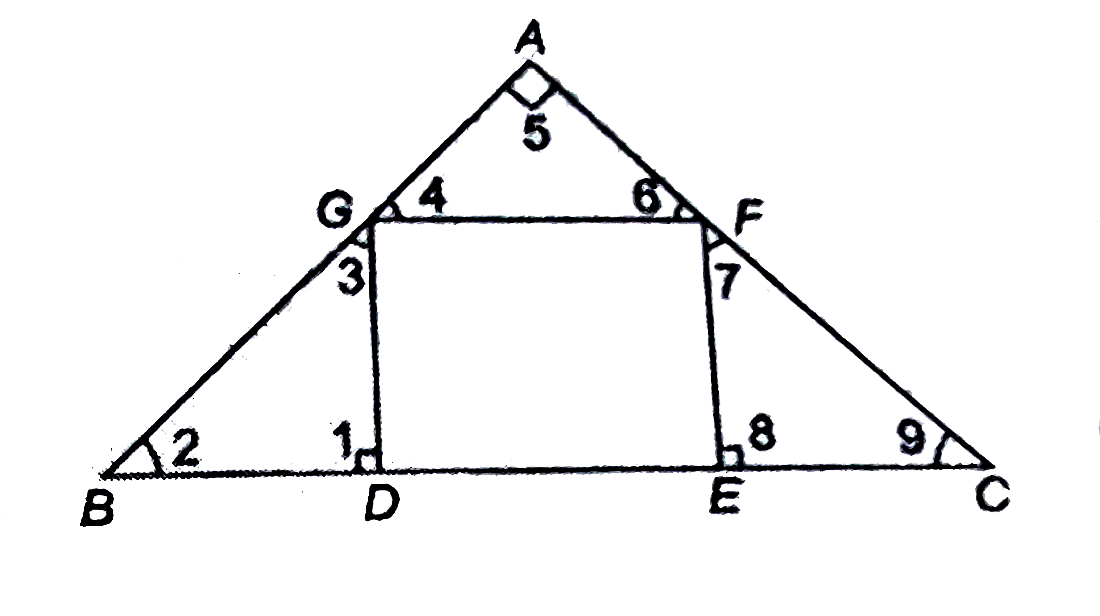
In the given figure , DEFG is a square a...

In the given figure , DEFG is a square and `angleBAC= 90^(@)`
prove that
(i) `triangleAGF~ triangleDBG`
`(ii) triangleAGF~triangleEFC`
(iii) `triangleDBG ~ triangleEFC`
(iv) ` DE^(2)= BD xx EC`

Promotional Banner

Topper's Solved these Questions

  • SAMPLE PAPER 7

    AGRAWAL PUBLICATION|Exercise EXERCISE|81 Videos
  • SAMPLE PAPER 9

    AGRAWAL PUBLICATION|Exercise EXERCISE|85 Videos

Similar Questions

Explore conceptually related problems

In the given figure DEFG is a square and angleBAC=90^(@) . Show that FG^(2) = BG xx FC .

In the given figure if angleB= 90^(@) and BD is perpendicular to AC then prove that: (i) triangleADB~triangleBDC (ii) triangleADB~triangleABC (iii) triangleBDC ~ triangleABC (iv) BD^(2)= AD xx DC (v) AB^(2)= AD xx AC (vi) BC^(2)= CD xx AC (vii) AB^(2)+BC^(2)= AC^(2)

In fig.7.84, DEFG is a square and angleBAC = 90° . Prove that: (i) DeltaAGF~DeltaDBG (ii) DeltaAGF~ DeltaEFC (iii) DeltaDBG~ DeltaEFC (iv) DE^(2) = BD xx EC

In the given figure, ABCD is a square and anglePQR=90^(@).If PB=QC=DR, prove that. (i) QB = RC (ii) PQ = QR (iii) angleQPR=45^(@)

In the given figure, angle ACB=90^(@) and CD bot AB . Prove that CD^(2)=BD*AD

In the adjoining figure, BD = CE and angleADB=angleAEC=90^(@) , prove that (i) DeltaABD cong DeltaACE (ii) ABC is an isosceles triangle.

In the given figure,AD = AE and AD^(2)=BD xx EC prove that: triangles ABD and CAE are similar.

In the given figure, AB"||"DC and angleD=angleC . Prove that : (i) AD = BC (ii) AC = BD

In the adjoining figure, ABCD is a square and PAB is an equilateral triangle. Find : (i) angleAPD (ii) anglePDC (iii) angleDPC (iv) Prove that DP = CP

AGRAWAL PUBLICATION-SAMPLE PAPER 8-EXERCISE
  1. Find the greatest 4-digit number which is divisible by 15, 24 and 36.

    Text Solution

    |

  2. Determine the AP whose 3rd term is 5 and the 7^(th) term is 9 .

    Text Solution

    |

  3. In the given figure , DEFG is a square and angleBAC= 90^(@) prove t...

    Text Solution

    |

  4. Draw a line segment of length 5.6 cm and divide it in the ratio 4:3. M...

    Text Solution

    |

  5. In Figure, a quadrilateral ABCD is drawn to circumscribe a circle . ...

    Text Solution

    |

  6. A cubical block of side 7 cm is surmounted by a hemisphere. What is...

    Text Solution

    |

  7. Solve for x : (1)/(x + 4) - (1)/(x-7) = (11)/(30), x ne 4, 7

    Text Solution

    |

  8. Using the quadratic formula,solve for x: 3x^(2)+2sqrt(5)x-5=0

    Text Solution

    |

  9. State and prove the Pythagoras theorem.

    Text Solution

    |

  10. The angle of elevation of the top of a tower from a point on the gr...

    Text Solution

    |

  11. After how many places will the decimal expansion of (189)/(125) termin...

    Text Solution

    |

  12. Insert a rational and irrational number between 2 and 3

    Text Solution

    |

  13. Find the zeros of the polynomial 4x^(2) -12x+9.

    Text Solution

    |

  14. If x=a,y=b is the solution of the equations x-y=2 and x+y=4, then find...

    Text Solution

    |

  15. Find discriminant of the quadratic equation 2x^2+4x-7=0

    Text Solution

    |

  16. Find the roots of quadratic equation x^2 - 4x + 2.

    Text Solution

    |

  17. If Sn = 5n^2 + 3n, then find its n^(th) term.

    Text Solution

    |

  18. In an A.P., a=-6 and d = 2. Find the sum of its first 20 terms.

    Text Solution

    |

  19. Write the relationship between the coefficients, if the following pair...

    Text Solution

    |

  20. In a triangleABC, right-angled at B, if AB : AC = 1:2, then find the v...

    Text Solution

    |