Home
Class 10
MATHS
Radio towers are typically tall structur...

Radio towers are typically tall structures designed to support antennas for tele communications and broadcasting, including television. There are 2 main types: guyed and self-supporting structures.
They are among the tallest human-made structures. Masts are often named after the broadcasting organizations that originally built them or currently use them.

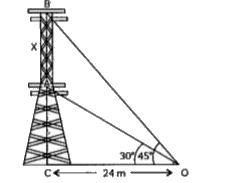
On a similar concept, a radio - station tower was built in two sections A and B. From a point 24 m from the base of the tower, the angle of elevation of the top of section A is `30^(@)` and the angle of elevation of the top of section B is `45^@).`


The height of the section B is

A

5.4 m

B

3.3 m

C

6.16 m

D

10.16 m

Text Solution

Verified by Experts

Promotional Banner

Topper's Solved these Questions

  • 2020 QUESTION PAPER (1)

    AGRAWAL PUBLICATION|Exercise EXERCISE|33 Videos

Similar Questions

Explore conceptually related problems

Radio towers are typically tall structures designed to support antennas for tele communications and broadcasting, including television. There are 2 main types: guyed and self-supporting structures. They are among the tallest human-made structures. Masts are often named after the broadcasting organizations that originally built them or currently use them. On a similar concept, a radio - station tower was built in two sections A and B. From a point 24 m from the base of the tower, the angle of elevation of the top of section A is 30^(@) and the angle of elevation of the top of section B is 45^@). The height of the tower is

Radio towers are typically tall structures designed to support antennas for tele communications and broadcasting, including television. There are 2 main types: guyed and self-supporting structures. They are among the tallest human-made structures. Masts are often named after the broadcasting organizations that originally built them or currently use them. On a similar concept, a radio - station tower was built in two sections A and B. From a point 24 m from the base of the tower, the angle of elevation of the top of section A is 30^(@) and the angle of elevation of the top of section B is 45^@). On the basis of the above information, answer any four of the following question: The length of the wire structure from the point o to the top of section B is

Radio towers are typically tall structures designed to support antennas for tele communications and broadcasting, including television. There are 2 main types: guyed and self-supporting structures. They are among the tallest human-made structures. Mosts are often named after the broadcasting organizations that originally built them or currently use them. On a similar concept, a radio - station tower was built in two sections A and B. From a point 24 m from the base of the tower, the angle of elevation of the top of section A is 30^(@) and the angle of elevation of the top of section B is 45^@). On the basis of the above information, answer any four of the following question: The length of the wire structure from the point to the top of section A is

For television broadcasting, the frequency employed is normally.

For television broadcasting, the frequency employed is normally

The supportive structure of our pinna is also found in

Range of frequencies allotted for commercial FM radio broadcast is

AGRAWAL PUBLICATION-(2019) QUESTION PAPER-EXAMPLE
  1. Radio towers are typically tall structures designed to support antenna...

    Text Solution

    |

  2. Check whether g(x) is a factor of P(x) by dividing polynomial p(x) by ...

    Text Solution

    |

  3. Find the area of the triangle formed by joining the mid-points of the ...

    Text Solution

    |

  4. Draw the graph of the equations x-y+ 1 = 0 and 3x + 2y - 12 = 0. Using...

    Text Solution

    |

  5. Prove that sqrt 3 is an irrational number.

    Text Solution

    |

  6. Find the greatest number which on dividing 1251, 9377 and 15628 leaves...

    Text Solution

    |

  7. A,B and C are interior angles of a triangle ABC. Show that sin[(B+C)/2...

    Text Solution

    |

  8. If angle A = 90^@, then find the value of tan [(B + C)/2]

    Text Solution

    |

  9. If tan(A +B) = 1 and tan(A - B) = 1/ sqrt 3, 0^@ < A + B < 90^@, A>B, ...

    Text Solution

    |

  10. In Figure, PQ is a chord of length 8 cm of a circle of radius 5 cm. Th...

    Text Solution

    |

  11. Prove that opposite sides of a quadrilateral circumscribing a circel s...

    Text Solution

    |

  12. Water in a canal, 6 m wide an 1.5 m deep, is flowing with a speed of 1...

    Text Solution

    |

  13. A class teacher has the following absentee record of 40 students of a ...

    Text Solution

    |

  14. A car has two wipers which do not overlap. Each wiper has a blade of l...

    Text Solution

    |

  15. A pole has to be erected at a point on the boundary of a circular park...

    Text Solution

    |

  16. If m times the m^(th) term of an Arithmetic Progession is equal to n t...

    Text Solution

    |

  17. The sum of the first three numbers is an Arithmetic Progression is 18....

    Text Solution

    |

  18. Construct a triangle ABC with side BC = 6 cm, AB = 5 cm and angle ABC ...

    Text Solution

    |

  19. In Figure, a decorative block is shown which is made of two solids, a ...

    Text Solution

    |

  20. In Figure, a decorative block is shown which is made of two solids, a ...

    Text Solution

    |

  21. A bucket open at the top is in the form of a frustum of a cone with a ...

    Text Solution

    |

