

Home
Class 12
MATHS
Let C(1) and C(2) be the graphs of the f...

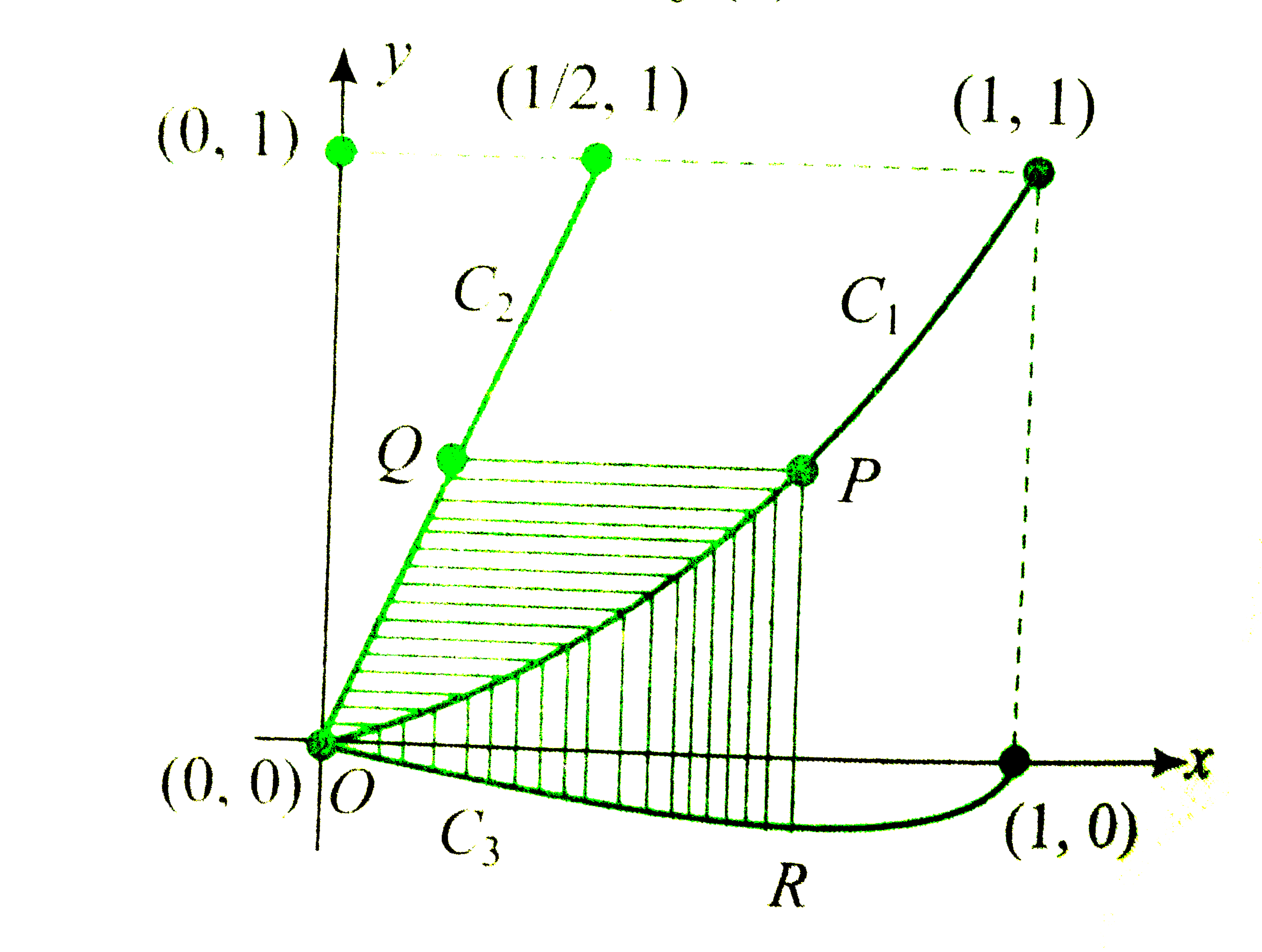
Let `C_(1) and C_(2)` be the graphs of the functions `y=x^(2) and y=2x,` respectively, where `0le x le 1." Let "C_(3)` be the graph of a function y=f(x), where `0lexle1, f(0)=0.` For a point P on `C_(1),` let the lines through P, parallel to the axes, meet `C_(2) and C_(3)` at Q and R, respectively (see figure). If for every position of `P(on C_(1)),` the areas of the shaded regions OPQ and ORP are equal, determine the function f(x).

Promotional Banner

Similar Questions

Explore conceptually related problems

Let C_1C_2 be the graphs of the functions y=x^2 and y=2x , respectively, where 0lt=xlt=1. Let C_3 be the graph of a function y=f(x), where 0lt=xlt=1, f(0) =0. For a point P on C_1, let the lines through P , parallel to the axis, meet C_2 and C_3 at Q and R , respectively (see Figure). If for every position of P(onC_1), the areas of the shaded regions OPQ and ORP are equal, determine the function f(x)

Let C be the centroid of the triangle with vertices (3, -1) (1, 3) and ( 2, 4). Let P be the point of intersection of the lines x+3y-1=0 and 3x-y+1=0 . Then the line passing through the points C and P also passes through the point :

Let f(x)=" max "{x^(2),(1-x)^(2),2x(1-x)} where 0le x le 1 . Determine the area of the region bounded by y=f(x) , x-axis, x = 0 and x = 1.

Two circles C_1 and C_2 intersect at two distinct points P and Q in a line passing through P meets circles C_1 and C_2 at A and B , respectively. Let Y be the midpoint of A B and Q Y meets circles C_1 and C_2 at X a n d Z respectively. Then prove that Y is the midpoint of X Z

The circle C1 : x^2 + y^2 = 3 , with center at O, intersects the parabola x^2 = 2y at the point P in the first quadrant. Let the tangent to the circle C1 at P touches other two circles C2 and C3 at R2 and R3, respectively. Suppose C2 and C3 have equal radii 2sqrt(3) and centers Q2 and Q3, respectively.If Q_2 and Q_3 lies on the y-axis, then

Let C_1 and C_2 be parabolas x^2 = y - 1 and y^2 = x-1 respectively. Let P be any point on C_1 and Q be any point C_2 . Let P_1 and Q_1 be the reflection of P and Q, respectively w.r.t the line y = x then prove that P_1 lies on C_2 and Q_1 lies on C_1 and PQ >= [P P_1, Q Q_1] . Hence or otherwise , determine points P_0 and Q_0 on the parabolas C_1 and C_2 respectively such that P_0 Q_0 <= PQ for all pairs of points (P,Q) with P on C_1 and Q on C_2

Let C_1 and C_2 be respectively, the parabolas x^2=y-1 and y^2=x-1 Let P be any point on C_1 and Q be any point on C_2 . Let P_1 and Q_1 be the refelections of P and Q, respectively with respect to the line y=x. If the point p(pi,pi^2+1) and Q(mu^2+1,mu) then P_1 and Q_1 are

Let C_1 and C_2 be respectively, the parabolas x^2=y-1 and y^2=x-1 Let P be any point on C_1 and Q be any point on C_2 . Let P_1 and Q_1 be the refelections of P and Q, respectively with respect to the line y=x. Arithemetic mean of PP_1 and Q Q_1 is always less than

Let C be a circle with centre P_(0) and AB be a diameter of C . suppose P_(1) is the midpoint of line segment P_(0) B, P_(2) the midpoint of line segment P_(1) B and so on Let C_(1),C_(2) ,C_(3) be circles with diameters P_(0)P_(1), P_(1)P_(2),P_(2)P_(3) ,... respectively Suppose the circles C_(1),C_(2),C_(2), ... are all shaded The ratio of the area of the unshaded portion of C to that of the original circle is

Let the circles S_(1)-=x^(2)+y^(2)+4y-1=0 S_(2)-= x^(2)+y^(2)+6x+y+8=0 touch each other . Also, let P_(1) be the point of contact of S_(1) and S_(2) , C_(1) and C_(2) are the centres of S_(1) and S_(2) respectively. The coordinates of P_(1) are