Two men `Pa n dQ`
start with velocity `u`
at the same time from the junction of two roads inclined at `45^0`
to each other. If they travel by different roads, find the rate at which
they are being separated.
Two men `Pa n dQ`
start with velocity `u`
at the same time from the junction of two roads inclined at `45^0`
to each other. If they travel by different roads, find the rate at which
they are being separated.
Text Solution
Verified by Experts
Let two men start from the point C with velocity v each at the same time.
Also, `angleBCA=45^(@)`
Since, A and B are moving with same velocity v. so they will cover same distance in same time.
Therefore, `DeltaABC` is an isosceles triangle with AC=BC.
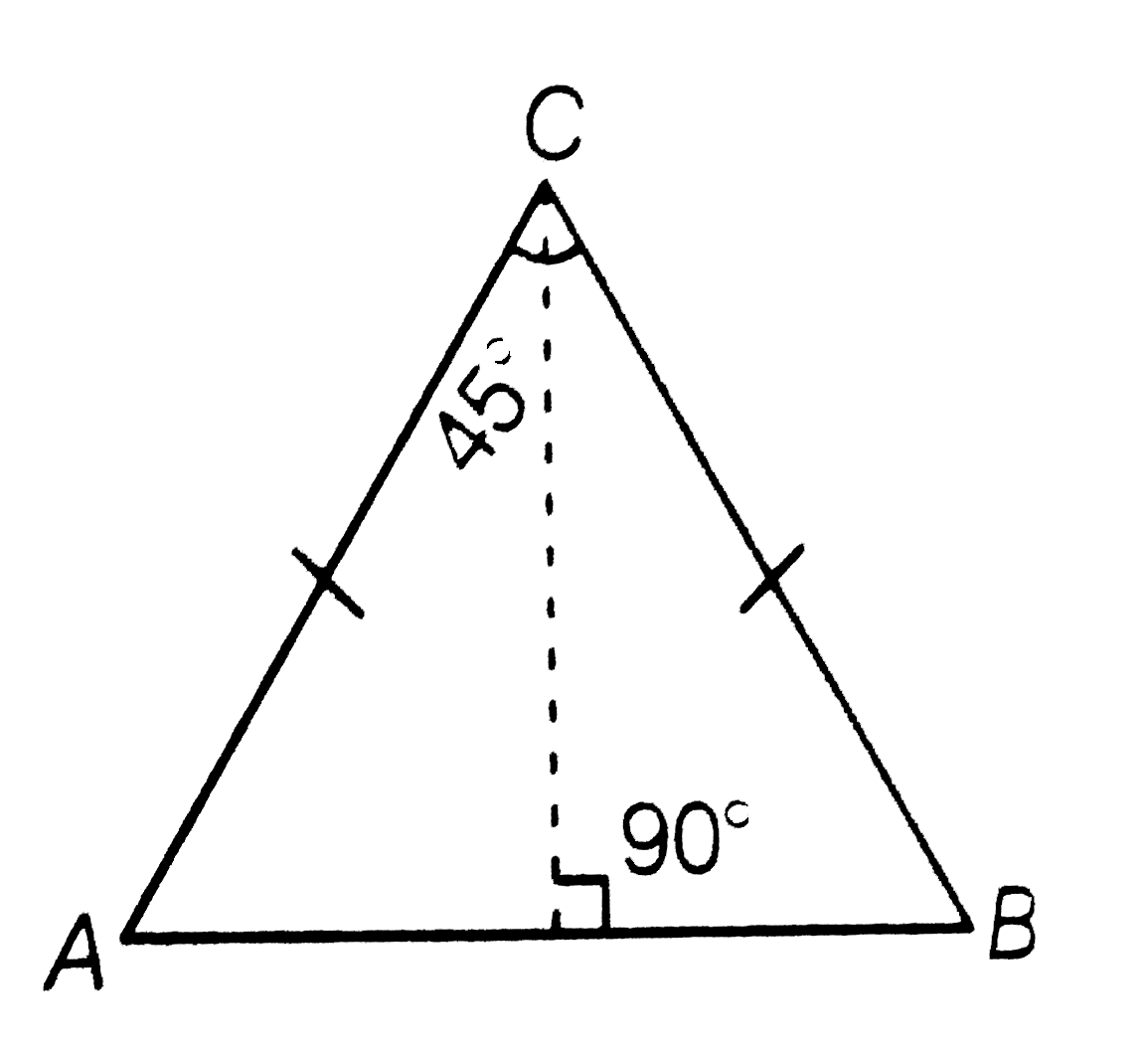
Now, draw CD `bot` AB.
Let at any instant t, the distance between them is AB.
Let AC=BC=x and AB=y
In `DeltaACD` and `DeltaDCB`,
`angleCAD = angleCBD`
`angleCDA = angleCDB=90^(@)`
`angleACD=angleDCB`
or `angleACD=1/2 xx angleACB`
`rArr angleACD=1/2 xx 45^(@)`
`rArr angleACD = pi/8`
`therefore sinpi/8 = (AD)/(AC)`
`rArr sinpi/8 = (AD)/(AC)`
`rArr sinpi/8 = (y//2)/(x)`
`rArr y/2 = xsinpi/8`
`rArr y=2x.sinpi/8`
Now, differentiating both sides w.r.t., we get
`(dy)/(dt) = 2.sinpi/8.(dx)/(dt)`
`=2.sinpi/8.v` `[therefore v=(dx)/(dt)]`
`=2v.(sqrt(2)-sqrt(2))/(2)` `[therefore sinpi/8 = (sqrt(2)-sqrt(2))/(2)]`
`=sqrt(2-sqrt(2))` v unit/s
Which is the rate at which A and B are bieng separated.
Also, `angleBCA=45^(@)`
Since, A and B are moving with same velocity v. so they will cover same distance in same time.
Therefore, `DeltaABC` is an isosceles triangle with AC=BC.
Now, draw CD `bot` AB.
Let at any instant t, the distance between them is AB.
Let AC=BC=x and AB=y
In `DeltaACD` and `DeltaDCB`,
`angleCAD = angleCBD`
`angleCDA = angleCDB=90^(@)`
`angleACD=angleDCB`
or `angleACD=1/2 xx angleACB`
`rArr angleACD=1/2 xx 45^(@)`
`rArr angleACD = pi/8`
`therefore sinpi/8 = (AD)/(AC)`
`rArr sinpi/8 = (AD)/(AC)`
`rArr sinpi/8 = (y//2)/(x)`
`rArr y/2 = xsinpi/8`
`rArr y=2x.sinpi/8`
Now, differentiating both sides w.r.t., we get
`(dy)/(dt) = 2.sinpi/8.(dx)/(dt)`
`=2.sinpi/8.v` `[therefore v=(dx)/(dt)]`
`=2v.(sqrt(2)-sqrt(2))/(2)` `[therefore sinpi/8 = (sqrt(2)-sqrt(2))/(2)]`
`=sqrt(2-sqrt(2))` v unit/s
Which is the rate at which A and B are bieng separated.



Similar Questions
Explore conceptually related problems
Two cyclists start from the junction of two perpendicular roads, there velocities being 3um//m in and 4um//m in , respectively. Find the rate at which the two cyclists separate.
Two cyclists start from the junction of two perpendicular roads, there velocities being 3um//m in and 4um//m in , respectively. Find the rate at which the two cyclists separate.
Places A and B are 100 km apart on a highway. One car start from A and another from B at the same time at different speeds. If the car travel in the same direction, they meet in 5 hours, if they travel towards each other, they meet in 1 hour. What are the speeds of the two cars?
Two Navy helicopters A and B are flying over the bay of Bengal at same altitude from the sea level to search a missing boat. Pilots of both the helicopters sight the boat the same time while they are part 10 km from each other. If the distance of the boat from A is 6 km and if the line segment AB subtends 60^(@) at the boat, find the distance of the boat from B.
Read the passage and Answer the following question: In, vacuum the velocity of light radiation with different wavelength is the same. But in a material medium, the velocity of different colour radiations is not the same and they travel with different paths. Due to this, the refractive index of the medium is different for different colours. If white beam of light is incident on a glass prism, the angle of refraction for different colours is different. When Sunlight is incident on a refracting surface, then it gets split into seven coloured spectrum and emerges out. The splitting of light into its component colours is called dispersion. Sir Isaac Newton was the first to use a glass prism to obtain the spectrum of Sunlight. A glass prism is transparent medium bounded by two plane surfaces inclined at an angle. When white light is dispersed into seven colours by a prism, different colours of light bend through different angles with respect to incident ray. Out of these seven colours, red light bends the least, while violet light bends the most. So, the rays of each colour emerge along different paths and becomes distinct. Hence, we get spectrum of seven - different colours. Q. Which light deviates the least and which one deviates the most ?
Read the passage and Answer the following question: In, vacuum the velocity of light radiation with different wavelength is the same. But in a material medium, the velocity of different colour radiations is not the same and they travel with different paths. Due to this, the refractive index of the medium is different for different colours. If white beam of light is incident on a glass prism, the angle of refraction for different colours is different. When Sunlight is incident on a refracting surface, then it gets split into seven coloured spectrum and emerges out. The splitting of light into its component colours is called dispersion. Sir Isaac Newton was the first to use a glass prism to obtain the spectrum of Sunlight. A glass prism is transparent medium bounded by two plane surfaces inclined at an angle. When white light is dispersed into seven colours by a prism, different colours of light bend through different angles with respect to incident ray. Out of these seven colours, red light bends the least, while violet light bends the most. So, the rays of each colour emerge along different paths and becomes distinct. Hence, we get spectrum of seven - different colours. Q. How do emergent rays appear ?
Read the passage and Answer the following question: In, vacuum the velocity of light radiation with different wavelength is the same. But in a material medium, the velocity of different colour radiations is not the same and they travel with different paths. Due to this, the refractive index of the medium is different for different colours. If white beam of light is incident on a glass prism, the angle of refraction for different colours is different. When Sunlight is incident on a refracting surface, then it gets split into seven coloured spectrum and emerges out. The splitting of light into its component colours is called dispersion. Sir Isaac Newton was the first to use a glass prism to obtain the spectrum of Sunlight. A glass prism is transparent medium bounded by two plane surfaces inclined at an angle. When white light is dispersed into seven colours by a prism, different colours of light bend through different angles with respect to incident ray. Out of these seven colours, red light bends the least, while violet light bends the most. So, the rays of each colour emerge along different paths and becomes distinct. Hence, we get spectrum of seven - different colours. Q. Write the colours of the Spectrum ?
Read the passage and answer the following question: In, vacuum the velocity of light radiation with different wavelength is the same. But in a material medium, the velocity of different colour radiations is not the same and they travel with different paths. Due to this, the refractive index of the medium is different for different colours. If white beam of light is incident on a glass prism, the angle of refraction for different colours is different. When Sunlight is incident on a refracting surface, then it gets split into seven coloured spectrum and emerges out. The splitting of light into its component colours is called dispersion. Sir Isaac Newton was the first to use a glass prism to obtain the spectrum of Sunlight. A glass prism is transparent medium bounded by two plane surfaces inclined at an angle. When white light is dispersed into seven colours by a prism, different colours of light bend through different angles with respect to incident ray. Out of these seven colours, red light bends the least, while violet light bends the most. So, the rays of each colour emerge along different paths and becomes distinct. Hence, we get spectrum of seven - different colours. Q. What is dispersion ?
Read the passage and Answer the following question: In, vacuum the velocity of light radiation with different wavelength is the same. But in a material medium, the velocity of different colour radiations is not the same and they travel with different paths. Due to this, the refractive index of the medium is different for different colours. If white beam of light is incident on a glass prism, the angle of refraction for different colours is different. When Sunlight is incident on a refracting surface, then it gets split into seven coloured spectrum and emerges out. The splitting of light into its component colours is called dispersion. Sir Isaac Newton was the first to use a glass prism to obtain the spectrum of Sunlight. A glass prism is transparent medium bounded by two plane surfaces inclined at an angle. When white light is dispersed into seven colours by a prism, different colours of light bend through different angles with respect to incident ray. Out of these seven colours, red light bends the least, while violet light bends the most. So, the rays of each colour emerge along different paths and becomes distinct. Hence, we get spectrum of seven - different colours. Q. What is spectrum ?
Recommended Questions
- Two men Pa n dQ start with velocity u at the same time from the juncti...
Text Solution
|
- Two men A and B start with velocities v at the same time from the junc...
Text Solution
|
- Two men Pa n dQ start with velocity u at the same time from the juncti...
Text Solution
|
- दो व्यक्ति A व B एकसमान वेग व् से एक-दूसरे से 45^@ का कोण बनती हुई सड़क...
Text Solution
|
- Two men A and B start with velocities v at the same time from the junc...
Text Solution
|
- Two men Pa n dQ start with velocity u at the same time from the juncti...
Text Solution
|
- Two cyclists start from the junction of two perpendicular roads, there...
Text Solution
|
- Two cyclists start from the junction of two perpendicular roads, there...
Text Solution
|
- Two men Pa n dQ start with velocity u at the same time from the juncti...
Text Solution
|