Home
Class 12
MATHS
Consider the frequency distribution, whe...

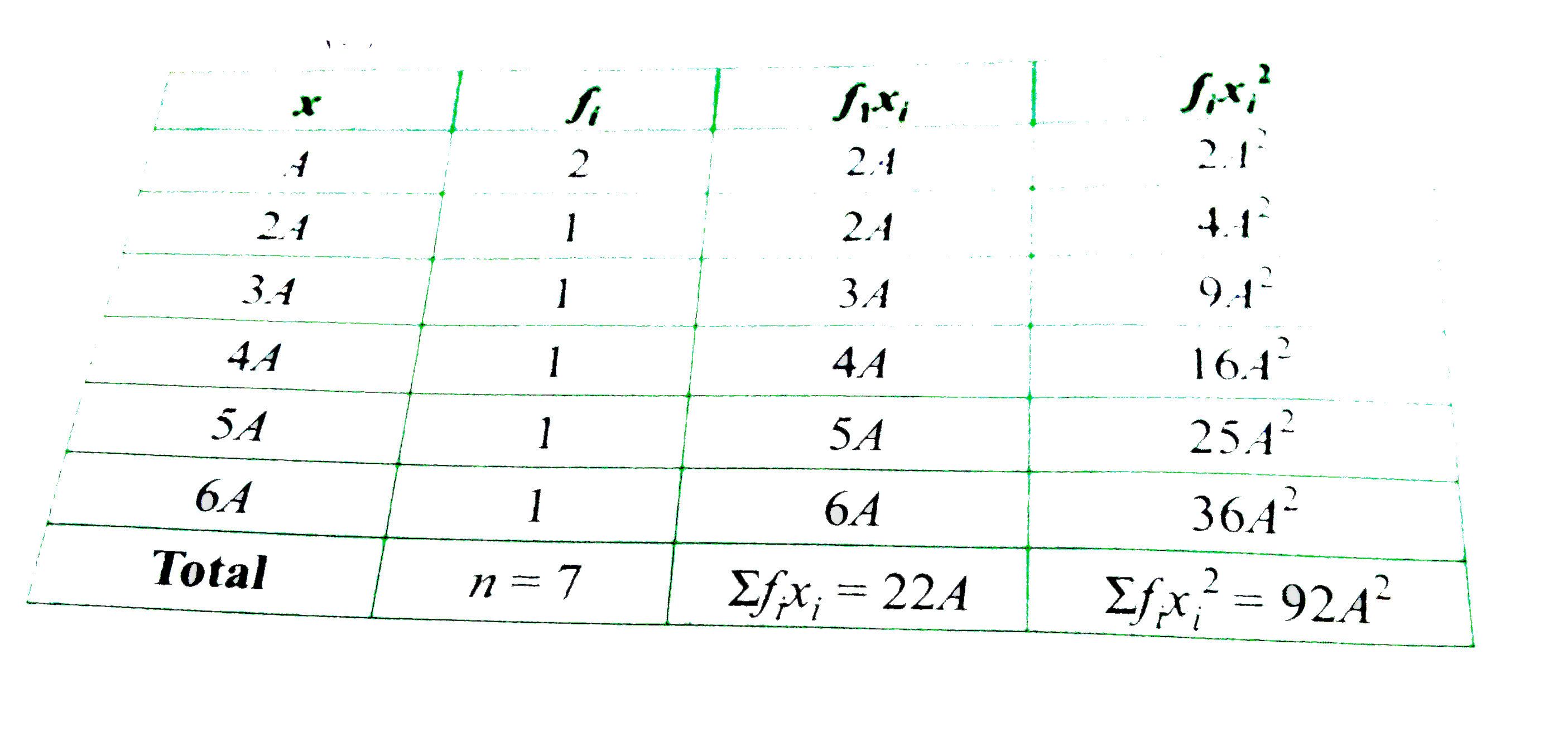
Consider the frequency distribution, where A is a positive interger :
`{:("x",A,2A,3A,4A,5A,6A),("f",2,1,1,1,1,1):}`

Text Solution

Verified by Experts

The correct Answer is:
C


`therefore sigma^(2)=(sum f_(i)x_(i)^(2))/(n)-((sum f_(i)x_(i))/(n))^(2)`
`implies 160=(92 A^(2))/(7)-((22 A)/(7))^(2)`
`implies 160=(92A^(2))/(7)-(484 A^(2))/(49)`
`implies 160=(644-484)(A^(2))/(49)`
`implies 160=(160 A^(2))/(49)`
`implies A^(2)=49`
`therefore A=7`
Promotional Banner

Topper's Solved these Questions

  • STATISTICS

    CENGAGE|Exercise Exercise 11.1|5 Videos
  • STATISTICS

    CENGAGE|Exercise Exercise 11.2|6 Videos
  • SOLUTIONS AND PROPERTIES OF TRIANGLE

    CENGAGE|Exercise Comprehension Type|6 Videos
  • STRAIGHT LINE

    CENGAGE|Exercise Multiple Correct Answers Type|8 Videos

Similar Questions

Explore conceptually related problems

The frequency distribution is given below. {:(x,k,2k,3k,4k,5k,6k),(f,2,1,1,1,1,1):} In the table, k is a positive integer, has a varience of 160. Determine the value of k.

The frequency distribution is given below. {:(x,k,2k,3k,4k,5k,6k),(f,2,1,1,1,1,1):} In the table, k is a positive integer, has a varience of 160. Determine the value of k.

If the mean of the distribution is 2.6, then the value of y is {:("Variate x",1,2,3,4,5),("Frequency f of x",4,5,y,1,2):}

Consider the real function f(x) =1 -2x find f(-1) and f(2)

Consider the function f(x)={2x+3,xlt=1 -x^2+6,x >1

consider the relation R ={ (x,2x -1 ) |x in A }, where A = { 1,-1,3 } write the range of R .

if (x_(1),x_(2))^(2)+(y_(1)-y_(2))^(2)=a^(2), (x_(2)-x_(3))^(2)+(y_(2)-y_(3))^(2)=b^(2) (x_(3)-x_(1))^(2)+(y_(3)-y_(1))^(2)=c^(2). where a,b,c are positive then prove that 4 |{:(x_(1),,y_(1),,1),(x_(2) ,,y_(2),,1),( x_(3),, y_(3),,1):}| = (a+b+c) (b+c-a) (c+a-b)(a+b-c)

consider the relation R ={ (x,2x -1 ) |x in A }, where A = { 1,-1,3 } write R in roster form

The normal to the curve y(x-2)(x-3)=x+6 at the point where the curve intersects the y-a xi s , passes through the point : (1/2,-1/3) (2) (1/2,1/3) (3) (-1/2,-1/2) (4) ((1/(2,1))/2)

Examine each of the following relations given below and state in each case, giving reasons whether it is a function or not ? (i) R={(4,1),(5,1),(6,7)} (ii) R={(2,3),(2,5),(3,3),(6,6)} (iii) R={(1,2),(2,3),(3,4),(4,5),(5,6),(6,7)} (iv) R={(1,1),(2,1),(3,1),(4,1),(5,1)}

