Home
Class 12
MATHS
A parallelepiped S has base points A ,B ...

A parallelepiped `S` has base points `A ,B ,Ca n dD` and upper face points `A^(prime),B^(prime),C^(prime),a n dD '` . The parallelepiped is compressed by upper face `A ' B ' C ' D '` to form a new parallepiped `T` having upper face points `A",B",C"a n dD"` . The volume of parallelepiped `T` is 90 percent of the volume of parallelepiped `Sdot` Prove that the locus of `A"` is a plane.

Text Solution

Verified by Experts
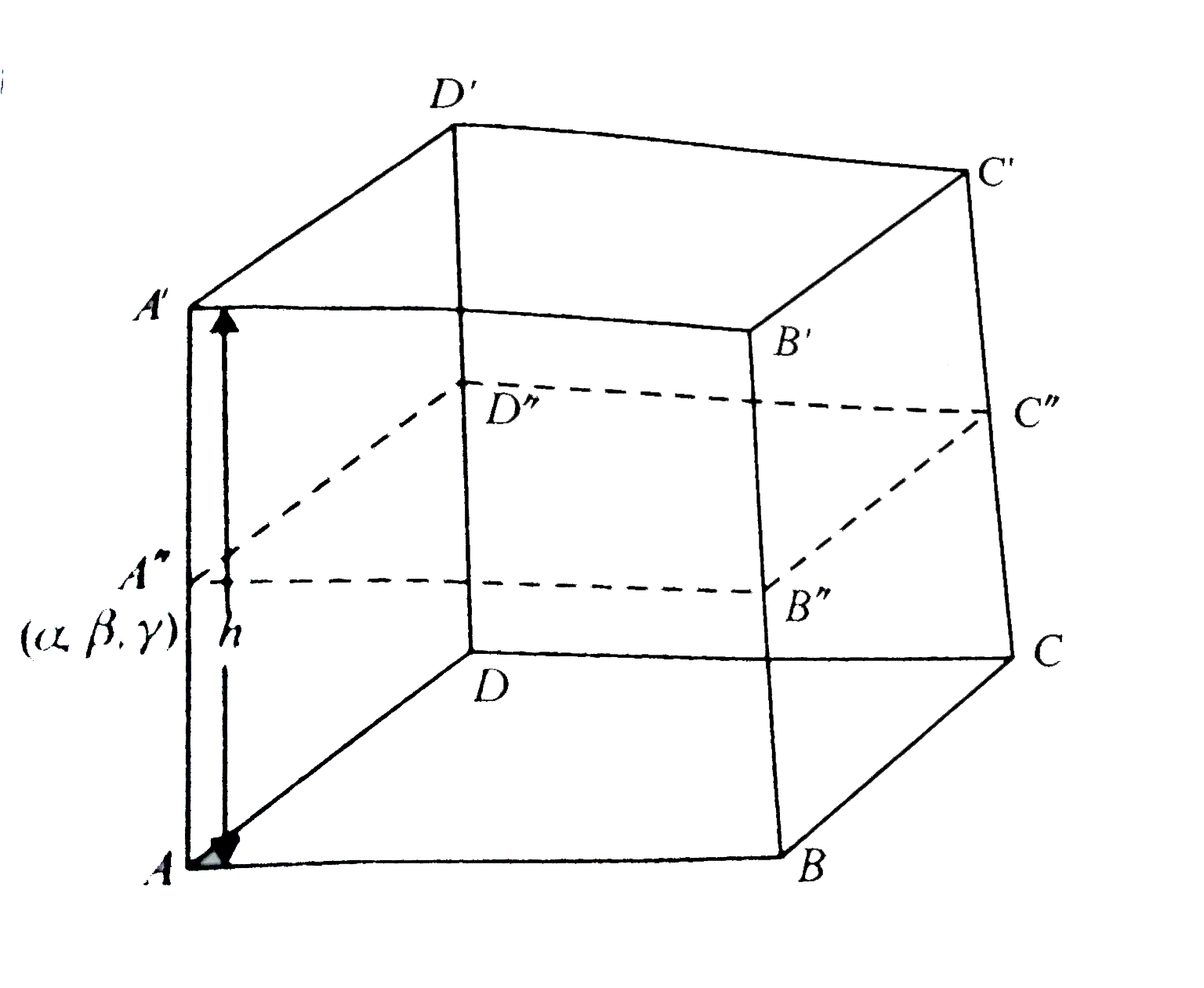
S is the parallelepiped with base point `A, B, C and D` and upper face points `A', B', C' and D'`. Let its volume ve `V_(s)`. By compressing it by upper face `A', B', C' and D'`, a new parallelepiped T is formed whose upper face points are now `A'', B'', C'' and D''`. Let its volume be `V_(T)`.
Let `h` be the height of original parallelepiped S. Then
`" "V_(S)= ("area of " ABCD)xxh" "` (i)
Let equation of plane `ABCD` be `ax+by +cz+d=0 and A''(alpha, beta, gamma)`.

Then the height of the new parallelepiped T is the length of the perpendicular from `A''` to `ABCD`, i.e., `(aalpha +bbeta+cgamma+d)/(sqrt(a^(2)+b^(2)+c^(2))`. Therefore
`" "V_(T)= ("ar "ABCD)xx((aalpha+bbeta+cgamma+d))/(sqrt(a^(2)+b^(2)+c^(2))" "` (ii)
But given that `V_(T)= (90)/(100)V_(s)" "` (iii)
From (i), (ii) and (iii), we get
`" "(aalpha+bbeta+cgamma+d)/(sqrt(a^(2)+b^(2)+c^(2))= 0.9 h`
or `" "aalpha+bbeta+cgamma+d-0.9 hsqrt(a^(2)+b^(2)+c^(2))=0`
Therefore, the locus of `A'' (alpha, beta, gamma)` is `ax+by +cz+d -0.9 h sqrt(a^(2)+b^(2)+c^(2))=0`, which is a plane parallel to `ABCD`. Hence proved.
Promotional Banner

Topper's Solved these Questions

  • THREE-DIMENSIONAL GEOMETRY

    CENGAGE|Exercise Exercise (Numerical)|10 Videos
  • THREE DIMENSIONAL GEOMETRY

    CENGAGE|Exercise Question Bank|12 Videos
  • TRIGNOMETRIC RATIOS IDENTITIES AND TRIGNOMETRIC EQUATIONS

    CENGAGE|Exercise Question Bank|4 Videos

Similar Questions

Explore conceptually related problems

A parallelepiped is formed by planes drawn parallel to coordinate axes through the points A=(1,2,3) and B=(9,8,5). The volume of that parallelepiped is equal to (in cubic units)

Fid the condition if lines x=a y+b ,z=c y+da n dx=a^(prime)y+b^(prime), z=c^(prime)y+d ' are perpendicular.

Find the condition if lines x=a y+b ,z=c y+da n dx=a^(prime)y+b^(prime), z=c^(prime)y+d ' are perpendicular.

The line joining the points (-2,1,-8)a n d(a ,b ,c) is parallel to the line whose direction ratios are 6,2,a n d3. Find the values of a ,b and c

The volume of he parallelepiped whose sides are given by vec O A=2i-2, j , vec O B=i+j-ka n d vec O C=3i-k is a. 4/13 b. 4 c. 2/7 d. 2

Find the altitude of a parallelepiped whose three coterminous edtges are vectors vec A= hat i+ hat j+ hat k , vec B=2 hat i+4 hat j- hat ka n d vec C= hat i+ hat j+3 hat kw i t h vec Aa n d vec B as the sides of the base of the parallepiped.

A variable plane passes through a fixed point (a ,b ,c) and cuts the coordinate axes at points A ,B ,a n dCdot Show that eh locus of the centre of the sphere O A B Ci s a/x+b/y+c/z=2.

The volume of a tetrahedron formed by the coterminous edges vec a , vec b ,a n d vec c is 3. Then the volume of the parallelepiped formed by the coterminous edges vec a+ vec b , vec b+ vec ca n d vec c+ vec a is a. 6 b. 18 c. 36 d. 9

If the two diagonals of one its faces are 6 hat i+6 hat ka n d4 hat j+2 hat k and of the edges not containing the given diagonals is c=4 hat j-8 hat k , then the volume of a parallelepiped is a. 60 b. 80 c. 100 d. 120

The number of triangles that can be formed with 10 points as vertices n of them being collinear, is 110. Then n is a. 3 b. 4 c. 5 d. 6

