Home
Class 12
MATHS
A balloon of radius r subtends an angle ...

A balloon of radius r subtends an angle` alpha` at the eyes of an observer and the center of balloon from the eye is `beta` . Find the height of the center of the balloon from the eye of observer .

Text Solution

Verified by Experts
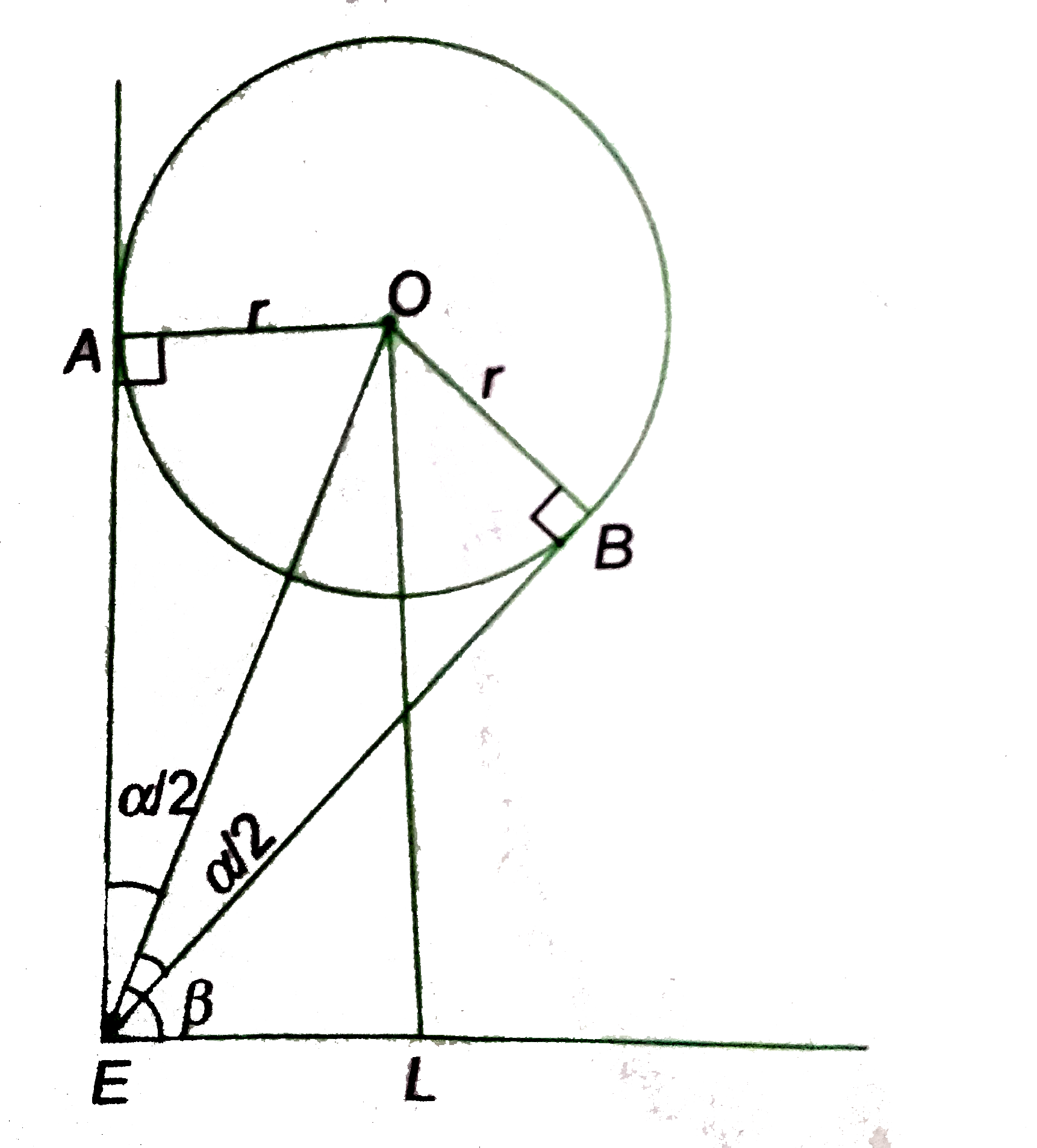
Let O be the centre of the balloon of radius which subtends an angle` alpha` at E , the eyes of observer .

EA and EB are the tangents to the balloon .
`therefore angle OEA = angle OEB =alpha//2`
Let the height OL of the balloon be h .
In `Delta` OLE ,
h=OE sinbeta
`= rcosec(alpha//2)sinbeta` ( in triangle OBE)
`=(rsinbeta)/(sin(alpha//2))`
Promotional Banner

Topper's Solved these Questions

  • HIGHT AND DISTANCE

    CENGAGE|Exercise Exercise|18 Videos
  • HIGHT AND DISTANCE

    CENGAGE|Exercise JEE Previous Year|3 Videos
  • GRAPHS OF TRIGONOMETRIC FUNCTIONS

    CENGAGE|Exercise Exercise|22 Videos
  • HYPERBOLA

    CENGAGE|Exercise JEE Advanced Previous Year|14 Videos

Similar Questions

Explore conceptually related problems

The line drawn from the eye of an observe to the point of object is ____.

A balloon rises straight up at 10m/s. An observer is 40 m away from the spot where the balloon left the ground. Find the rate of change of the balloon's angle of elevation in radian per second when the balloon is 30 metres above the ground.

A large balloon has been tied with a rope and it is floating in the air. A person has observed the balloon from the top of a building at angle of elevation of theta_(1) and foot of the rope at an angle of depression of theta_(2 ) . The height of the building is h feet. Draw the diagram for this data.

From a point on a hillside of constant inclination , the angle of elevation of the top a flagstaff on its summit is observed to be alpha and a meters nears the top of the hill, it is beta .If h is the height of the flagstaff ,find the inclination of the hill to the horizon .

Two persons are standing 'x' metres apart from each other and the height of the first person is double that of the other. If from the middle points of the linejoining their their feet an observe finds the angular elevations of their tops to be complementary, then the height of the shorter person (in metres) is

