Home
Class 12
MATHS
If f(x)=3sqrt(1−x^2)​+3sqrt(1−x^2)​, the...

If `f(x)=3sqrt(1−x^2)​+3sqrt(1−x^2)​, then f(x)` is

Text Solution

Verified by Experts
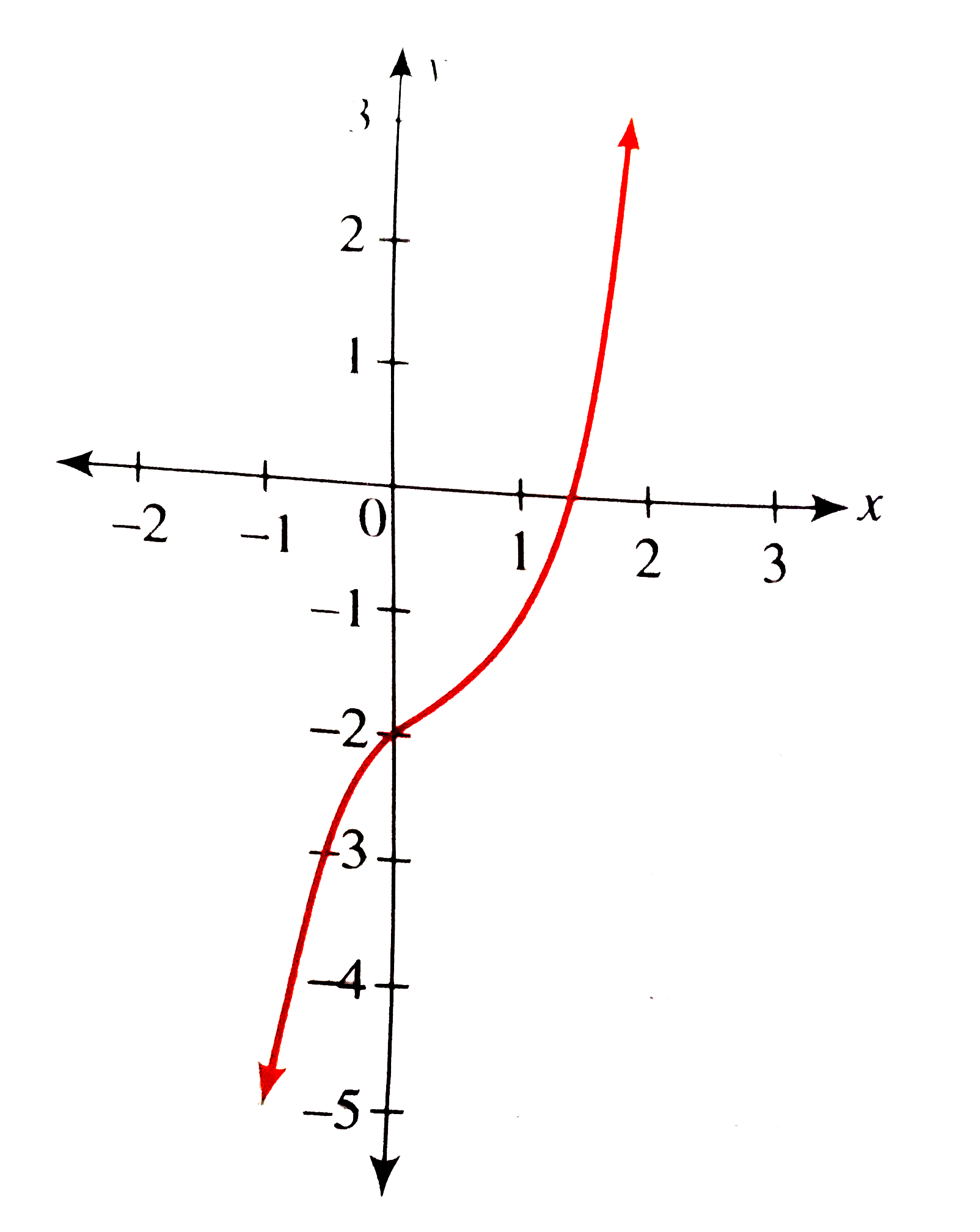
We have `y=f(x)=x^(3)-x^(2)+x-2`
`(dy)/(dx)=3x^(2)-2x+1 gt 0, AA x in R`
So `y=f(x)` increases.
Since the leading coefficient is '3', when `x rarr oo, f(x)rarr oo` and when `xrarr-oo, f(x)rarr-oo`.
`f(0)=-2`, hence the graph cuts the x-axis for some positive value of x.
Thus, the graph will cut the x-axis at one point only.
Also `f(1)=-1` and `f(2)=4`.
Thus, the graph will cut the x-axis somewhere between '1' and '2'.
From the above discussion, the graph of `y=f(x)` can be drawn as shown in the following figure.
Promotional Banner

Topper's Solved these Questions

  • GRAPHS OF POLYNOMIAL AND RATIONAL FUNCTIONS

    CENGAGE|Exercise Exercise|13 Videos
  • GRAPHS OF POLYNOMIAL AND RATIONAL FUNCTIONS

    CENGAGE|Exercise Exercises|4 Videos
  • GRAPHICAL TRANSFORMATIONS

    CENGAGE|Exercise Exercise|14 Videos
  • GRAPHS OF ELEMENTARY FUNCTIONS

    CENGAGE|Exercise Exercise|34 Videos

Similar Questions

Explore conceptually related problems

If f(x)=sqrt(4-x^2)+sqrt(x^2-1) , then the maximum value of (f(x))^2 is ____________

If f(x)=sqrt(4-x^2)+sqrt(x^2-1) , then the maximum value of (f(x))^2 is ____________

Let f(x)=sqrt(1+x^(2)) then

Let f(x)+f(y)=f(xsqrt(1-y^2)+ysqrt(1-x^2))[f(x) is not identically zero]. Then f(4x^3-3x)+3f(x)=0 f(4x^3-3x)=3f(x) f(2xsqrt(1-x^2)+2f(x)=0 f(2xsqrt(1-x^2)=2f(x)

If f'(x) = sqrt(x) and f(1) = 2 then f(x) is :

Which of the following function is (are) even, odd, or neither? f(x)=x^2sinx f(x)=sqrt(1+x+x^2)-sqrt(1-x+x^2) f(x)=log((1-x)/(1+x)) f(x)=log(x+sqrt(1+x^2)) f(x)=sinx-cosx f(x)=(e^x+e^(-x))/2

If f^(prime)(x)=1/(-x+sqrt(x^2+1)) and f(0)=(1+sqrt(2))/2 then f(1) is equal to- (a) log"(sqrt(2)+1) (b) 1 (c) 1+sqrt(2) (d) none of these

Let f(x)=int x^2/((1+x^2)(1+sqrt(1+x^2)))dx and f(0)=0 then f(1) is

