Home
Class 12
MATHS
Whether the given equation sqrt ((secθ−...

Whether the given equation `sqrt ((secθ−1)/(secθ+1)​)​= cotθ−cscθ` ?

Text Solution

Verified by Experts
(i) We have `y=f(x)=2x^(3)-9x^(2)+12x-(9//2)`
`:. f'(x)=6x^(2)-18x+12=6(x^(2)-3x+2)=6(x-1)(x-2)`
Now `f'(x)=0 rArr x=1 and x=2`
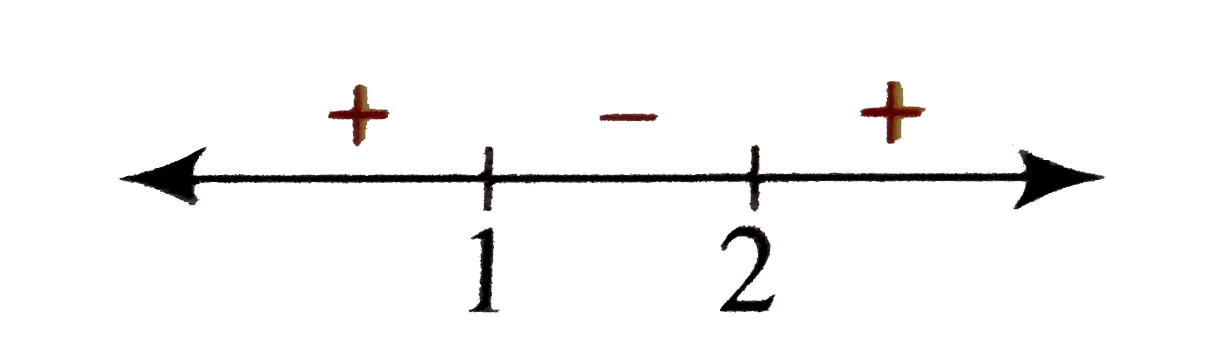
The sign scheme of `y=f'(x)` is as follows.

So `x=2` is the point of minima and `x=1` is the point of maxima.
`f(1)=2-9+12-(9//2) gt 0`
and `f(2)=16-36+24-(9//2) lt 0`
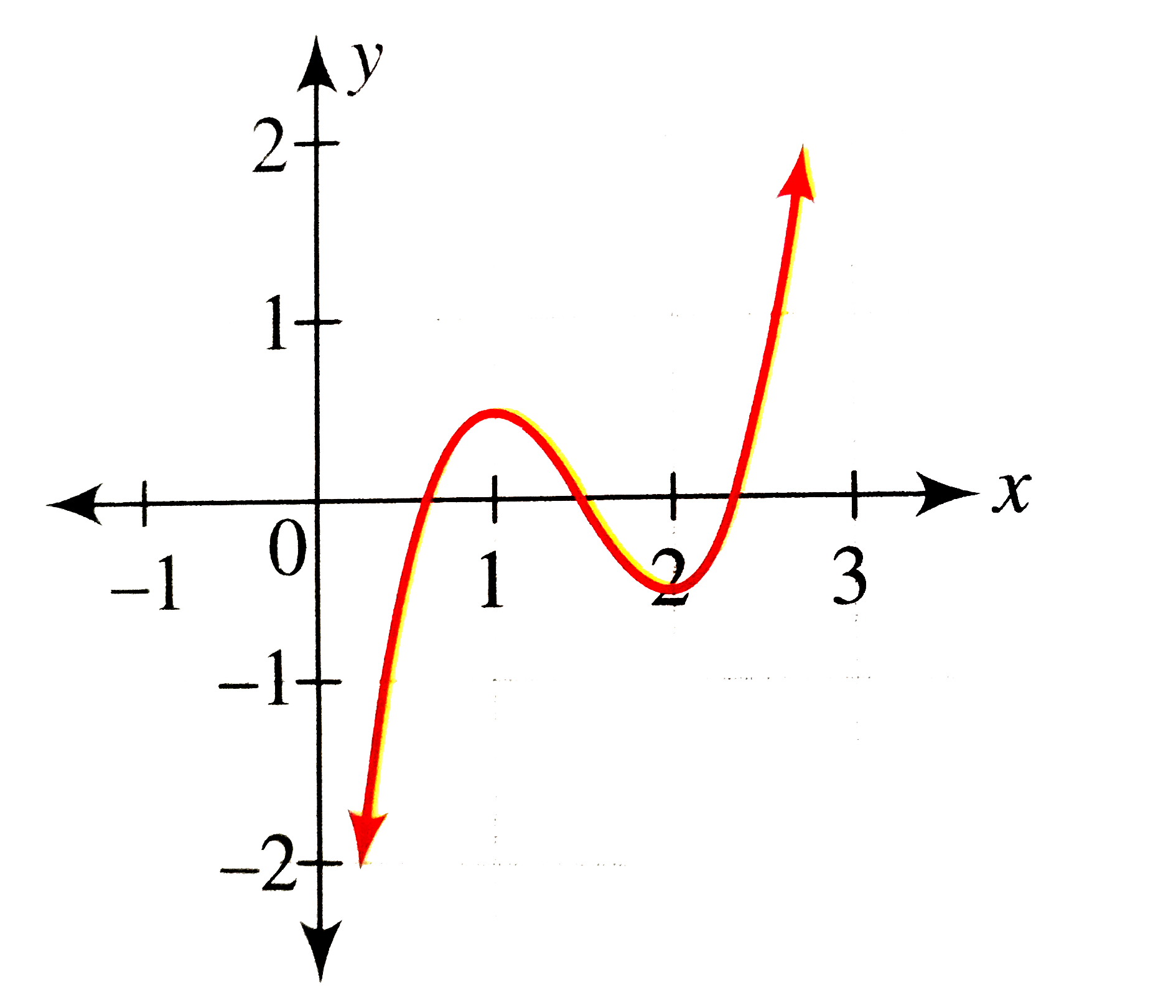
Hence the graph of the function `y=f(x)` is as shown in the following figure.

As shown in the figure, the graph cute the x-axis at three distinct points.
Hence the equation `f(x)=0` has three distinct roots.
(ii) We have `y=f(x)=2x^(3)-9x^(2)+12x-3`
`f'(x)=0 rArr x=1` and `x=2`
Also `f(1)=2-9+12-3 = 2 "and" f(2) = 16-36+24-3=1`
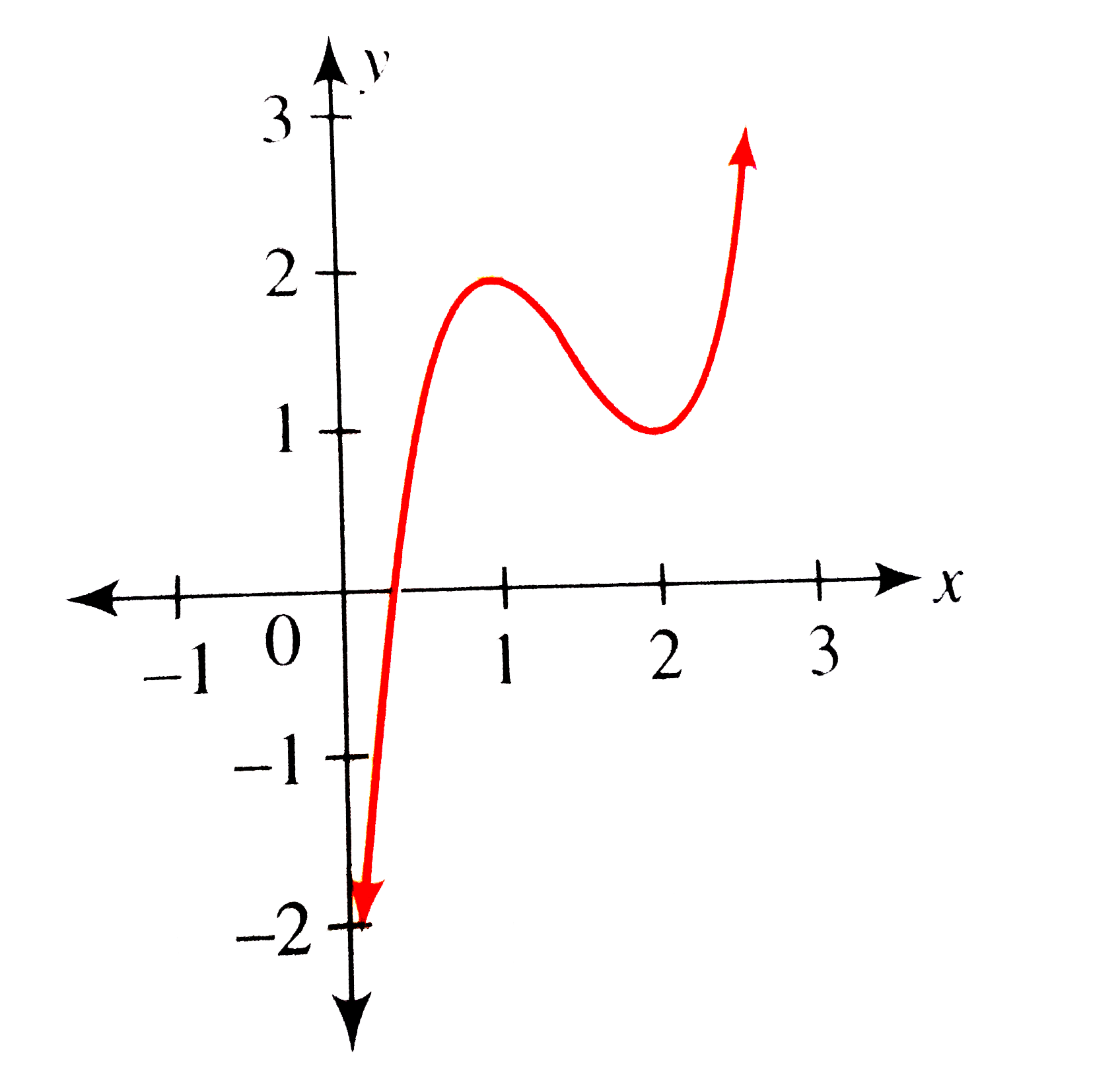
Hence the graph of `y=f(x)` is as shown in the following figure.

Thus, from the graph we can see that `f(x)=0` has only one real root, though `y=f(x)` has two turning points.
Promotional Banner

Topper's Solved these Questions

  • GRAPHS OF POLYNOMIAL AND RATIONAL FUNCTIONS

    CENGAGE|Exercise Exercise|13 Videos
  • GRAPHS OF POLYNOMIAL AND RATIONAL FUNCTIONS

    CENGAGE|Exercise Exercises|4 Videos
  • GRAPHICAL TRANSFORMATIONS

    CENGAGE|Exercise Exercise|14 Videos
  • GRAPHS OF ELEMENTARY FUNCTIONS

    CENGAGE|Exercise Exercise|34 Videos

Similar Questions

Explore conceptually related problems

Check whether the given equation is a quadratic equation. i) (x+1)^2=3(x-1) ii) (x^2-4x)=(-2)(4-x) .

Solve the equations: cos 2theta = (sqrt(5) + 1)/(4)

Answer the equation: int(1)/(x+sqrt(x))dx

Check whether the equations are quadratic or not? x^(2)+(1)/(x^(2))=2(x ne0)

Solve the equation sqrt(a(2^x-2)+1)=1-2^x ,x in Rdot

The equation sqrt(x+1) - sqrt(x-1) = sqrt(4x-1) has

The degree of the differntial equation sqrt(1+(dy/dx)^(1//3))=(d^(2)y)/(dx^(2))

Solve the equations: sin theta + sqrt(3) cos theta = 1

Solve the differential equations : (dy)/(dx)=sqrt((1-y^(2))/(1-x^(2)))

Check whether the equations are quadratic or not? (2x+1)(3x+1)=b(x-1)(x-2)