Home
Class 12
MATHS
Let f(x)=x^(3)-9x^(2)+24x+c=0 have three...

Let `f(x)=x^(3)-9x^(2)+24x+c=0` have three real and distinct roots `alpha, beta` and `lambda`.
(i) Find the possible values of c.
(ii) If `[alpha]+[beta]+[lambda]=8`, then find the values of c, where `[*]` represents the greatest integer function.
(ii) If `[alpha]+[beta]+[lambda]=7`, then find the values of c, where `[*]` represents the greatest integer function.s

Text Solution

Verified by Experts
We have `y=f(x)=x^(3)-9x^(2)+24x+c`
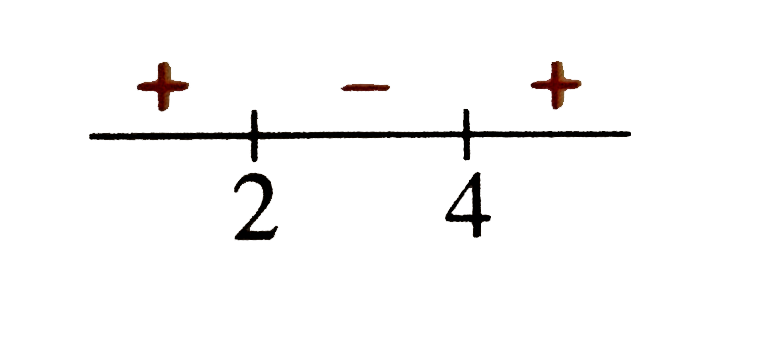
`f'(x)=3x^(2)-18x+24=3(x-2)(x-4)`
Sign scheme of `f'(x)` is as follows.

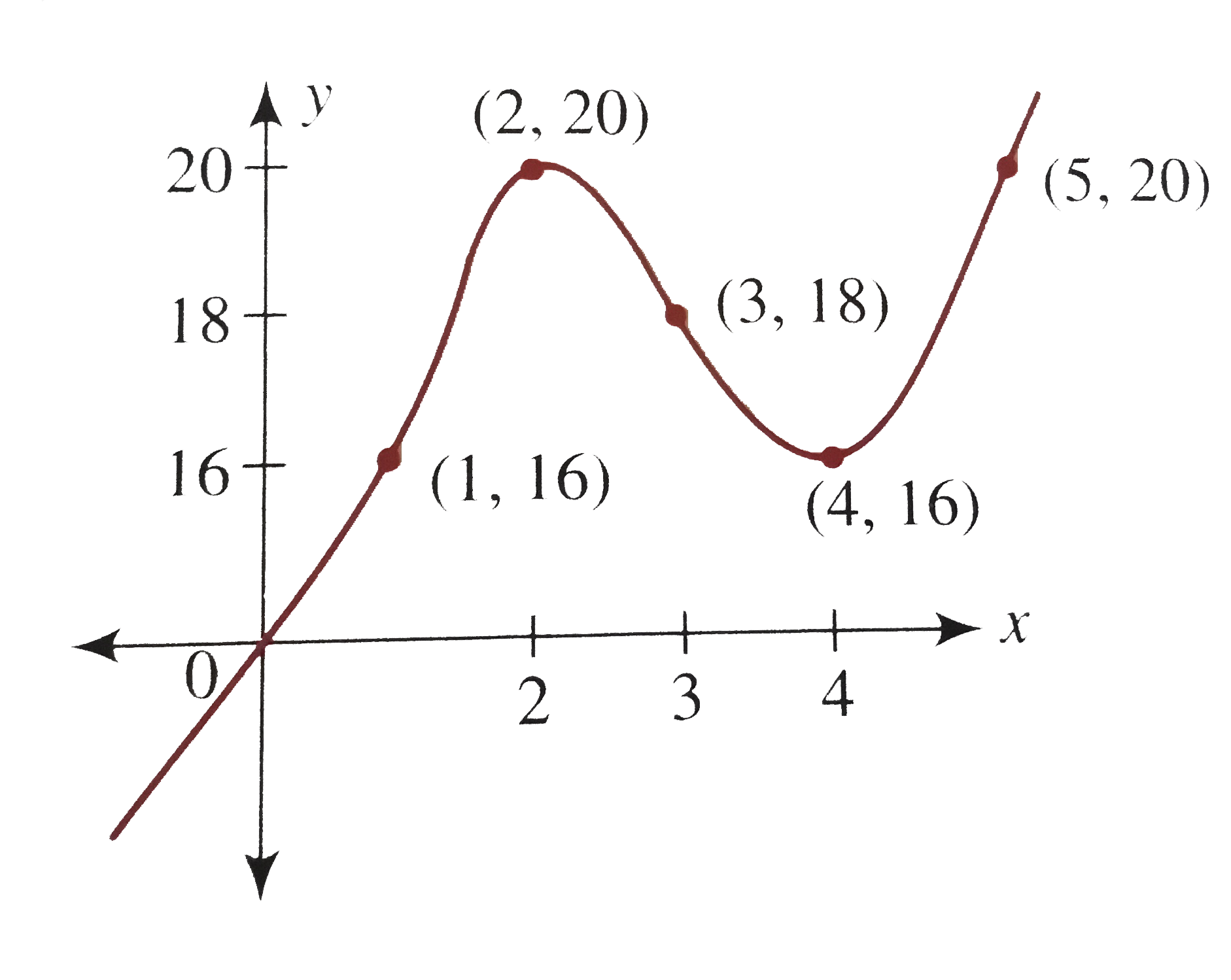
x=4 is the point of local minima and x = 2 is the point of local maxima.
`f(2)=20, f(4)=16`
`If c=0, " then " f(0)=0`
So the graph of `y=f(x)` for `c=0` can be draws as follows.

From the figure, for three real roots of `f(x)=x^(3)-9x^(2)+24x+c=0`, c must lie in the interval `(-20, -16)`.
`:. f(0)=c lt 0`
`f(1)=1-9 +24+c=c+16 lt 0, AA c in (-20, -16)`
`f(2)=8-36+48+c=c+20 gt 0, AA c in (-20, -16)`
`:. alpha in (1,2) rArr [alpha]=1`
`f(3)=27-81+72=18+c`
`rArr f(3) gt 0 " if " c in (-20, -18) " or " f(3) lt 0 " if " c in (-18, -16)`
or ` beta in (2, 3) " if " c in (-18, -16)`
and `beta in (3, 4) " if " c in (-20, -18)`
Now `" " f(4)=64-144+96+c=16 +c lt0, AA c in (-20, -16)`
`f(5) = 125 - 225 +120 +c = c+ 20 gt 0, AA c in (-20, -16)`
` :. lambda in (4, 5) rArr [lambda] = 4`
Thus `" " [alpha]+[beta]+[lambda]= {{:(1+3+4", " -20 lt c lt -18),(1+2+4", " -18 lt c lt -16):}`
Promotional Banner

Topper's Solved these Questions

  • GRAPHS OF POLYNOMIAL AND RATIONAL FUNCTIONS

    CENGAGE|Exercise Exercise|13 Videos
  • GRAPHS OF POLYNOMIAL AND RATIONAL FUNCTIONS

    CENGAGE|Exercise Exercises|4 Videos
  • GRAPHICAL TRANSFORMATIONS

    CENGAGE|Exercise Exercise|14 Videos
  • GRAPHS OF ELEMENTARY FUNCTIONS

    CENGAGE|Exercise Exercise|34 Videos

Similar Questions

Explore conceptually related problems

IF [x^(2) - 2x + a]=0 has no solution, then find the values of a (where [*] represents the greatest integer).

Evaluate : [lim_(x to 0) (tan x)/(x)] , where [*] represents the greatest integer function.

Evaluate: int_0^(100)x-[x]dx where [dot] represents the greatest integer function).

Evaluate: ("lim")_(xvec0)(tanx)/x where [dot] represents the greatest integer function

Find x satisfying [tan^(-1)x]+[cot^(-1)x]=2, where [.] represents the greatest integer function.

Find the value of x in [1,3] where the function [x^2+1]([dot] represents the greatest integer function) is discontinuous.

Draw the graph of f(x) = cos pi[x] , where [*] represents the greatest integer function. Find the period of the function.

Find the domain of f(x)=sqrt(([x]-1))+sqrt((4-[x])) (where [ ] represents the greatest integer function).

Evaluate : ("lim")_(xrarr2^+) ([x-2])/("log"(x-2)) , where [.] represents the greatest integer function.

The greatest value of f(x)=cos(x e^([x])+7x^2-3x),x in [-1,oo], is (where [.] represents the greatest integer function). -1 (b) 1 (c) 0 (d) none of these