`y=f(x)=(x^(2)-x+1)/(x^(2)+x+1)`
The domain of the function is R as `x^(2)+x+1=0` has no real roots.
1. y-intercept
`f(0)=1`
So the graph cuts the y-axis at (0,1).
2. x-intercept (zeros)
Put `y=0` or `x^(2)-x+1=0`.
This equation has no real roots.
Hence the graph does not intersect the x-axis.
3. Asymptotes
Vertical asymptotes
Since `x^(2)+x+1=0` had no real roots, the graph has no vertical asymptote.
Horizontal asymptotes
Since the degree of the numerator and that of the denominator are same, the horizontal asymptote is
` y= underset(x rarr +- oo)lim (x^(2)-x+1)/(x^(2)+x+1)`
or `y= underset(xrarr +- oo)lim (1-(1)/(x)+(1)/(x^(2)))/(1+(1)/(x)+(1)/(x^(2)))` or `y=1`
Clearly, the graph has no ablique asymptote.
4. Extremum
`f'(x)=(2(x^(2)-1))/((x^(2)+x+1)^(2))`
`f'(x)=0 rArr x = +-1`
Sign scheme of `f'(x)` is as follows.
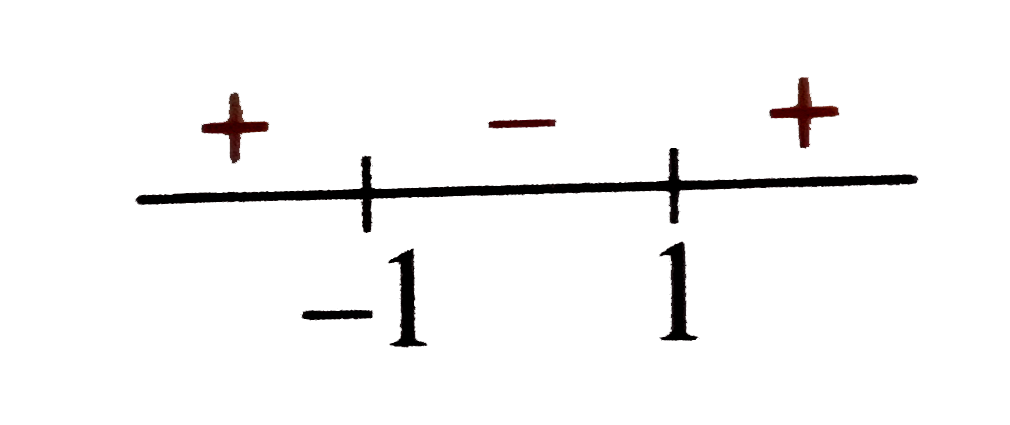
From the sign scheme, x = 1 is the point of minima and x = -1 is the point of maxima.
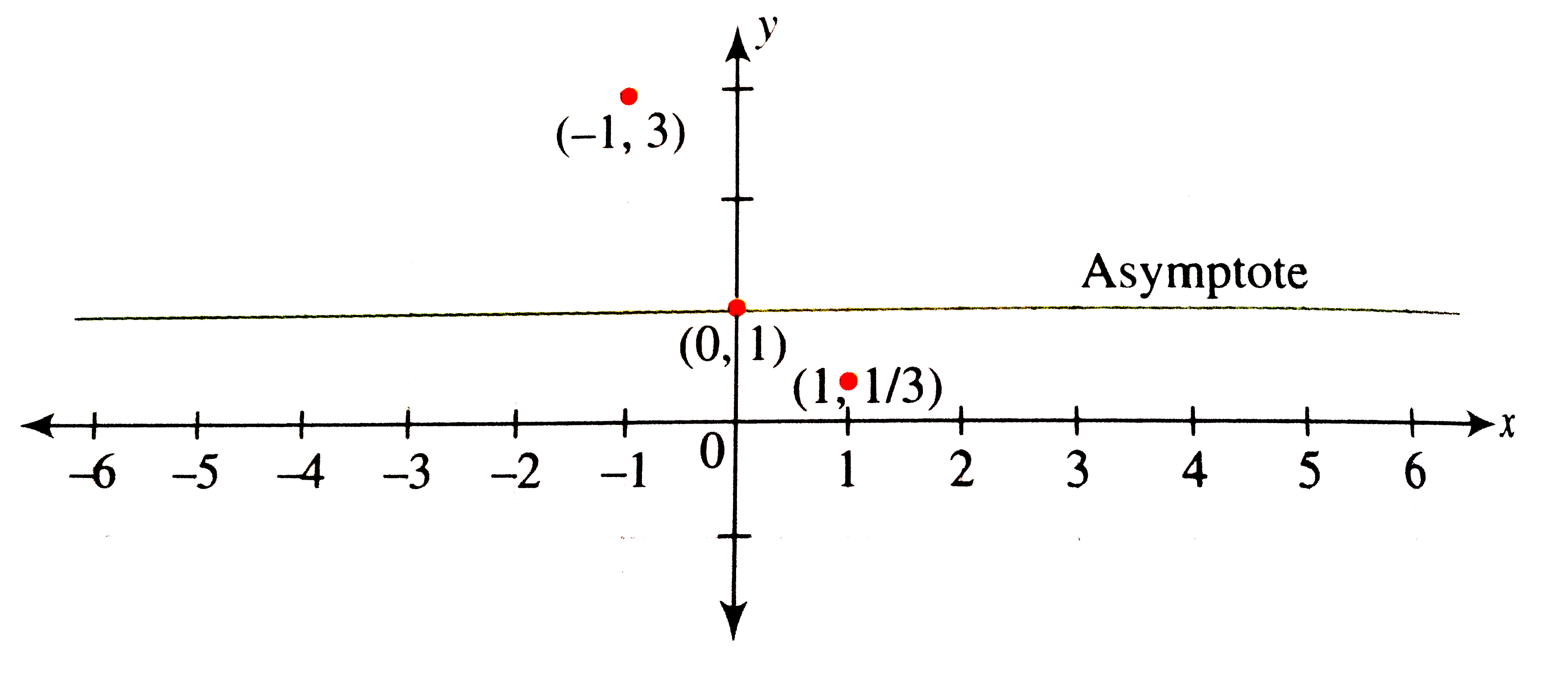
Also `f(1)=(1)/(3)` and `f(-1)=3, f(0)=1`.
From the above discussion, we have the following reference points and lines.
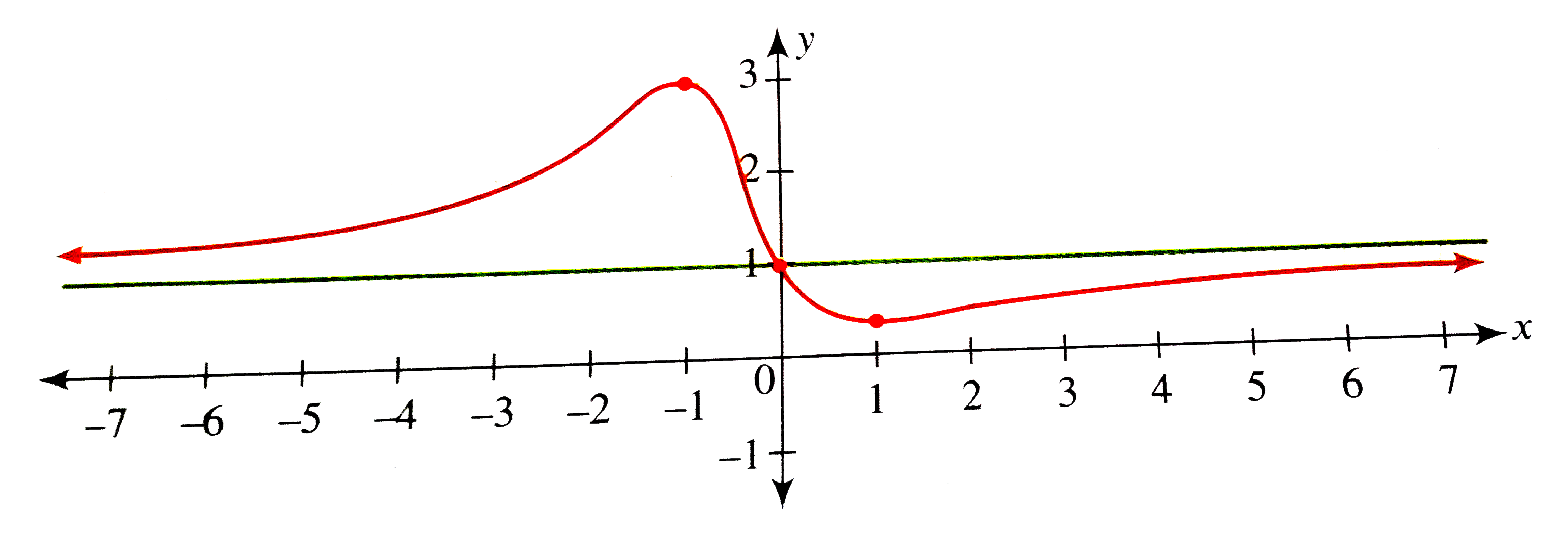
When `x rarr oo, y rarr 1` and in `(-oo, -1), f(x)` increases from '1' to '3'.
At `x=-1, f(x)` attains the maximum value '3'.
In `(-1, 1), f(x)` decreases from '3' to '1/3' intersecting the y-axis at (0, 1) and attains minima at x = 1.
In `(1, oo), f(x)` increases from '1/3' to '1' and finally approaches to asymptote y = 1 when `x rarr oo, y rarr 1`.
Thus , the graph of `y=f(x)` is as shown in the following figure.