Home
Class 12
MATHS
Write a rational function g with vertica...

Write a rational function g with vertical asymptotes at `x = 3` and `x = -3`, a horizontal asymptote at `y = -4` and with no `x`-intercept.

Text Solution

Verified by Experts
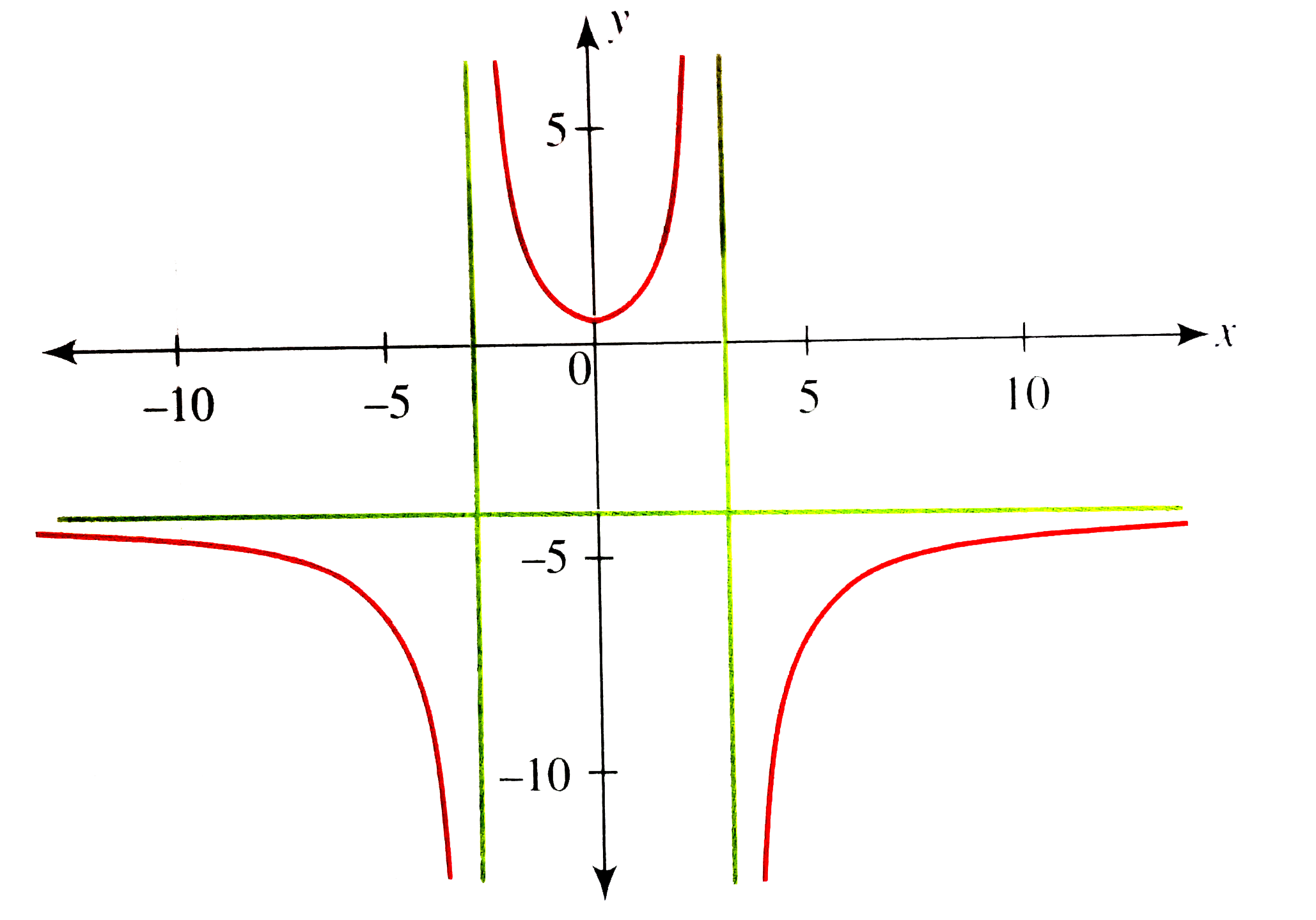
`*` Since g has vertical is asymptotes x = 3 and x = -3, then the denominator of the rational function contains the product of (x-3) and (x+3) . Function g has the form
`g(x)=(h(x))/((x-3)(x+3)`
`*` For the horizontal asymptote to exist, the numerator h(x) of g(x) has same degree as that of the denominator with a leading coefficient equal to -4. At the same time, h(x) has no real zeros. Hence
`f(x)=(-4x^(2)-6)/((x-3)(x+3))`
`*` Check the characteristics in the graph of g shown below.
Promotional Banner

Topper's Solved these Questions

  • GRAPHS OF POLYNOMIAL AND RATIONAL FUNCTIONS

    CENGAGE|Exercise Exercise|13 Videos
  • GRAPHS OF POLYNOMIAL AND RATIONAL FUNCTIONS

    CENGAGE|Exercise Exercises|4 Videos
  • GRAPHICAL TRANSFORMATIONS

    CENGAGE|Exercise Exercise|14 Videos
  • GRAPHS OF ELEMENTARY FUNCTIONS

    CENGAGE|Exercise Exercise|34 Videos

Similar Questions

Explore conceptually related problems

Write a possible rational function h with a hole at x = 5 , a vertical asymptote at x = -1 , a horizontal asymptote at y = 2 and x-intercept at x = 2 .

Write a possible rational function f that has a vertical asymptote at x = 2, a horizontal asymptote y = 3 and a zero at x = -5. Also draw the graph of the function.

Find the asymptotes of the curve x y-3y-2x=0 .

Find the eccentricity of the hyperbola with asymptotes 3x+4y=2 and 4x-3y=2.

The equation of a hyperbola whose asymptotes are 3x +- 5y =0 and vertices are (+-5,0) is

(a) Can the graph of the function intersect the horizontal asymptote? (b) Can the graph of the function intersect the vertical asymptote?

Find the asymptotes of the function f(x) = (1)/(x + 1)

The asymptote to the curve y^(2)(2 + x) = x^(2) (6 - x) is

Find the asymptotes of the curve f(x) = (3x^(2) - 27)/(x^(2) - 25)

Find the equation of the hyperbola which has 3x-4y+7=0 and 4x+3y+1=0 as its asymptotes and which passes through the origin.

